
Birding in the Western Ghats in India is something that I had wanted to do for quite some time, especially given the natural surroundings and of course the birds. So when my friend Ajit mentioned of having spent a lovely holiday with his family in a homestay in Sakleshpur, I could not wait to go.
First, what is the Western Ghats? Well, it is a mountain range that stretches from the state of Kerala to the state of Gujarat. It is also known as Sahyadri. It roughly covers an area of 140 sq. kms. in a stretch of 1600 kms parallel to the western coast of India. It is considered as one of the eight “hottest hot-spots” of biological diversity in the world. It contains a large portion of the country’s flora and fauna, many of which are found nowhere else in the world. So now you know why any nature enthusiast would earn to visit it. Thankfully we got to see many of them 😀 .
Sakleshpur is a hill station located in the Western Ghats, specifically in the Hassan district in the state of Karnataka.
I had Kumar as companion for the trip. The trip was an overall 3 days (including travel to and fro from Bangalore). We effectively got 2 full days at Sakleshpur, reaching by noon on the first day and leaving around noon on the third. And what a packed 2 days it was! All that we did was literally bird, except for the meal times and sleeping at night 😀 . We were up and out before first sunrise on both the mornings. There is nothing like hearing the bird songs at dawn, especially that of the Malabar Whistling Thrush and the Puff-throated Babbler. I am not going to give a day-wise report. Rather I will summarise our sightings from the trip.
I have to start with the king and queen, or rather a species that a lot of people yearn to see in these parts; the Malabar Trogon. They were very easy to see during our stay at the homestay (more details of it later in the post). In fact, we got a little tired (I can’t believe I am actually saying this!) of spotting them in almost every birding session we did 😀 . There was a breeding pair in the property itself. The best sighting was when we were having lunch and the pair decided to perch at a eye level in a shrub opposite us. Of course, we did not have our cameras with us 😦 . By the time Kumar scrambled and got them, the birds had moved to a different perch. Here are a couple of pictures of the pair:
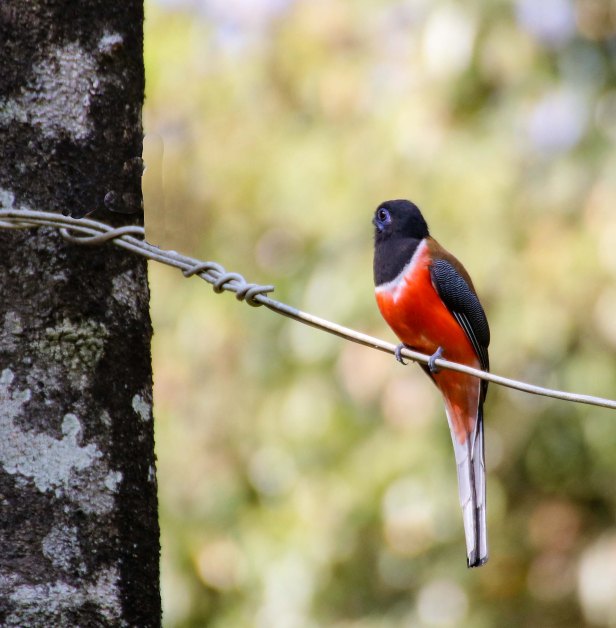
Malabar Trogon (M) 
Malabar Trogon (F)
Another bird that we would hear often and at times spot, was the Indian Scimitar Babbler. When you catch a glimpse of them, there is no ignoring their beauty.
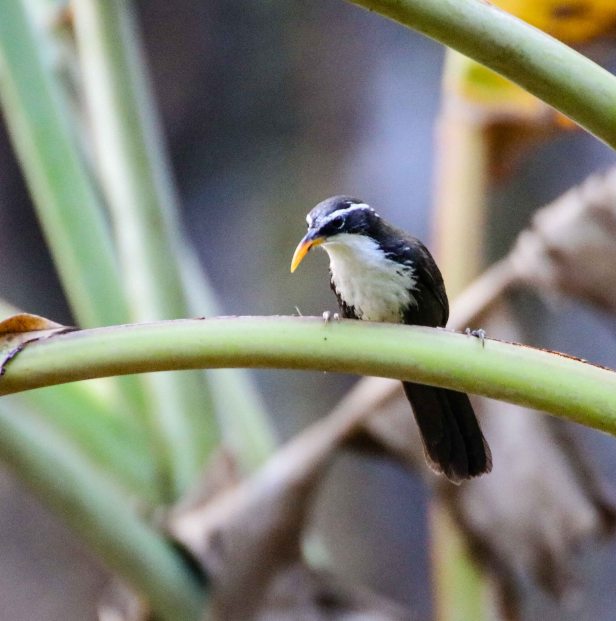
Indian Scimitar Babbler 
Indian Scimitar Babbler
One of the most colourful birds has to be the Orange Minivet. Here is a female one:

Orange Minivet (F)
Giving it competition is the winter migrant, the Black-naped Oriole.

Black-naped Oriole
One of the endemics is the Malabar Woodshrike. Quite a vocal bird I must say!

Malabar Woodshrike 
Malabar Woodshrike
Another of the endemics is the Crimson-backed Sunbird. Here is a male and a female of it:
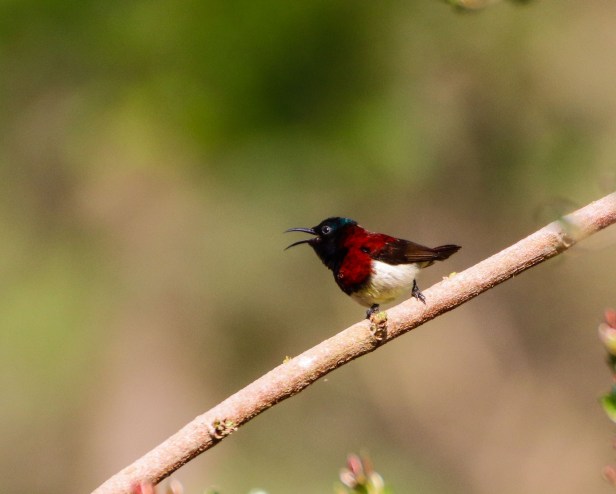
Crimson-backed Sunbird (M) 
Crimson-backed Sunbird (F)
A bird that cannot be ignored is the Indian Paradise Flycatcher, especially when the male flies around in front of you. Here is a male and a female:

Indian Paradise Flycatcher (M) 
Indian Paradise Flycatcher (F)
With plenty of trees around, there are bound to be Woodpeckers. Here is a male and female of a Greater Flameback:

Greater Flameback (M) 
Greater Flameback (F)
But the one that stole my heart was the Heart-spotted Woodpecker. Here is a male and female of it:

Heart-spotted Woodpecker (M) 
Heart-spotted Woodpecker (F)
A number of Warblers had also made their winter migration to these parts. We saw the Blyth’s Reed Warbler, Green Warbler, Greenish Warbler and the Western Crowned Warbler. None of them obliged for decent photos (as if they ever do 😀 ). So here is what I could manage:
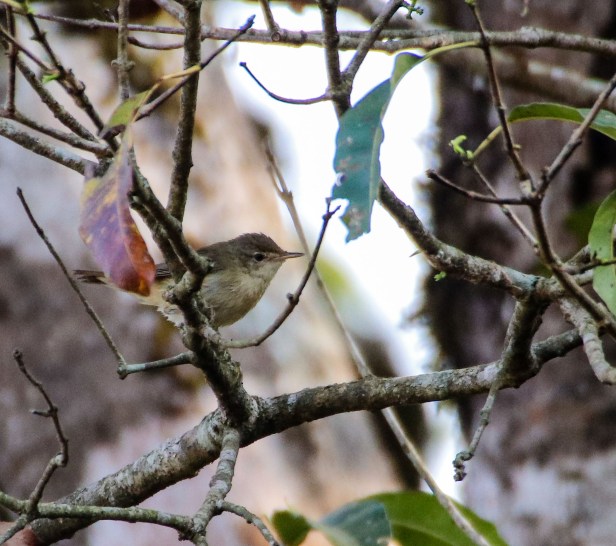
Blyth’s Reed Warbler 
Green Warbler 
Western Crowned Warbler
We also got to spend decent amount of time observing a visiting Asian Brown Flycatcher going about have a bath on a leaf that had water from rain showers.

Asian Brown Flycatcher
A couple of other birds that are a sight to see are the endemic White-bellied Treepie and the Asian Fairy-bluebird.

White-bellied Treepie 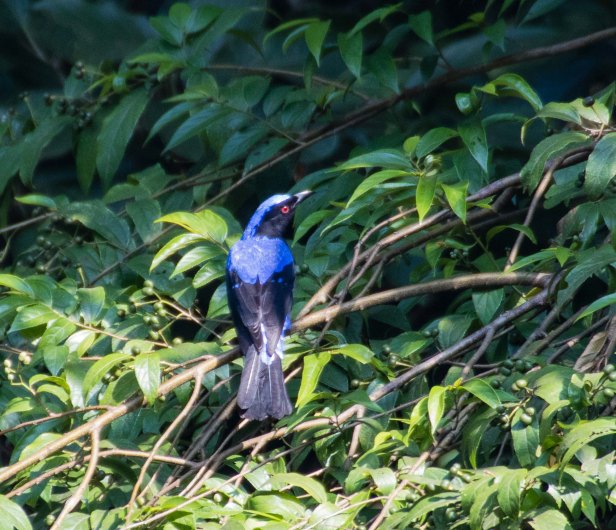
Asian Fairy-bluebird (M)
Not to be left were some of the other “commoners”; the Velvet-fronted Nuthatch, Common Iora, Golden-fronted Leafbird and the Indian Peafowl.

Velvet-fronted Nuthatch 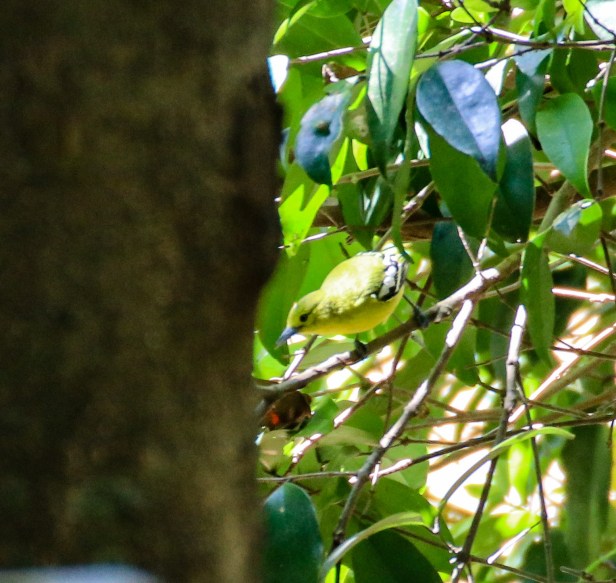
Common Iora 
Indian Peafowl 
Golden-fronted Leafbird
We were happy to see a few House Sparrows as well around; a sight not common for city dwellers nowadays.

House Sparrow (F)
Of the birds that we had to strain to see were the White-rumped Needletail and the Little Swifts. One can also get to the Brown-backed Needletails in the region.

White-rumped Needletail
An early morning bird is the Rufous Babbler. They are pretty shy birds and tend to stay in the undergrowth.
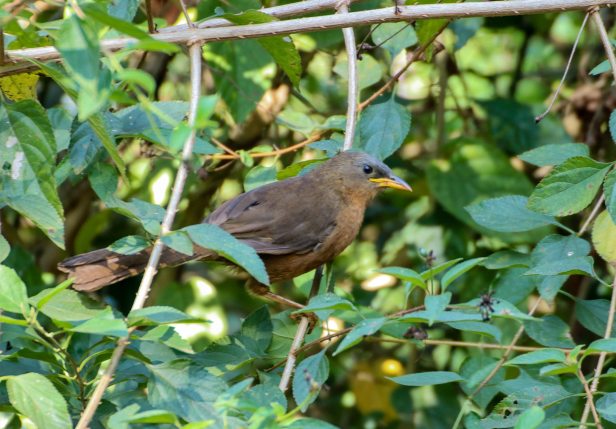
Rufous Babbler
In raptors, we got to see the Oriental Honey Buzzard, Crested Serpent Eagle and Eurasian Kestrel in the skies. A Crested Goshawk however obliged us with views of it perched on a tree branch on a foggy morning.

Crested Goshawk
Another of the endemics is the Malabar Hornbill. We would see them coming to raid a fruiting palm tree in the evenings.

Malabar Hornbill
A bird that will surely be heard and seen a lot of times is the Vernal Hanging-Parrot, India’s only Parrot. But most of the time they will up on the tree canopy. So for me to get some very close to one is considered a blessing :-D. Here are a couple of photos of one that felt pity on us:

Vernal Hanging-Parrot 
Vernal Hanging-Parrot
Another winter visitor in these parts is the Chestnut-headed Bee-eater; a stunning bird when you get it in the right light!
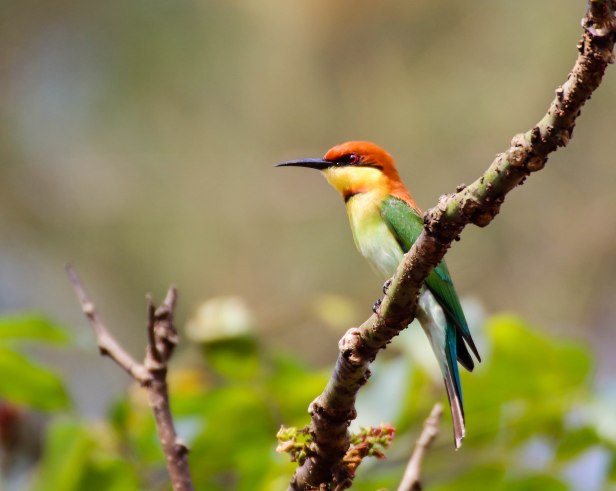
Chestnut-headed Bee-eater
A bird high on my list for the region was the Grey-headed Bulbul, another endemic of the region. I heard several of them calling on the first day. But it was only on the morning of the third day that I got to see a few of them finally. Phew!

Grey-headed Bulbul 
Grey-headed Bulbul
It is not just the birds that are enchanting here. One can several numerous types of butterflies and moths too. Here are a couple that I was able to photograph in between searching for birds.
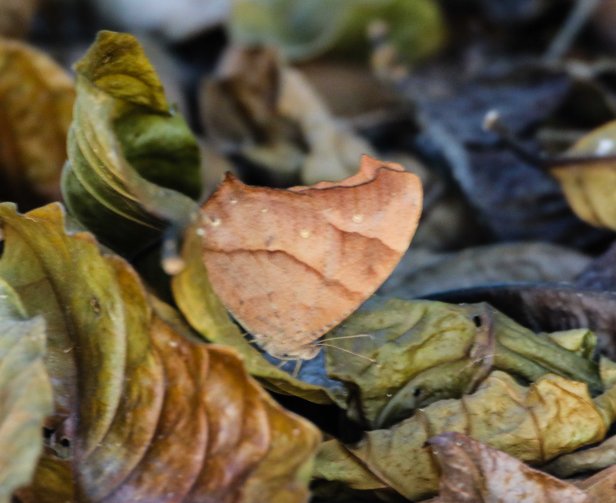

One can also get to see wonderful play of lights as well as interesting plants.


Useful Information
Sakleshpur is a great place not just for birding but as a short getaway for the entire family. The region has a lot of homestays in all budgets and many in coffee plantations. Homestays are a great way to experience the place. Different ones offer different levels of comforts and facilities. So it is best to decide what is needed for you and your group and then select the homestay accordingly.
We had chosen to stay at a homestay called Mugilu, a couple run enterprise located inside a coffee estate. They themselves stay in the property. We found it to be a nature lovers paradise. The cottages are nicely constructed to blend in with the nature and provide great views. They had also left half of the estate entirely for nature to grow as it wanted. The place was a magnet for birds and butterflies! Mind you, there are no usual “distractions” like television and cable TV; a treat as far as we were concerned. I would definitely recommend visiting it.
Wherever one may end up staying, make sure to walk around. Again bird photography may not be easy, given that the tree cover is pretty dense. If you are visiting in the winter, like we did, then expect mist in the first half.
The road to Kadumane Estate is also a great place to bird. Look out for the Wayanad Laughingthrush and Rufous-bellied Eagle enroute. If you can get permission to bird in the Kadumane Estate, then there is nothing like.
Winter is a good time to visit. Being in the hills, it does get chilly. So take some light warm clothes. Rainy season can be difficult as it can rain very heavily. A lot of homestays close down during the rainy season as well.
Most importantly go with intent to slow down and take things as they come. Have no expectations. You will automatically find yourselves slowing down in the midst of nature.
 Mad about Birding and Travel
Loved reading it as always. Every post makse me feel like I was there with you.
LikeLiked by 1 person
You should visit the homestay with your wife. Amazing experience even just to get away from the city bustle. Birding is always a bonus 😉
LikeLike
Amazing post Thomas. One interesting thing about the facility was birding while attending to nature’s call. Just insane place man. A small video i made using composite photos of the heart spotted woodpecker feeding
LikeLiked by 1 person
Don’t remind of that important “feature” 😀
LikeLike
https://m.youtube.com/watch?v=lN0tP4UECS0 – missed the link
LikeLike
Awesome.. heard of Mugilu before… hope things become normal soon
LikeLiked by 1 person
They will eventually Balu 🙂
LikeLike
Such Pretty birds with colourful wings! Here’s a quote I am reminded of:
:“The reason birds can fly and we can’t is simply because they have perfect faith, for to have faith is to have wings.”
― J.M. Barrie, The Little White Bird
LikeLiked by 1 person
Lovely quote. I think it will take some more time for me have that level of faith 😀
LikeLike
Nice writeup about birds…
LikeLike
Thanks Ram
LikeLike
Very nice photos. Sir where all was the birdwatching done. We are visiting sskleshpur on 4/3/21. Can you give us some tips on sites to do birdwatching. Thank you.
LikeLike
Hi Prakash,
We birded primarily in the Mugilu property and areas around it. The road to Kadumane Estate is also a great place to bird
LikeLike
amazingly written n fotographed…
LikeLike
Thanks a lot
LikeLike
Tnx for sharing such a beautiful experience & Amazing clicks. Can you plz tell us which month exactly you visited?
LikeLike
Thanks Archana. I went towards end of Jan.
LikeLike