Rahul and I were on a 10 day birding trip to the Eaglenest and a few other places like Sela Pass, Mandala etc. We had just finished our first part of birding at the Eaglenest Sanctuary (well technically before the Eaglenest Sanctuary) when covering the area around Lama Camp (you can read about that here). Now it was time to get into the Eaglenest Sanctuary and bird 🙂 .
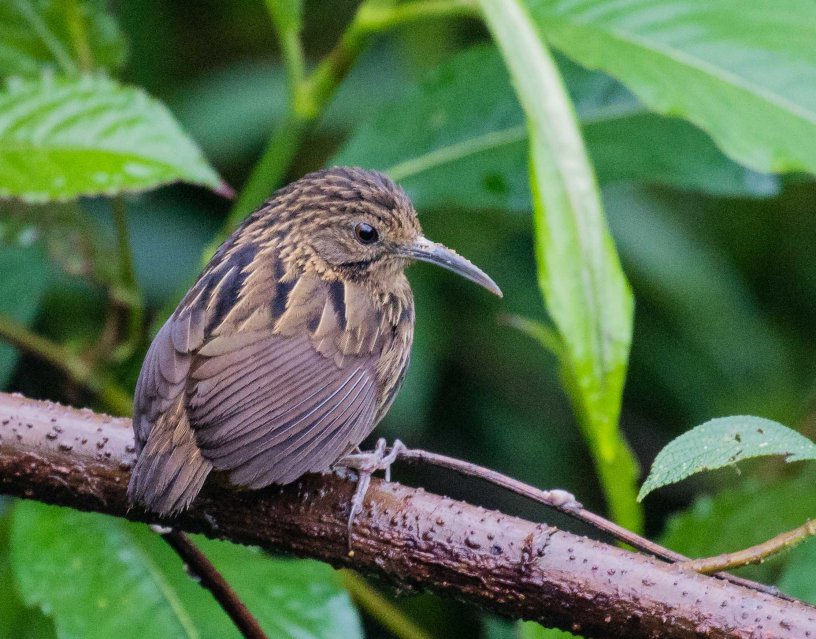
To enter into the Eaglenest Sanctuary when coming from Lama Camp, we had to cross the Eaglenest Pass. This is the highest point on the way. We kept our ears and eyes open for any signs or calls of the Temminck’s Tragopan as we crossed the Pass. But it was not to be. It was raining and quite misty for any bird activity 😦 . We headed on. Thankfully the rain reduced as we went further thus allowing to bird intermittently at spots. The prized catches from doing so were the Chestnut-headed Tesia, the Rufous-throated Wren-Babbler and the White-spectacled Warbler. All of them very shy birds and had stayed put at one place. The pictures below were when they stopped for a second or two in between hopping around.


Another lifer that I go on the path was a Dark-rumped Snowfinch. It had been a female. I literally had to squeeze out through the open car window and take a shot in the rain 🙂 .
Our place of stay in the Eaglenest Sanctuary was the Bompu Camp. This was to be our halt for the next 3 nights. We reached the camp by around noon. Lunch done and we were eager to start birding. But the rain was not letting down. It was accompanied by dense mist. So we just had to wait it out 😦 .
It was a couple of hours before we could head out. One of the first birds we got to see was just behind the dining area. It was a flock of Rufous-fronted Barwings. We then walked on further where it was expected to get a flycatcher. And we did. It was the Slaty-blue Flycatcher; a nice male at that. But it was extremely shy making photographing impossible. But we were happy to hear it and see it well through the binoculars.
We spent some time on a path not too far from the camp. Visibility was not great though the rain had stopped. We first heard a Sikkim Wedge-billed Babbler calling from near the path. But it refused to come out in the open. Then a flock of Golden-naped Finches showed up. One thankfully sat on an open branch for a bit.

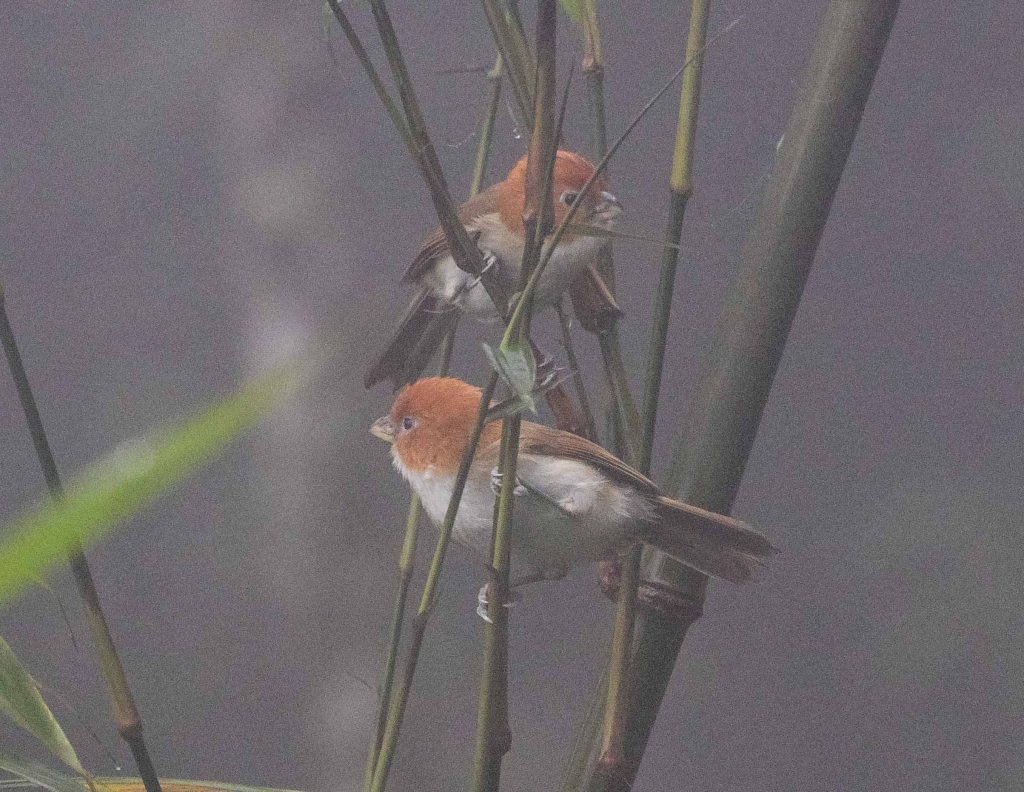
The other highlight was a flock of Greater Rufous-headed Parrotbills. They were busy feeding on the bamboo. It was really a pleasure to see them in action, though getting any decent photos was out of the question.

With it starting to drizzle again, we headed back to the camp.
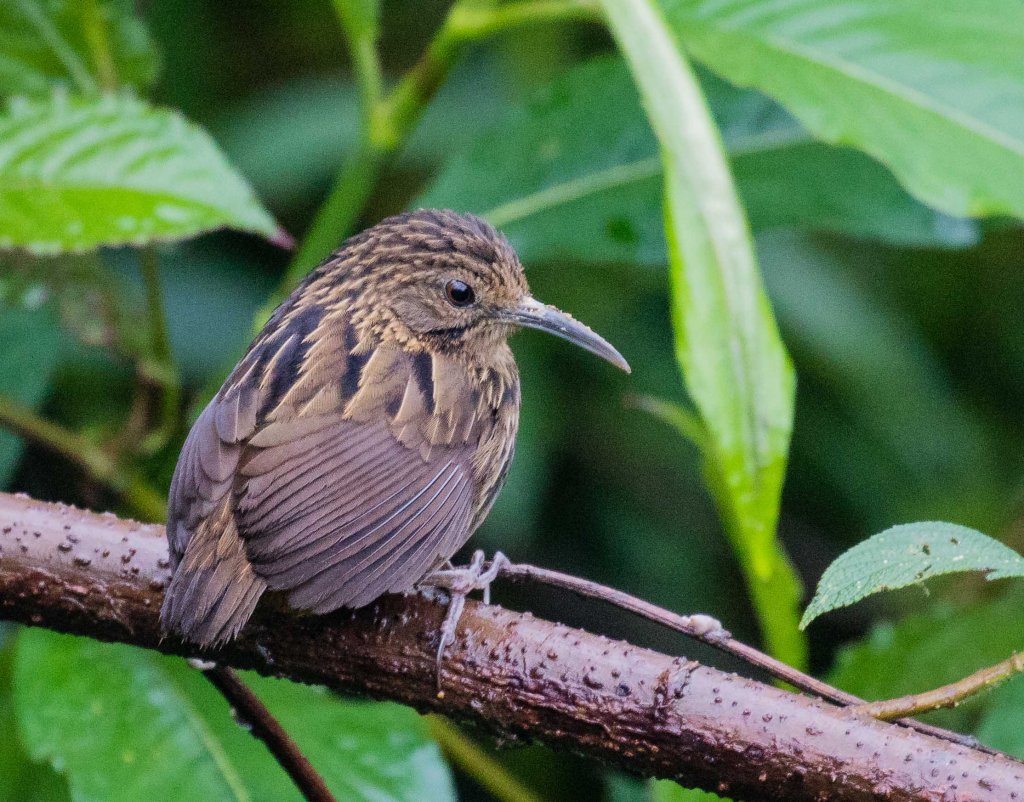
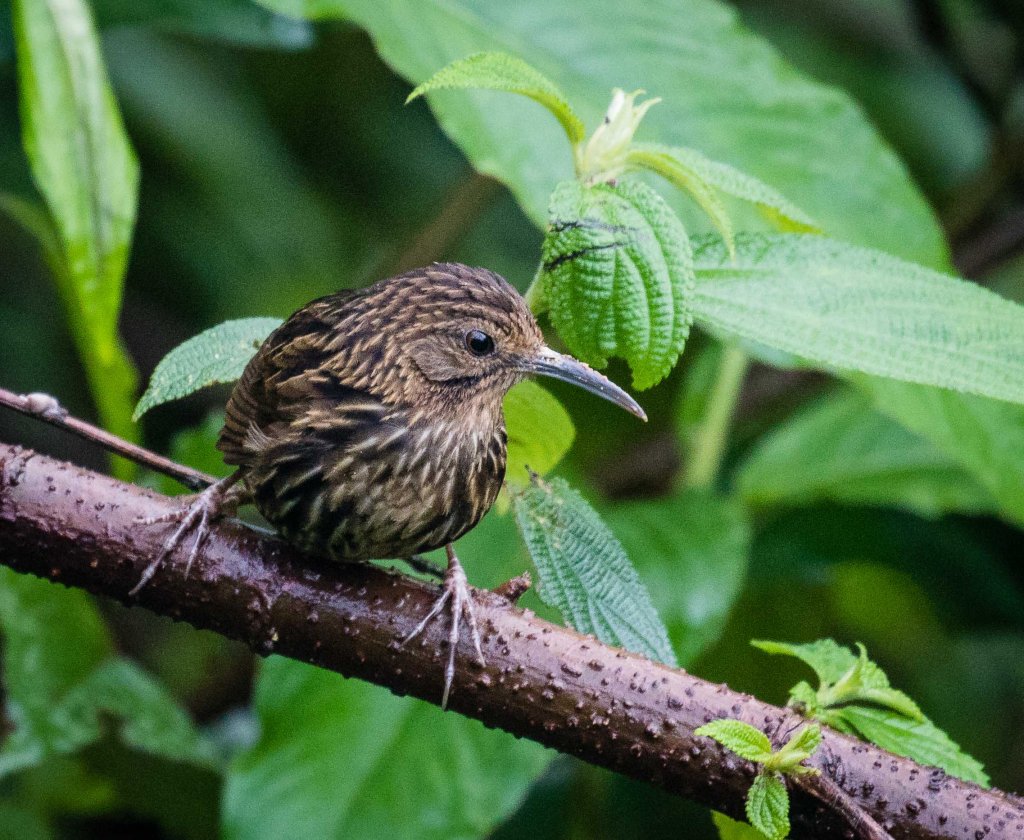
At the camp we had a celebrity show up to entertain us. It was a bold and vocal Long-billed Wren-Babbler. And what a show the little chap put for us! You should check out the video later in the post to see it in action. Here are a couple of pictures of it in the meantime:
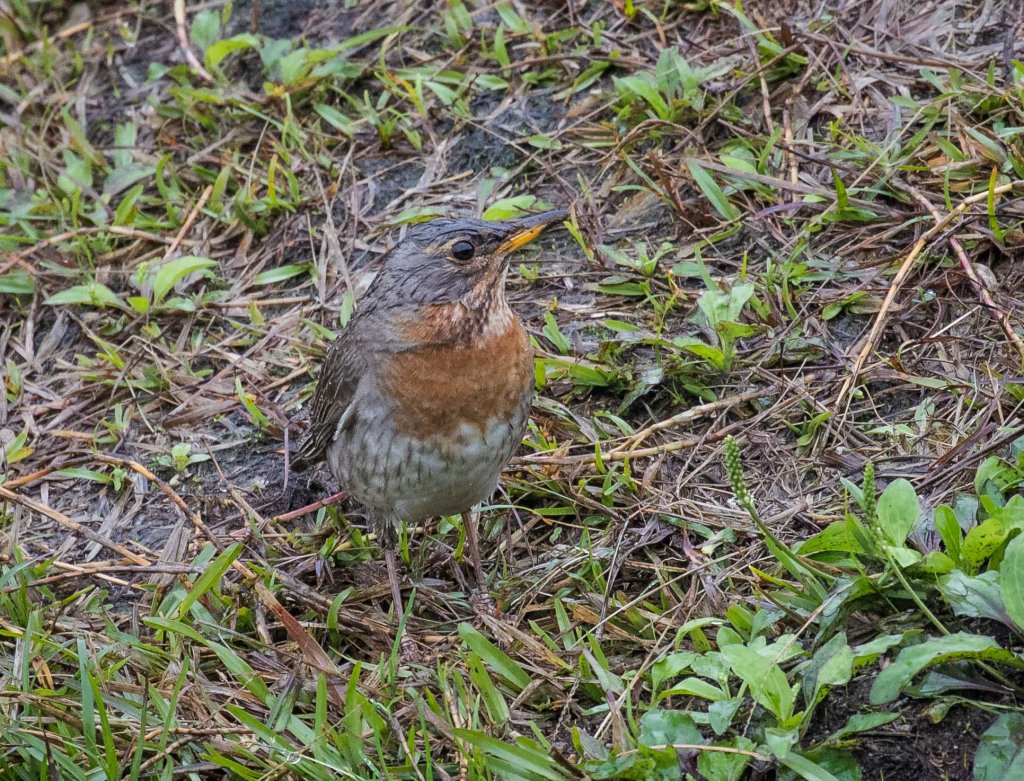
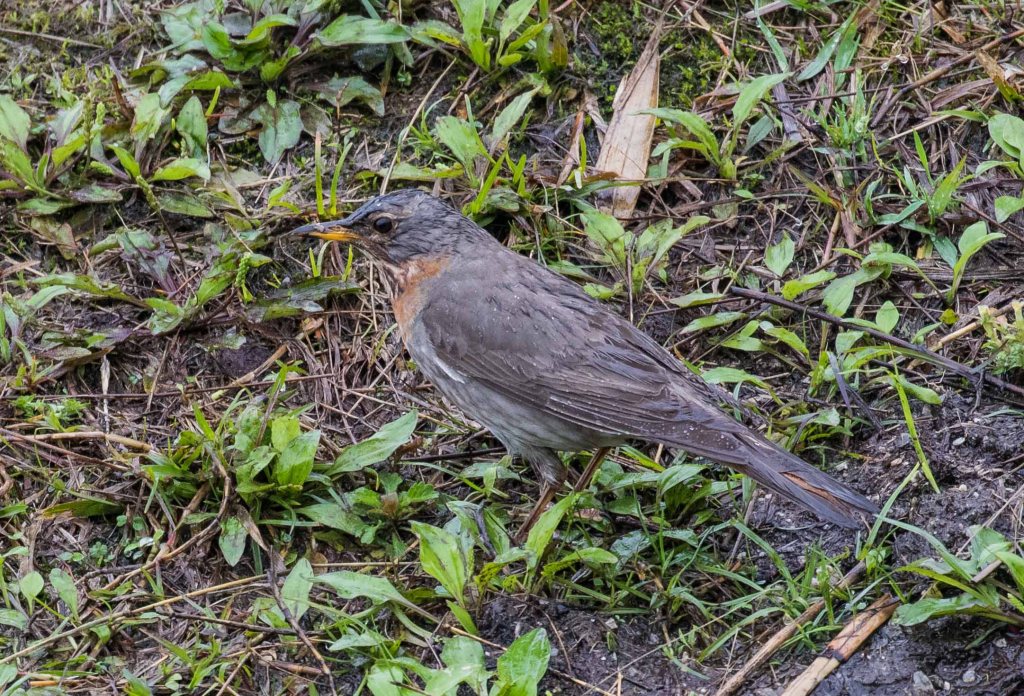
It continued to rain accompanied by mist for the remainder of the evening. All we could do was walk and look around the camp grounds (with an umbrella at times). We found a Blue-fronted Redstart and a Red-throated Thrush that had made the camp grounds their patch. Here is the “wet” Thrush:
The night had us hearing a Mountain Scops-Owl.
Next morning did not bring any cheer on the weather front. It was raining and misty. Here is what it looked like:

Yes, that is all mist behind me. Again all that we could do is peer through the binoculars from the dining area. This time, along with the Red-throated Thrush, we also saw an Olive-backed Pipit.
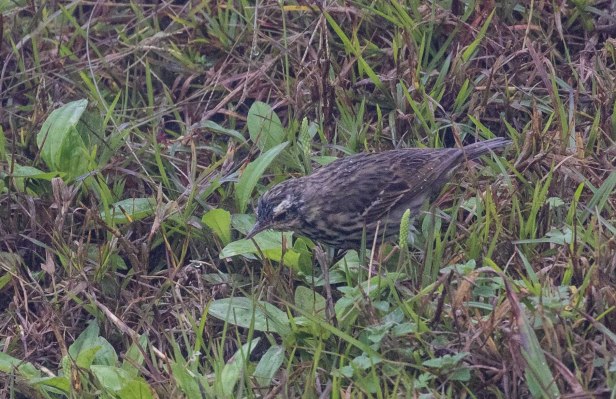
We also saw a flock of Golden-naped Finches in the grass patch behind the dining hall. This time there were also a few females along with males. Here is a female bird:

Breakfast done and we decided to head out in the car in the hope that weather would improve soon. The first flock of birds we saw were the Coral-billed Scimitar-Babblers (now called the Black-crowned Scimitar-Babbler). They are such beautiful birds with a colourful bill. Sadly the it was still drizzling and misty. Here is a photo that I could somehow manage of one bird:

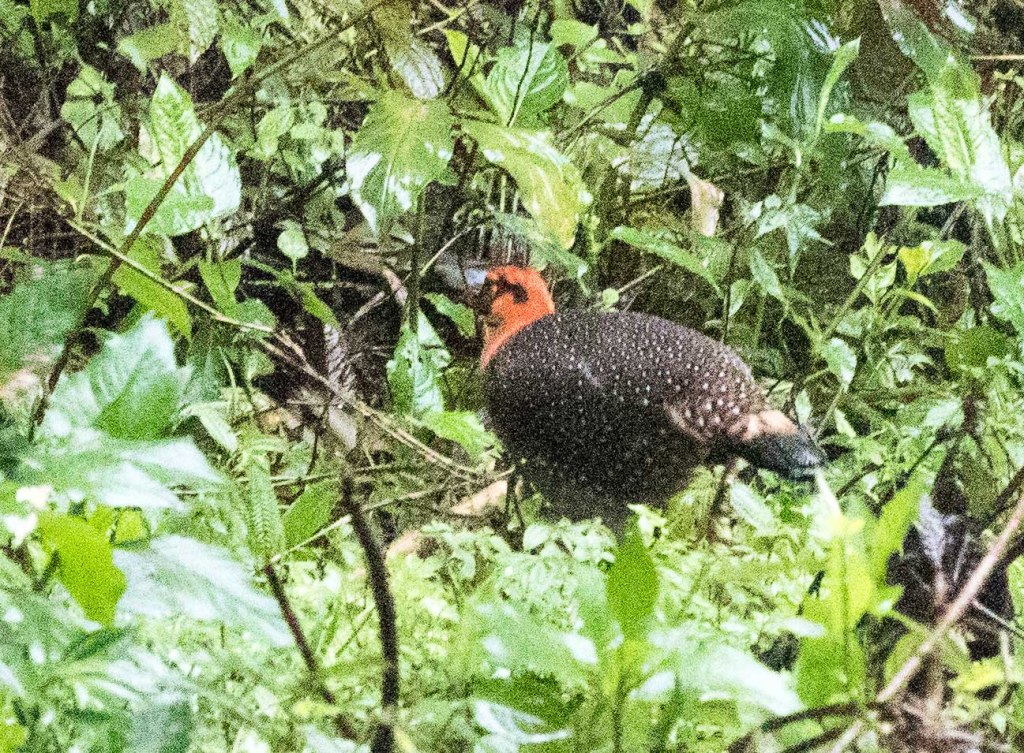
We soon had to go back to camp given the continuous rain and mist. The session post lunch however proved more fruitful. It still rained intermittently. But we were determined to look for birds. And our perseverance paid off eventually. We got to see a Blyth’s Tragopan, and twice!. The first was just for a few seconds as it started to cross road but hurried back in when it sensed our presence. Though we waited many minutes, it did not appear again. So we headed on further. To our luck, on our return back to the camp at about the same place on the road we saw it on the road itself. The moment we stopped the car, it started to move into the vegetation. Here are a couple of photos that I could manage after jumping out of car. They do not justice to how beautiful the bird really is.

The other interesting birds we got in this session are the Mountain Tailbird, the Slaty-bellied Tesia, Pygmy Cupwing and a pair of Kalij Pheasants. Here is a photo of the male Kalij Pheasant.

The plan for the next day was to drive towards Kelong. This would have us going from an altitude of 1945m at Bompu to around 1200m. So we hoped to see some of the lowland species as we headed lower. We stared at a bit after dawn. This time we would have our breakfast on the go. The first bird we saw a Mountain Imperial-Pigeon. Our next stop was a place where we hoped to see a Beautiful Nuthatch, a species that I really wanted to see. Well, luck favoured us. We saw one a few minutes after stopping. It stayed way up on top of a tall tree. But we got some good views of it from the binoculars. Here is picture I also managed of it.
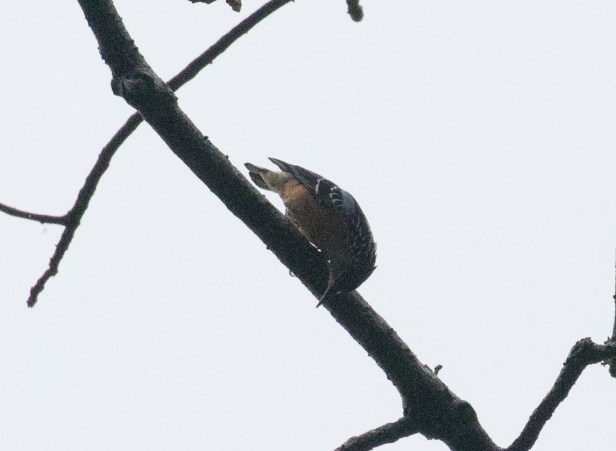
We decided to spend some time around this area exploring. There a mixed flock that appeared soon. The flock included the Whiskered Yuhina, Black-eared Shrike-Babbler, Blue-winged Minla, Red-tailed Minla, Black-throated Tit, Chestnut-crowned Warbler, Yellow-cheeked Tit and Rufous-winged Fulvetta. It is crazy to experience such a mixed flock or a bird wave. With so many appearing at time, one finds it difficult to decide where to look, let alone photograph 🙂 .
A walk around the area had us seeing a Small Niltava and Large Niltava followed by brief views of a couple of Common Green-Magpies that had been calling loudly. Rahul managed to also see a Scarlet Finch. A walk further ahead had us hearing a Blue-naped Pitta calling away for some time. It however did not show itself.
We soon drove off towards Kelong. The path had several obstacles; literally. They included rocks that had to be moved out and fallen trees that had to be chopped and cleared.

Dombe commented that the fallen trees were most likely the act of elephants. We had seen elephant dung on the path. This meant that we had to proceed with caution. We still decided to head further on. Yes, even elephants cannot deter mad birders that easily 😀 . But we did not end up going all the way to Kelong given the risk. Some of the birds that we saw and heard were the Rufous-backed Sibia, Eyebrowed Wren-Babbler, Mountain Tailorbird, White-naped Yuhinas, Maroon Oriole, Rufous-necked Hornbill, Grey Peacock-Pheasant, Bay Woodpecker and White-gorgeted Flycatcher. Our return journey gave us better view of the Beautiful Nuthatch, albeit a little distant.

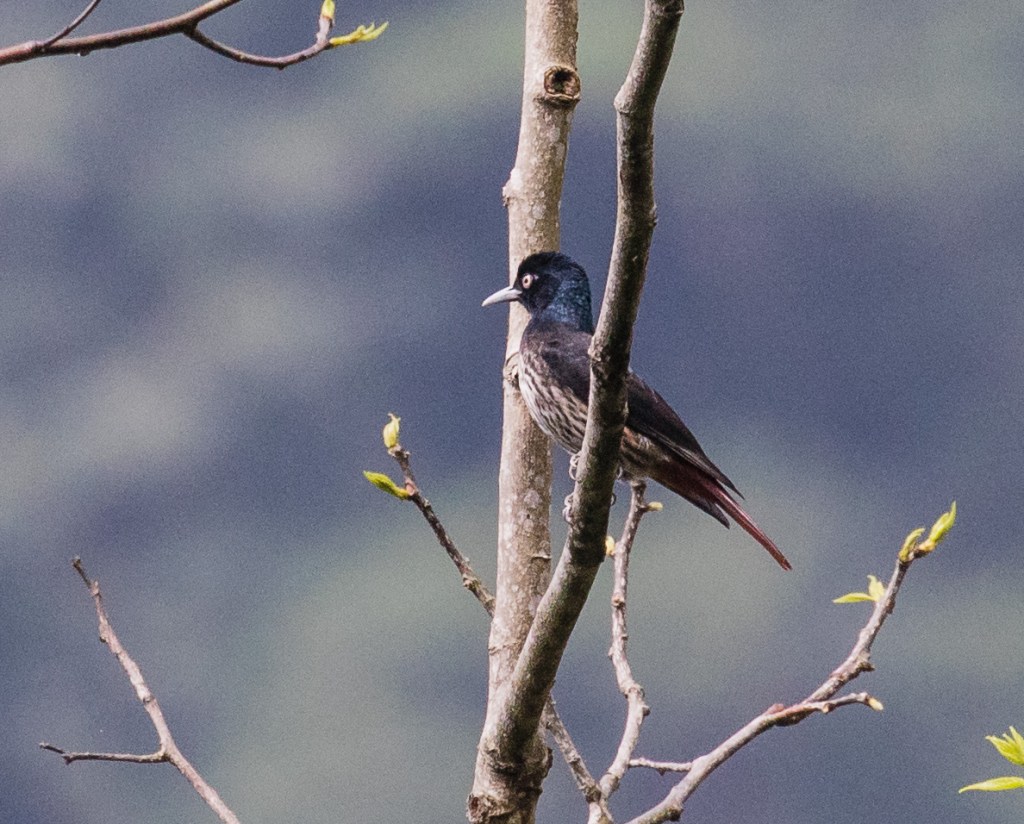

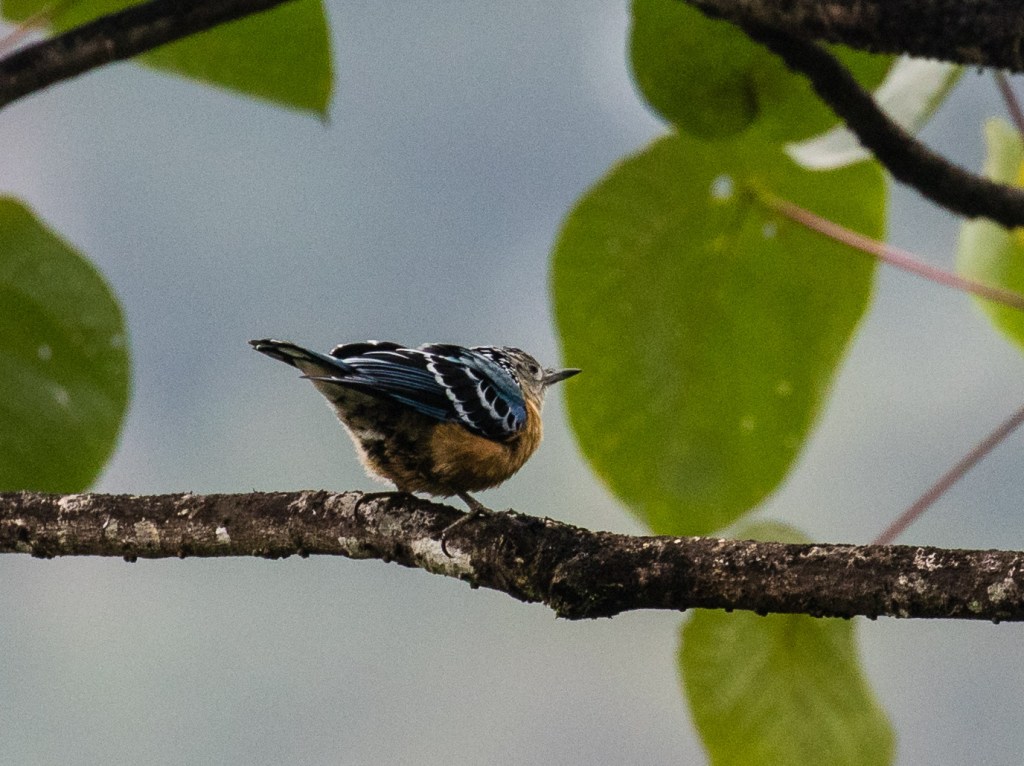
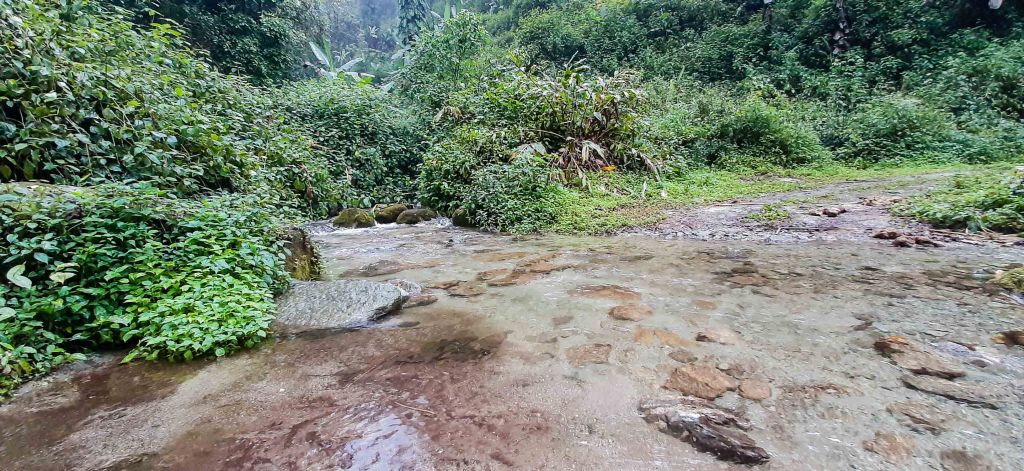
Here is us getting ready to have breakfast at a stream crossing.

Here is a view of the surroundings from that spot:

The evening session was done close to the camp. We got to see the Scaly-breasted Cupwing, Grey-bellied Tesia, Slaty-bellied Tesia, Kalij Pheasant and Grey-cheeked Warbler.
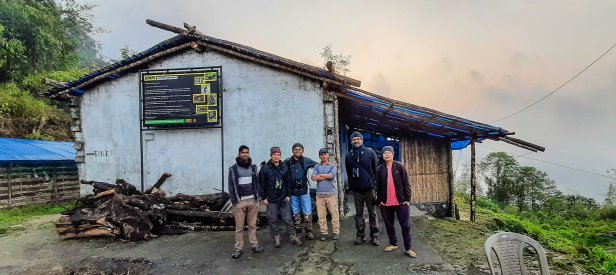
Next day earlier morning, it was time to leave Bompu camp. Here is a picture with some of the staff at the dining area before we headed off.
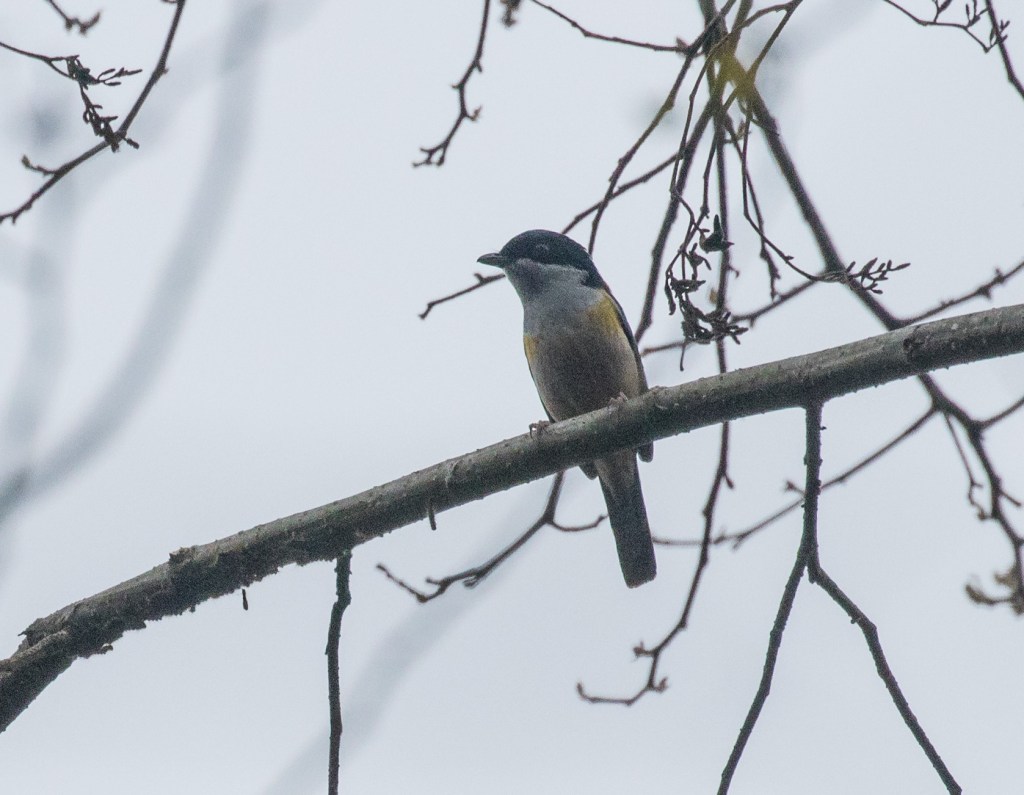
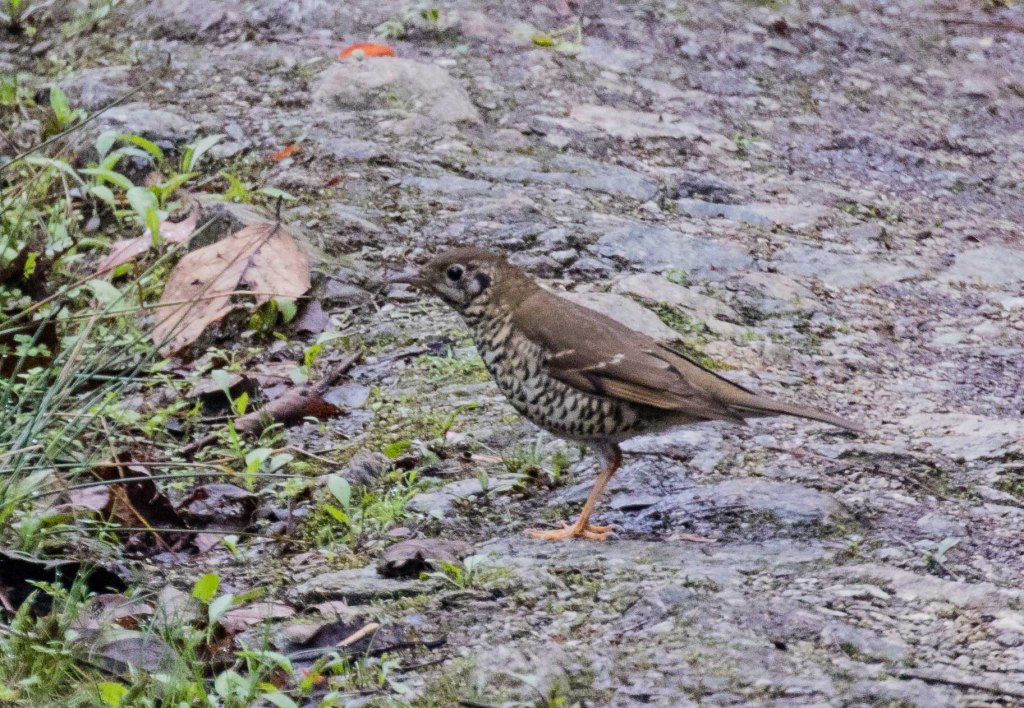
The drive back out of the Eaglenest Sanctuary had us stopping at lots of places and seeing many new birds. These included the Hill Partridge, Black-headed Shrike-Babbler, Broad-billed Warbler, Slender-billed Scimitar-Babbler, Long-tailed Thrush, Black-throated Sunbird and Brown Bullfinch. Here are pictures of some of them.

But the stars of the return journey was the sighting of the Ward’s Trogon, Eurasian Woodcock and a Scaly-breasted Cupwing. Here are some pictures:


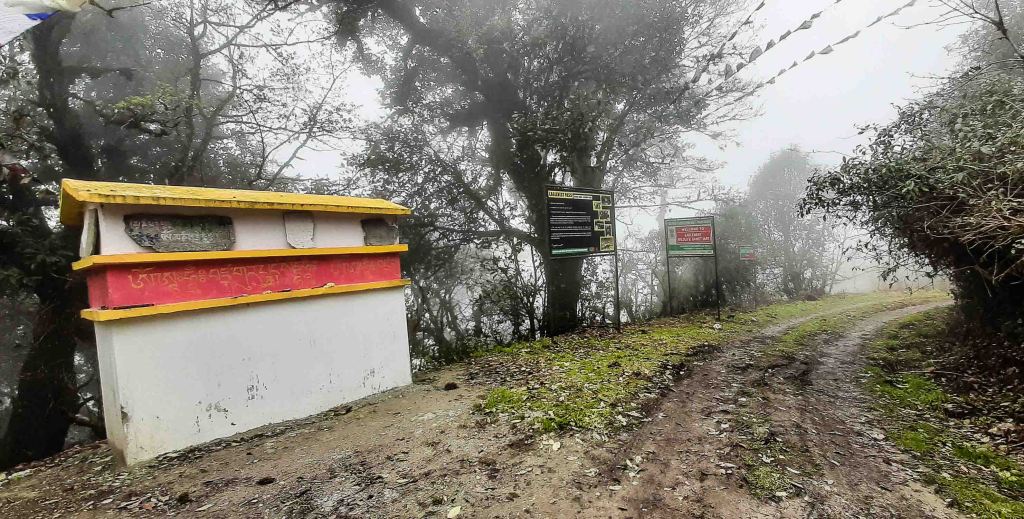
As we passed the Eaglenest Pass, we continued to keep a lookout for any signs of the Temminck’s Tragopan. But luck was not in our favour this time too. Well, one can’t have everything I guess 🙂 . Here are some photos of the area near the Pass:


Video
Here is a video that I put together showing parts of the journey as well as some of the birds in action.
Summary
If we thought birding around Lama Camp had been good, well birding around Bompu Camp is great 🙂 . We got plenty of rain and mist, like you can see in the photos and the video. We still had a great time in the sessions that we managed to “squeeze” out of the weather. But as with Lama Camp, there are some things to keep in mind when planning a trip to Bompu Camp. Many of them are similar to that for Lama Camp area. Here they are:
- The infrastructure at the camp is pretty basic. You will be sleeping in tents. It can get really cold during some months of the year. There is only power for a few hours in the evening as it is entirely run on power generator. They switch it off once your dinner is done. There is no running water. They store and make water available in a barrel. It is also a good idea to take along a multi-point power extension box, given that power sockets available in the dinning area is limited.
- Birding is pretty on the road, or rather the path on which we drive on. There is no tarred road as such. So the ride itself is pretty rough and bumpy. But the birds make it worth it 🙂
- Birds are often shy and can disappear. So my recommendation is to try and see them through the binoculars first, especially if they are lifers for you. Photographing them can be the next step 🙂 . And some you may end up only hearing their call/song
- Knowing the birds by their calls is very important. Their calls is usually the first indicator of the bird’s presence. So getting a guide, if you are not familiar with it, with this knowledge will be very useful. Sometimes you get bird waves; basically a mixed flock of birds suddenly passing through. It can be sometimes overwhelming trying to figure our which birds they are and which one to look at or photograph; a good problem to have 😉
- Days start early and finish early in this part of the country. So be mentally and physically ready for it
 Mad about Birding and Travel
Wow, amazing collection of birds and your title does truly justify, thanks for sharing
LikeLiked by 1 person
Thanks a lot 😊
LikeLiked by 1 person
Great to read about your trip.Did you take a birding guide & if so can you share contact No since we are planning a trip out there
LikeLike
Thanks Venky. Yes we did take a guide. His name is Dombe Pradhan. You can contact him over Facebook Messenger.
LikeLike
Very nicely written… reliving every moment we were there. Thanks.
LikeLiked by 1 person
Thanks Rahul. One of the reasons why I love writing these posts is that I get to relive the moments 🙂
LikeLike
Fabulous captures and birds!
LikeLiked by 1 person
Thanks Cindy 🙂
LikeLike
Hello
Thanks for interesting & educative information’s of the sights & fabulous photographs of birds & sightings. Also about your travel.
Kindly share the cost of Lama & Bompu camp. & cost of the vehicle.
As I wish to visit the seven States ( sisters) of North East India
Regards,
Meera.V.Bopardikar
LikeLike
Hi Meera.
Thanks for your appreciation.
I don’t have the cost breakup you wanted. We got it arranged as a whole trip with our birding guide Dombe Pradhan. If you are interested in engaging him, you can reach out to him of FB. Else let me know. I should be able to send his contact details.
LikeLike