Birding in Coastal Karnataka; something that I had been wanting to do several times. I had made plans thrice before. Unfortunately they all had to be aborted mid way. Well I finally managed to do it in mid Jan 2020.
The trip happened when I decided to join a pelagic birding trip from Mangalore, a coastal town in the state of Karnataka in India. Some of my friends, who were also doing the pelagic trip, had decided to reach Mangalore a couple of days earlier and bird around the region. I did not need a better reason to join 😀 . I reached Mangalore the day before, early in the morning.
The first spot for birding was Kundapura. This was in Udupi, 2 hr drive north from Mangalore. It started with a bump in the road; my overnight bus to Mangalore had reached a hour late. Rahul, Novel and Harshith were however, kind enough to wait for me despite this delay. A quick freshening up at the hotel and we were off.
Birding in Kundapura is essentially done on a boat. Harshith had called his regular boatman Mr. Narayana. After a quick breakfast of some local dishes at a nearby restaurant, we met Mr. Narayana at the jetty. We were soon on our way.
Each of us had a bird species wishlist for the session. For me they were Crab Plover, Great Knot and Sandwich Tern. As the boat was slowed pushed, all of us keenly scanned the surroundings. The first birds we saw were Common Redshanks. There were several of them busily walking around the oyster covered islands. Accompanying them and foraging for food, were lots of Terek Sandpipers and a few Ruddy Turnstones. It was interesting to watch the Terek Sandpipers scampering whenever they sighted some crustacean. It was also easy to see where Ruddy Turnstone got their name; they turned small stones periodically to get at any grub beneath them.
A bird on the other shore turned out to be a Black-bellied Plover. We asked Narayana to guide the boat towards a sizeable flock of birds at a distance away. The large flock turned out to be Lesser Crested Tern and Greater Crested Tern. There were a number of Brown-headed Gulls and Caspian Terns in their midst. We could also see plenty of birds flying around as well. Almost all were Gull-billed Terns. One came to inspect us closely.
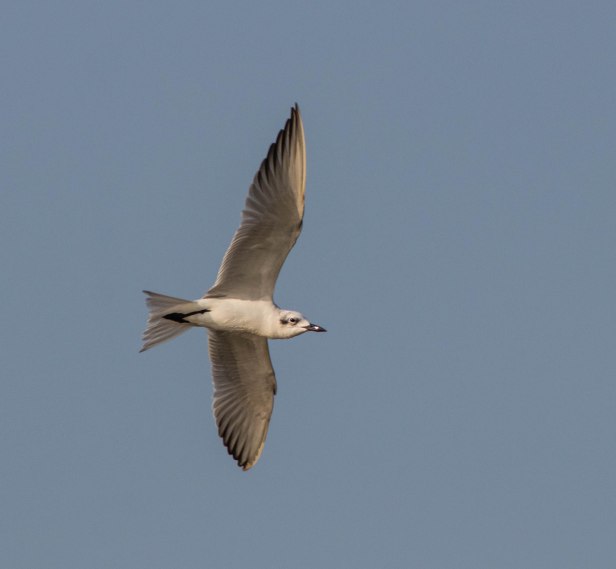
Gull-billed Tern
Giving company to the terns and gulls were Whimbrel, Eurasian Curlew, Bar-tailed Godwits and Black-tailed Godwits. There was also a small flock of Lesser Black-backed Gulls behind the flock of terns. A single Pallas Gull stood out in them owing to its comparatively large size.
As I scanned to the shore, I exclaimed, “Crab Plover!”. As we neared it decided to fly off to the other shore but not before I got a flying shot of it 🙂 .
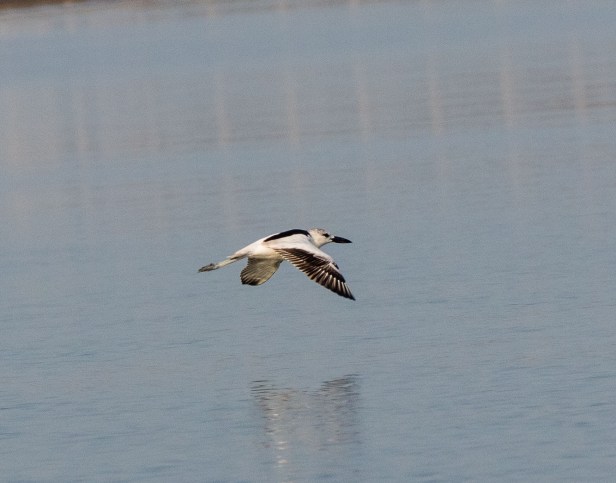
Crab Plover
A lifer for some of us, we decided to go to follow to get better views of it. The individual turned out to be quite a cooperative one.
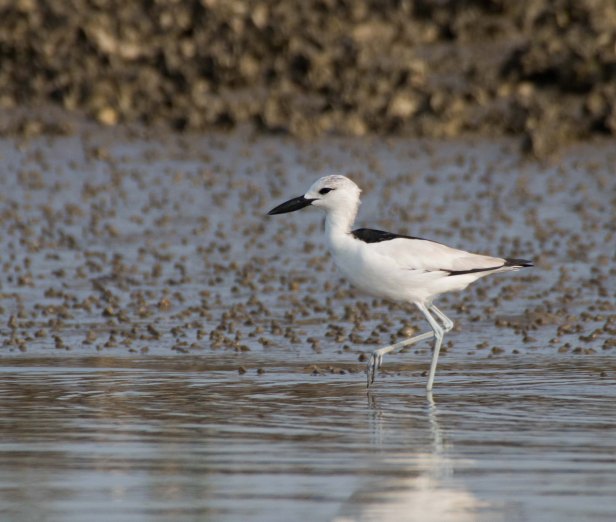
Crab Plover
We also got to see why is it was called a Crab Plover. Here it is devouring a crab:
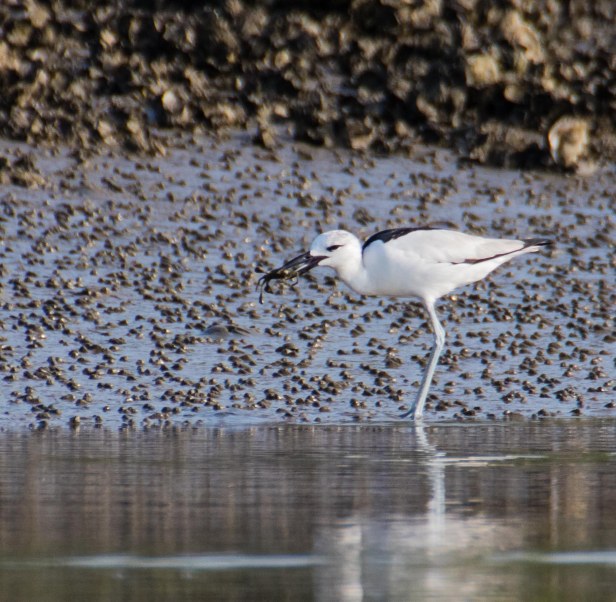
Crab Plover eating a crab
It was going to be low tide soon and we wanted to cover as much of the estuary as possible. So we left it to enjoy its meal and headed on.
Well, where there are oysters, there are bound to be oystercatchers; atleast that is what we hoped for. And we were not disappointed. Soon enough we got to see three Eurasian Oystercatchers on another island along with several Lesser and Greater Sand-Plovers. A Common Greenshank and Common Sandpiper foraged in the distance. Two raptors sitting on a pole turned out to be a Brahminy Kite and an Osprey.
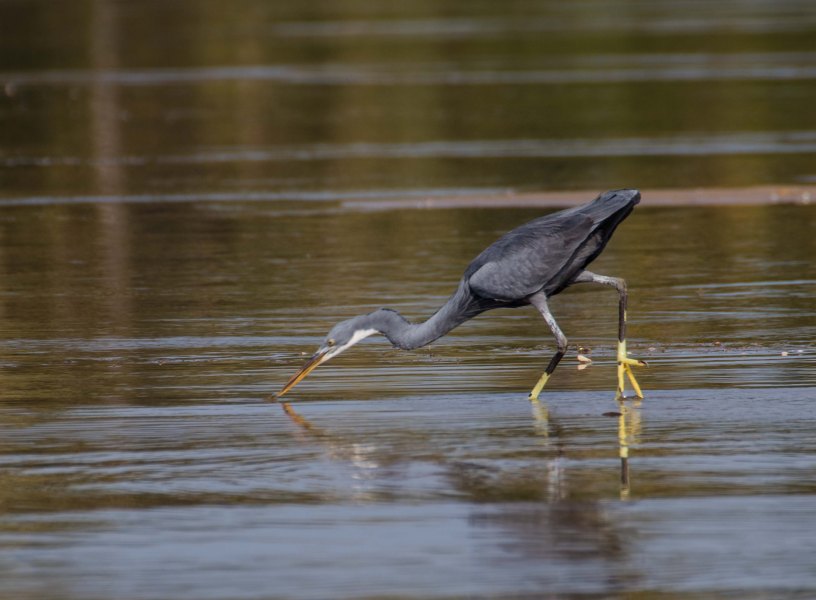
A pair of Western Reef Herons also gave us fascinating views of their hunting skills.
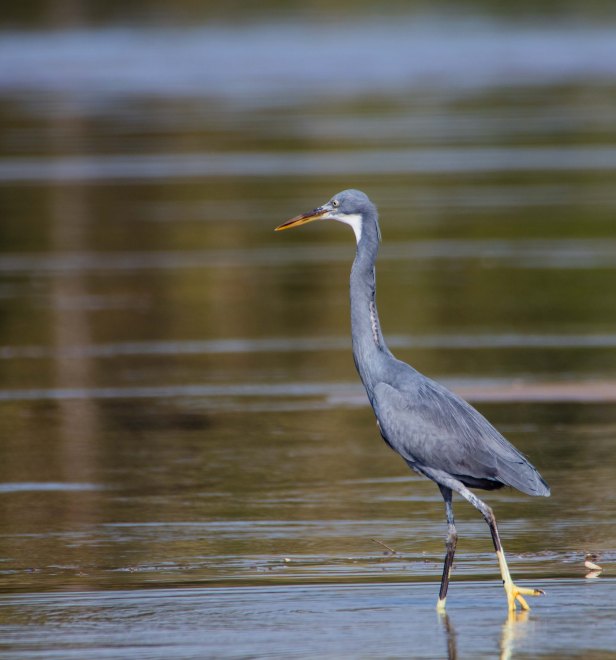
Western Reef Heron 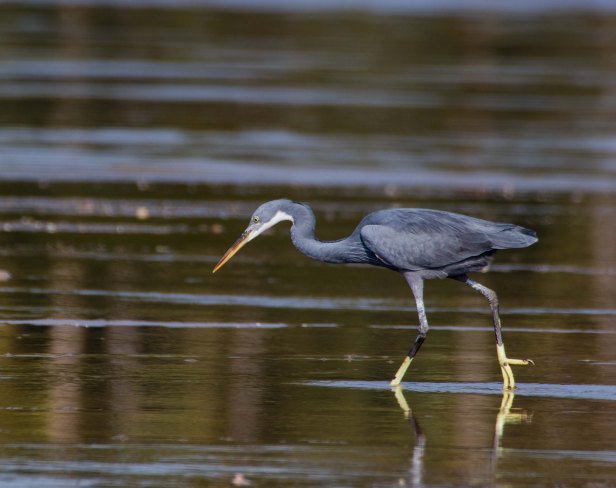
Wait for it… 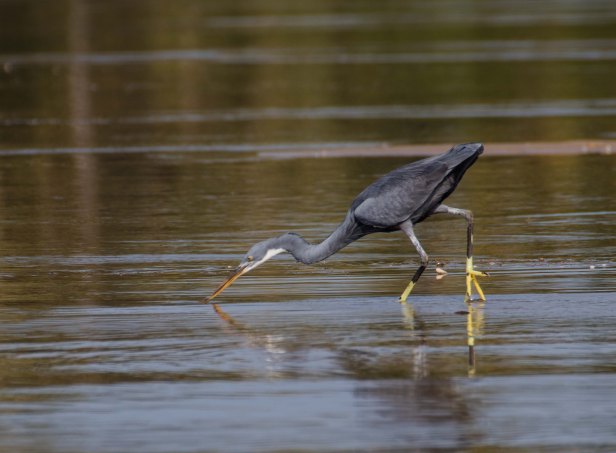
Got You!
Once back at the jetty, it was time to say goodbye to Narayana and his brother who had expertly steered the boat for us. While packing our gear into the car, we saw a pair of sailboats appear with colourful sails. We had to of course get our picture taken as well 😉 . Picture is courtesy of Rahul who is behind the camera.
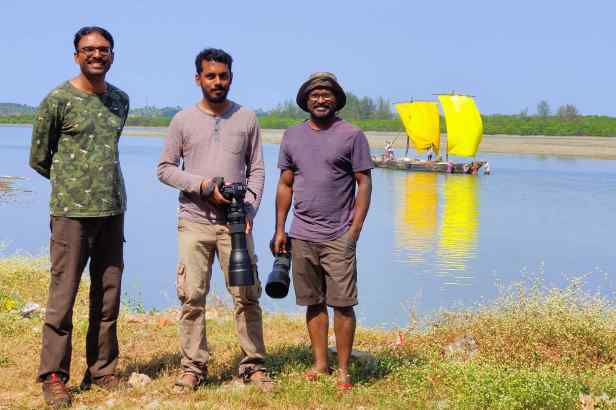
R to L : Novel, Harshith and Me
We were to break for lunch soon. But not before we tried for another fairly elusive bird; the Indian Thick-Knee. It is elusive because it is a nocturnal bird. During the day, it stays hidden in dry scrub, its plumage acting as a superb camouflage. The only time I had seen it earlier was on a trip to Hampi. It had been dusk and they were calling. Hence I could locate them.
Harshith knew someone who had been seeing it often in a patch behind his house. So we were more hopeful of seeing it. And we did, but after a bit of a search.
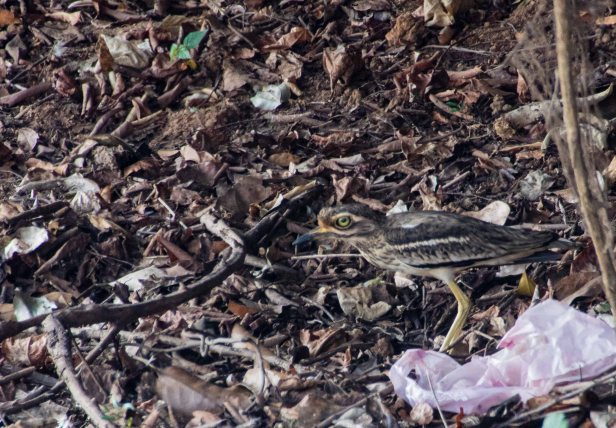
Indian Thick-Knee 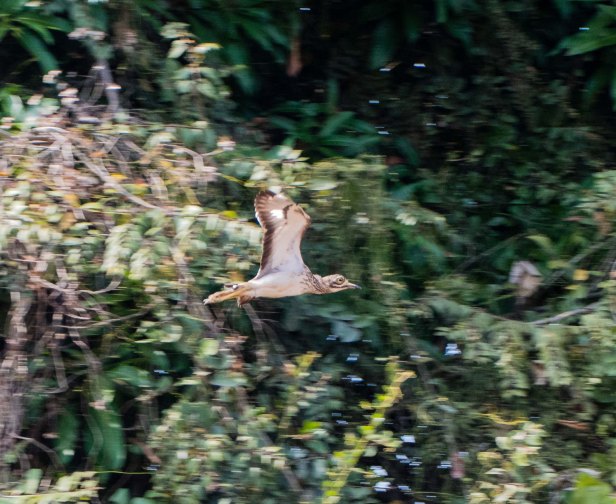
Post lunch session was around Manipal. The target was the beautiful Black-backed Dwarf-Kingfisher (Oriental Dwarf Kingfisher). It was one bird that had been on my list for quite some time. The rest of the gang had already seen it the day before in a spot in Mangalore. So their endeavour now was to show it to me. Again Harshith used his contacts to find a location where there had been recent sightings. Once at the location Walking around did not reveal it. Given the habitat that it lives in and being a tiny bird, it was to be expected. I had almost given up when it made its appearance. We stood riveted to the spot admiring its beauty.
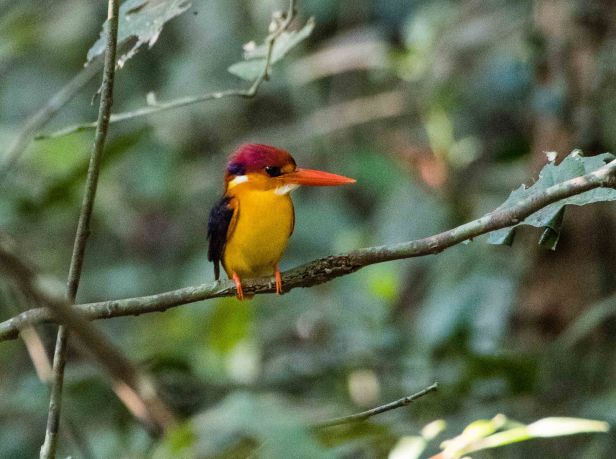
Black-backed Dwarf-Kingfisher
The place also had a healthy population of Grey-headed Bulbuls, with calls being heard frequently. But they, as always, preferred to keep inside the tree cover. Several Orange-headed Thrushes also went about foraging in the leaf litter on the ground.
The day was to end with us heading to a place known to have Orange-breasted Green-Pigeons. They decided to grace us with their appearance only close to dusk, when we had almost decided to head off. Before that we got to see a tree with almost no leaves and about 10 Grey-fronted Green-Pigeons acting as its leaves 😀 .
As dusk came on, we called it a day and headed back to Mangalore.
Video
Here is a short video of some of the birds that we saw in Kundapura.
On the pelagic birding trip I had mentioned at the start, you can read about it here.
 Mad about Birding and Travel
Thanks for sharing this, Thomas. I havent done Pelagic until now and have heard a lot about it. I hope to explore both Kundapura and Pelagic at once, but not during the pandemic of course. 😀
LikeLiked by 1 person
Kiran, you must. It will be an experience for sure (good or bad). I have a post coming up next on the pelagic birding experience. Read that too to be prepared for pelagic 🙂
LikeLike
Lovely Blog. And enjoyed the video too. The Crab Plover and Ruddy Turnstone living up to their names was terrific. How does one contact Narayana the boatman. I plan to visit Kundapura in Jan 2021.
LikeLiked by 1 person
Thanks Harish.
With regards to Narayana, i don’t have his contact details. His service was organised by someone else. Let me see if i can get it.
LikeLike
I am repeating the request made by your reader Mr.Rao. Need Narayana, the boatman’s number. I am planning to be in Kundapura next month. Thanks in Advance and an even bigger thanks for your superlative blog, which is a correct blend of superb writing and visuals
LikeLike
Hi, I have sent you an email with the contact details that I had for him.
LikeLike
sir my name is captain srinivas i am 80 years old and hobby bird photographer i am dying to go to kundapura please please may i have the contact number of boatman narayan bes regards and thanks in advance
LikeLike
Hi Captain Srinivas
I have sent you an email with the details I have. Hope you have a great trip. If you host your photos online, please do share the link to them. It would be nice to see them.
LikeLike
well thanks to you i got osprey and other waders.now for another big Favour.where did you get the ODKF like you gave me ramanna can i have the name and contact number for both ODKF as well as the Malabar Trogon please sir thanks a lot Capt srini
LikeLike
Hello Sir, I am unable to give any specific names for these unfortunately.
LikeLike
Lovely as usual…. Let me try this December holidays near kundapura….. last year it was Sims park based on your blog
LikeLiked by 1 person
Have a great trip Balu
LikeLike
Well written and informative blog! I am planning to visit Mangalore for Kambala and will club the birding trip also.
LikeLike
Thanks. I hope you have a great trip there.
LikeLike