
The temple popularly called Lepakshi Temple, is actually the 16th century Veerabhadra Temple in the village of Lepakshi in the Anantapur district of state of Andhra Pradesh, India.
I had “bumped into” the temple when reading up on attractions around the Gandikota and Belum Caves. The intent had been to visit it on our way back from Belum Caves. But it was not to be. So I had been looking for an opportune time to head back. It finally came in the last week of June 🙂
The temple was built by two brothers, Virupanna Nayaka and Viranna, who were Governors. The temple is typical of the Vijayanagara architectural style. Seeing the temple will remind one of the wonderous lost city of Hampi.
Mythological History
The story goes in Ramayana, Sita was abducted by Ravana and was being taken to Lanka (present Sri Lanka). The bird Jatayu, fought with Ravana in an attempt to rescue her. But he got wounded and fell down. It was in this village were it fell. Lord Rama, following the abduction trail, reached the village and seeing the wounded Jatayu, said “Le Pakshi”; meaning “Rise Bird” in the local language. And thus the village got the name Lepakshi.
There is another interesting aspect in one of the attractions in the temple, associated with this mythology. Read on!
Sri Veerabhadra Swamy Temple
It is the main temple. And what a beautiful temple it is! As one goes around the complex, this becomes more and more evident. But to admire the place, one needs to be reach early in the day, so that one can appreciate the expanse of the place, before the visitor groups start to come in. And that is how we had planned our travel so as to reach early; we reached around 9am.
I think it is also important to have read up on the place the one is visiting. This will allow to get some history of the place. It is also good to know the main attractions of the place. I am going to cover, in this post, what I think are the aspects that are worth covering in a visit to the temple. They are spread across the temple complex. So you should keep a keen eye for them 🙂 .
Main Entrance
It is easy to just walk through the entrance of a building. But this one has to be admired. It provides a grand beginning to the wonders inside.

It also has nice gopuram on top of it.
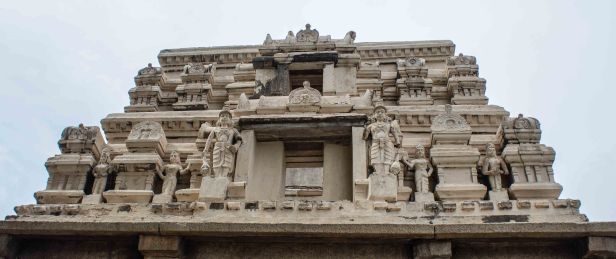
Here is another angle of it.
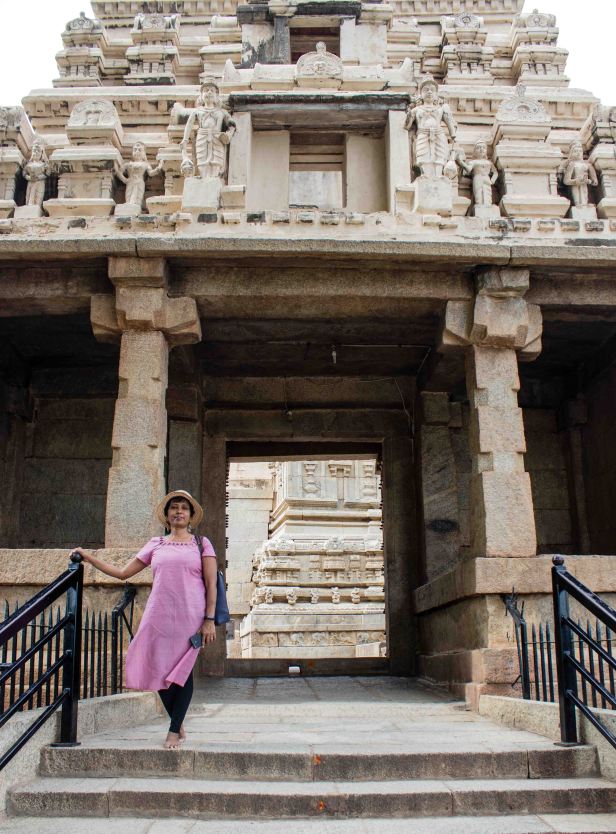
From here you also get the first peek into the inside of the temple complex.

Corridors Around the Temple
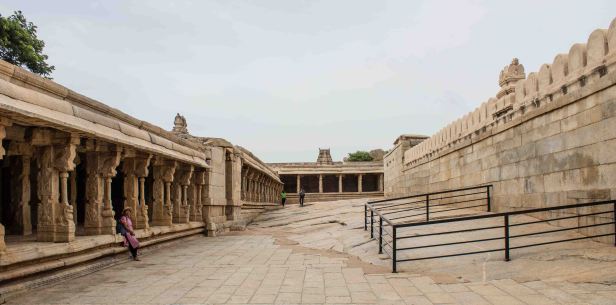
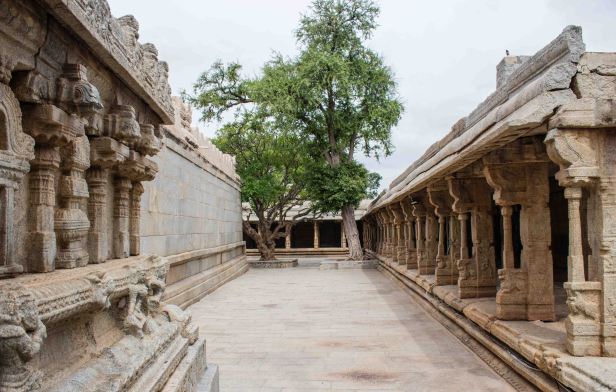
All around the main temple structure are corridors that have intricately carved pillars. Each pillar will be worth spending time looking at, as the carvings on them seemed unique.

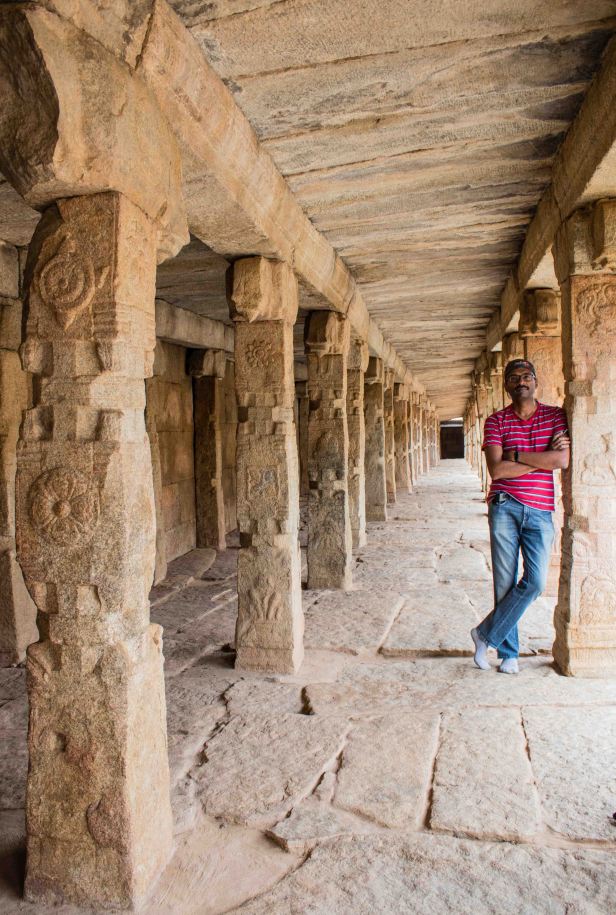

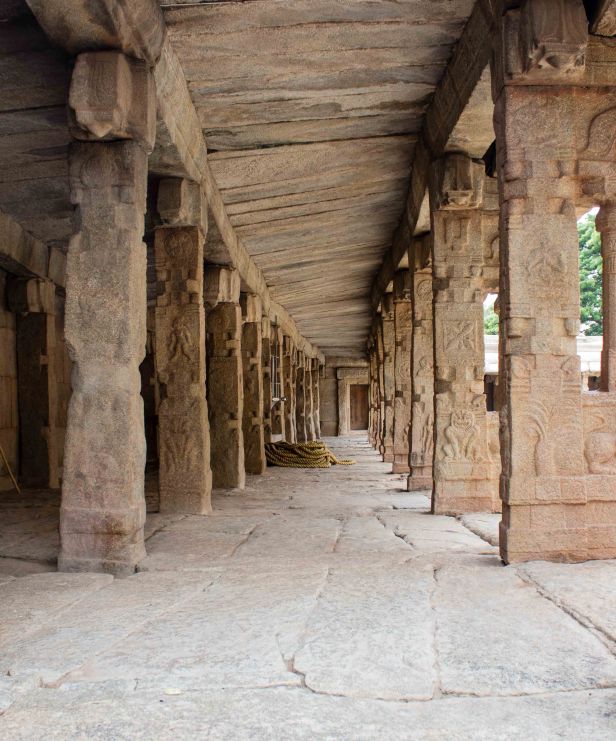

The walk around the main temple structure can be magical as well as calming, especially if it is devoid of other visitors. It really transports you to a different world, far away from the usual hustle and bustle of our routine life 🙂 .



Hanuman Plaque
There is a structure in the compound that has a plaque dedicated to Hanuman. You can see it as you walk around the temple.


Magnificent Tree
As you walk around the main temple complex through the courtyard, you will come across a tree that brings in an unique character to the area. I found it mesmerising. During our visit, we ended up spending over 15 minutes just around that spot.
The tree will completely different depending on if it has got leaves or not. When we visited, the had got fresh new leaves. This is of course depended on the season that you are visiting in.
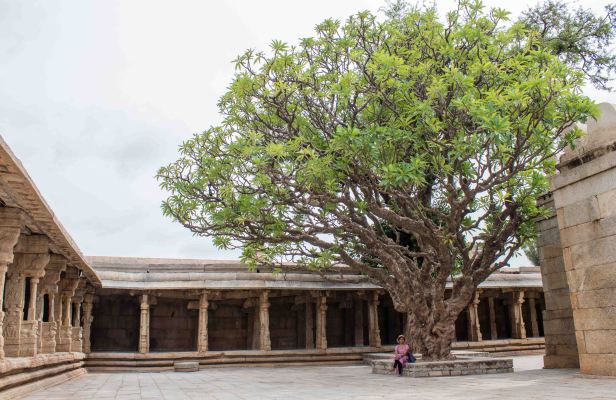

Here is another view, this time for the other end:
Naga Shrine cum Shiva Linga
This shrine holds a seven-hooded serpent (Naga) coiled in 3 layers around a Shiva Linga. The combination depicted in this structure is not very common; atleast I have not seen it elsewhere in any of the temples that I have visited so far. Whatever be it’s significance and history, it is certainly a treat to the eyes and hence not to be missed.

Ganesha Shrine
This can be easily missed if does not make a conscious effort to explore all parts of the area around the temple. This is found just to the side of the Naga Shrine. A closer examination will reveal a snake around his belly. Of course, Lord Ganesha is always depicted with his faithful vehicle, the mouse.
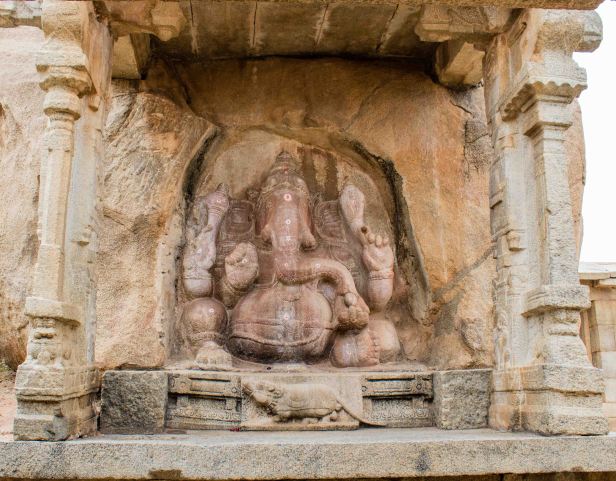
There is also a lot resemblance to the Sasivekalu Ganesha seen in Hampi, especially the front view, albeit smaller in size here. You can read of it here.
To the left of the Ganesha shrine is a rock with a relief. It depicts a warrior praying to a Shiva Linga as well as an elephant with its trunk over a Shiva Linga.

Open Air Kalyana Mantapa
This is certainly not to be missed in your visit. This was meant to be a marriage hall. But it is easily evident that the structure is incomplete. Well, history has it that the work was stopped as one of the brothers, Virupanna, was found guilty of embezzling. Whatever be it, one can only imagine how the place would have turned out had it got completed!
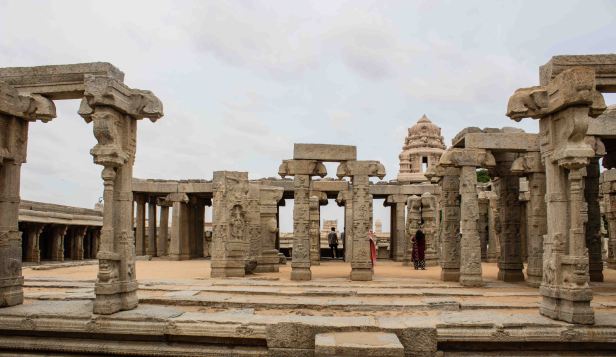
The pillars in the mantapa are works of art. They hold figures of warriors and dancers.
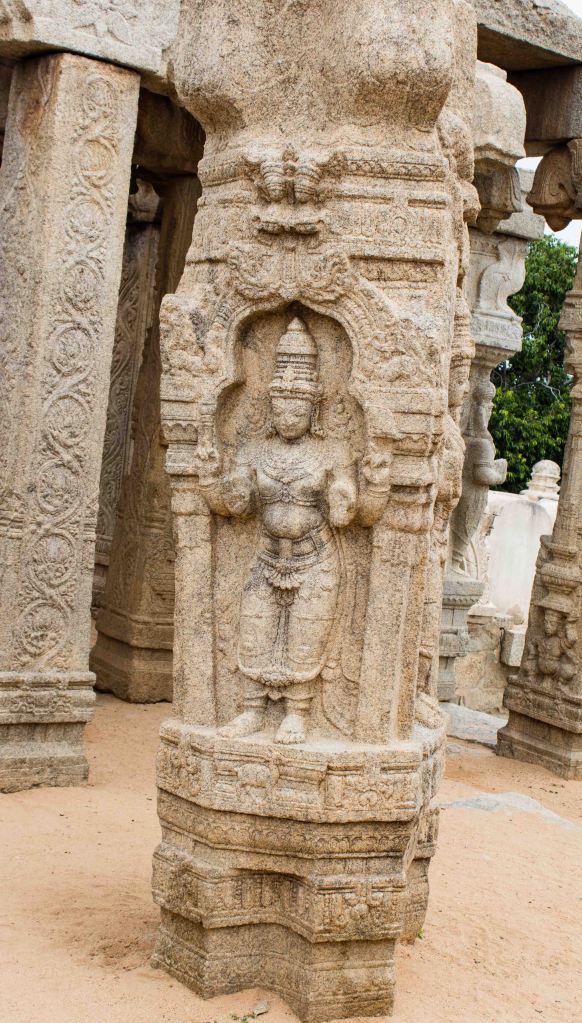

Here are two pillars depicting Brahma and Vishnu:

Eyes on the Wall
Just across the wall opposite the Kalyana Mantapa there are two spots that seem to have “blood” running down them. Well, it is said that the King got very angry with the accountant, owing to the construction of the Kalyana Mantapa. As a punishment, he ordered his eyes to be popped out. These marks are a reminder of that. Don’t now how true this is though.

Sita’s Footprint
Another attraction that can be easily missed. This one is found beside’s the Hanuman plaque and the Kalyana Mantapa.
It is said that when Jayatu was Ravana, Sita’s foot touch the ground in Lepakshi. It is this footprint that is seen in the temple complex.

Another interesting fact of this is that the footprint is always wet. Even if you were to wipe it dry, it will soon have water come back into it.
Main Temple Complex
The entry into the main temple complex is in itself beautiful. First is a lamp post right at the entrance.
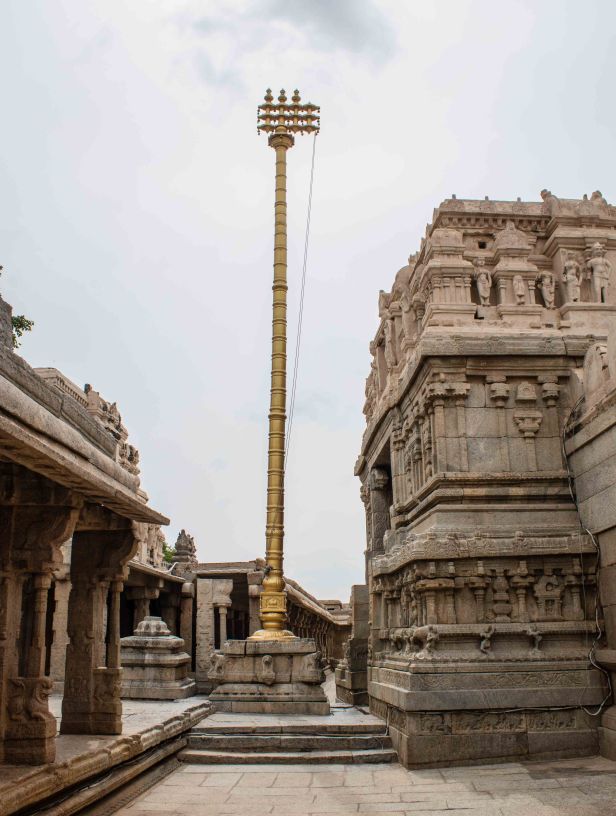
The base of this post is also decorated with elephants. Sadly they have lost their original shape.

The doorway is decorated with carved beauties on either side.

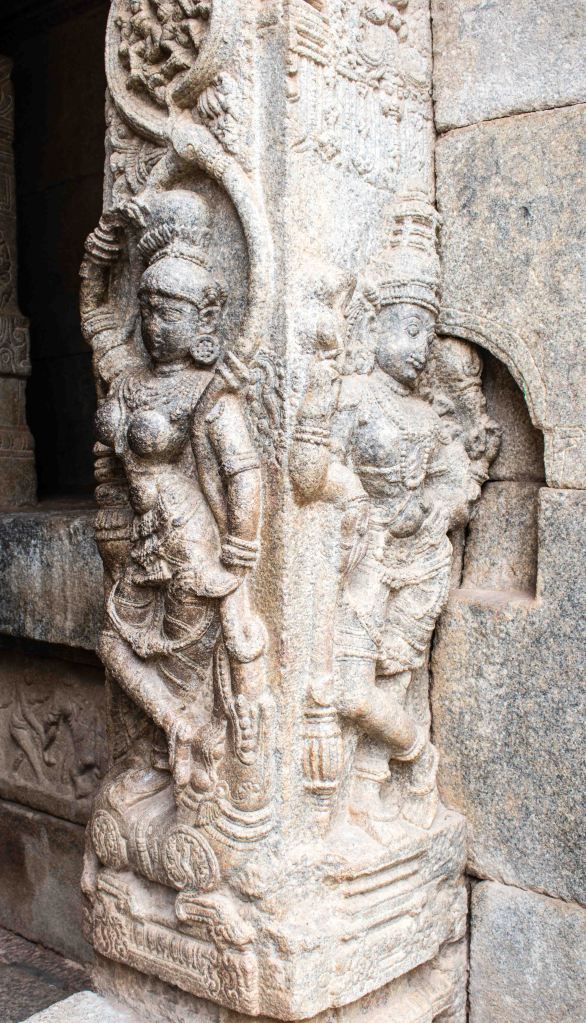
The temple has been structured into three parts. The outer most one is called the Natya Mantapa, the next is the Arda Mantapa and the inner most one is the Garbhagriha (or Sanctum Sanctorum).
The Garbhagriha is where the presiding deity is; in this case it is the near life-size image of Veerabhadra. Photography is not permitted in this section.
The Natya Mantapa and the Arda Mantapa sections are like art museums. Each of the pillars have been intricately carved to depict various figures, each of them unique.


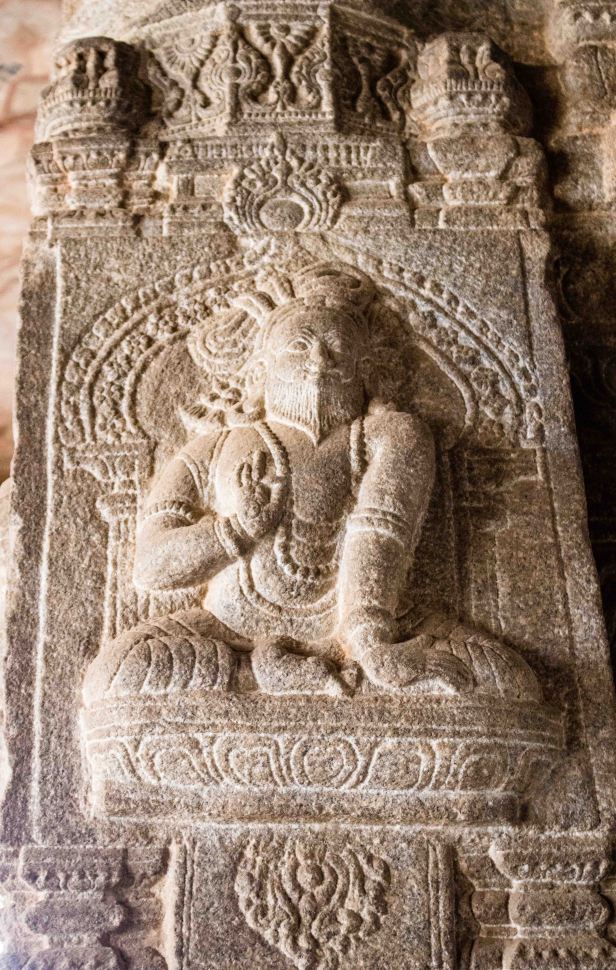

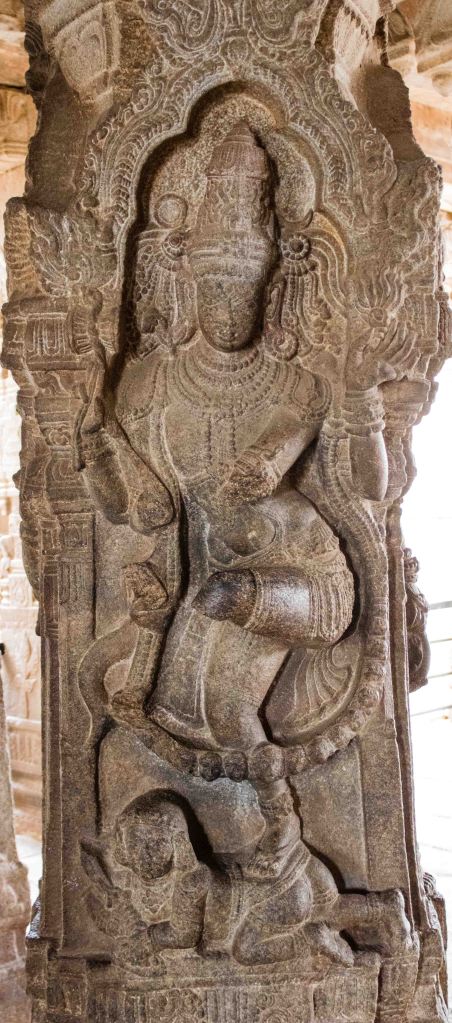

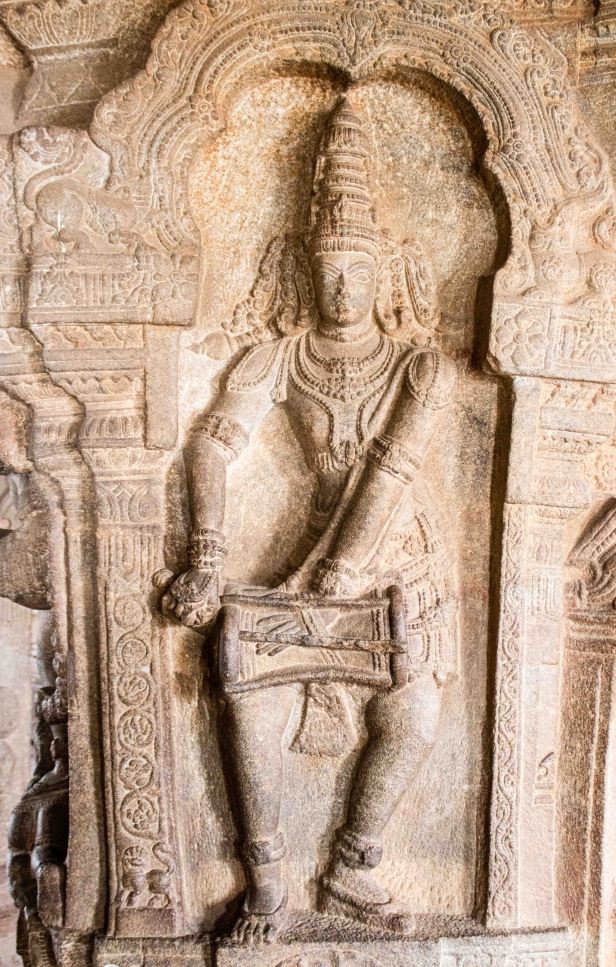


It is not just the pillars that have been decorated. A look up to the ceiling in this area will reveal numerous paintings.

The Hanging Pillar
This is considered the star attraction for visitors. Again it can be easily missed if one does not particularly look out for it. It can be found left of the entrance to the sanctum sanctorum.

One can pass a piece of cloth under this pillar. It is said that the during the British rule of India, a British engineer tried to uncover its secret. Upon moving the pillar, the whole structure of the temple started shaking. Experiencing this, the engineer ran for his life. It also goes to say that the hanging pillar was an integral part of the temple design.
Nandi at Basavanna Temple
This is actually outside the Veerabhadra Temple complex but very close by. the Nandi bull, considered the divine vehicle of Lord Shiva, has been cut out of a huge granite rock. It has also been placed placed such that it is looking towards the Shiva Linga in the Naga Shrine behind the Veerabhadra Temple.
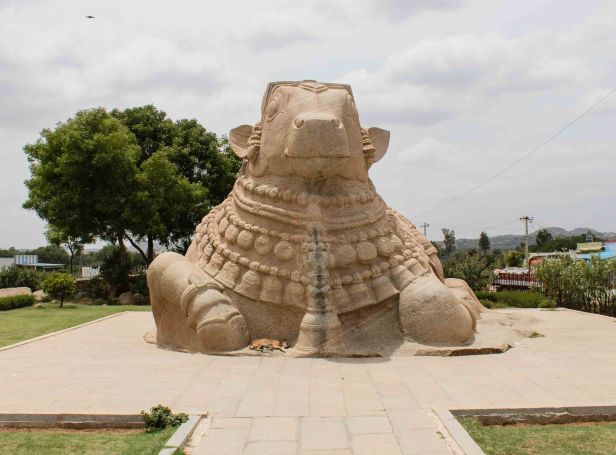

It is believe to be the second largest monolithic Nandi in India.
Virtual Tour
Here is a short video I made to give you a virtual tour of the place:
Recommendations
This temple is certainly worth a visit, especially if stay in and around Bangalore. It is roughly a 2 hour drive, depending on where you stay. As always my suggestion, read up on the temple before you visit, so that you do not miss out on aspects.
Try and reach there early. The visitors count start to increase post 10am. Best if you can reach before 8:30am I think. Parking can be found in the lane that leads up to the temple.
You will need to leave your footwear outside before entering the temple complex. Wear socks if you are not used to walking barefoot. The stony surface around the temple also get hot once the sun comes out. So wearing socks helps here as well.
It is best to carry your own food and water. You can however find some restaurants while driving down from Bangalore.
This is a live temple. So be respectful in the way you dress and behave while inside, especially the inner sanctum.
 Mad about Birding and Travel
Such an informative post accompanied by lovely pictures. Loved your close ups of the carvings. They are so intricate and detailed.
LikeLiked by 1 person
Thanks Leah, the carvings were indeed a sight to see during the visit.
LikeLiked by 1 person
I went there last year and liked this place a lot….. Best place to visit in lepakshi Temple
is Monolithic Nandi, A giant status of SHivji wahan… ❤
LikeLike
Yes Amit, certainly a wonderful place.
LikeLike