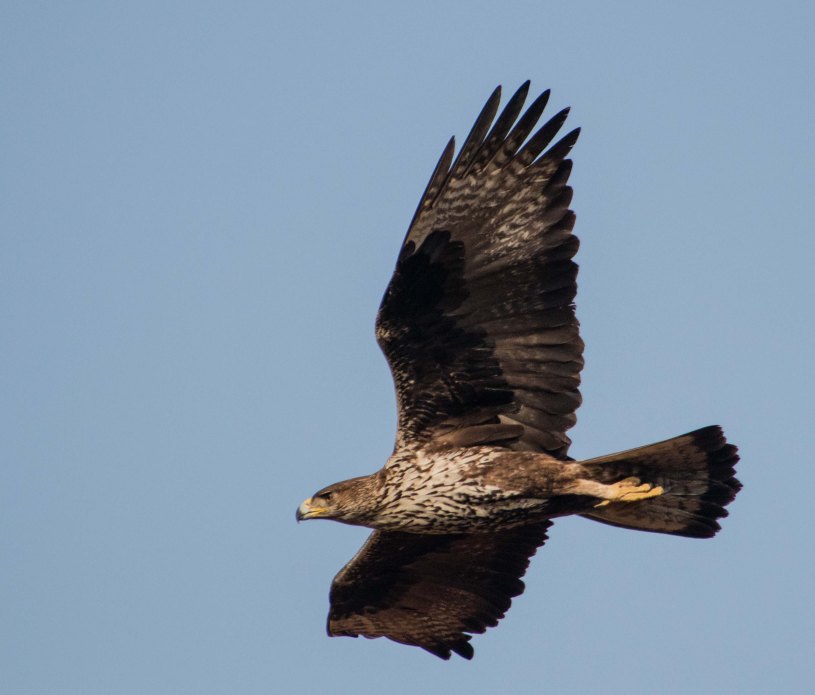
I have watched many documentary films on birds of prey. Of these, some have included, in parts, them raising their young ones. Amongst them, my all time favourite has been that of a Harpy Eagle. Almost the whole film was about it raising a chick. What a documentary it was!
Ever since seeing the documentary on the Harpy Eagle, I desired to see a raptor raising their young in the wild; the adults guarding the nest, bringing in food, feeding the chicks, chicks testing their wings etc. Yes, I know, wishful thinking 🙂 . Getting to actually witness a bird of prey, like an Eagle, raising their young in the wildlife, is rare, to say the least. But, as they say, be careful what you wish for; it may just come true. And come true it did for me! Not with a Harpy Eagle (I would have to go the Amazon for that), but with a pair of Bonelli’s Eagles. What I witnessed over a period of 9 weeks was so much more than I had ever imagined! It has left me in awe of their parenting skills; their care, attention to each chick, fearlessness to protect and dedication.
Before I decided to write this post, I debated with myself several times, on if I should. Nesting sites are to be treated sensitively. The last thing I wanted, was to endanger it in any manner, as other people may also want to try and visit. The more the visitors, the greater the chances of it getting disturbed and thus may impact further breeding in that area.
To help me make up my mind, I searched on the internet to see if there were easily accessible material that described the parenting behaviour of Bonelli’s Eagles. I understood that breeding studies of Bonelli’s Eagles had been well conducted around Europe. However, I did not find anything satisfying for me; something that was in simple language, descriptive and with pictures. I am fairly sure that I had not made any discovery of some startling behaviour. But I had witnessed and captured so many beautiful moments and behaviours in this journey that I felt compelled to share it, so that any one of similar interests may benefit from it. However, with a view that the site may still continue to be used by the pair for nesting in the future, I have decided not to disclose the specific coordinates of the site.
So here goes!
Warning: This is going to be a looong post as it contains pictures and behaviour observations gathered from ALL my visits over 9 weeks. This, I feel, is the only way that I can properly document as well as share what I observed. The post also includes a video compiled from the period. Make sure you view that as well. I was able to video record a lot of the behaviour that I have described against the various weeks.
Disclaimer: I am no ornithologist or scientist. Any inferences or comments made on the behaviour I observed, are purely my speculation or guess. I would be happy to receive any feedback from people who are experts, on corrections required on any of my inferences.
Before I proceed further, I must first thank my birding friend, Rahul Singh, without whose telling me of the nest, I would not have been able to witness all that I did. A big Thank You!
Wonderful News!
It was 2nd Feb. I was chatting with Rahul to make birding plans to try and sight the Sulphur-bellied Warblers, as I had not seen them before. As I was asking him to share some of his pictures of the warbler that he had seen recently, he says “Before that you enjoy this” and sends me the below picture.
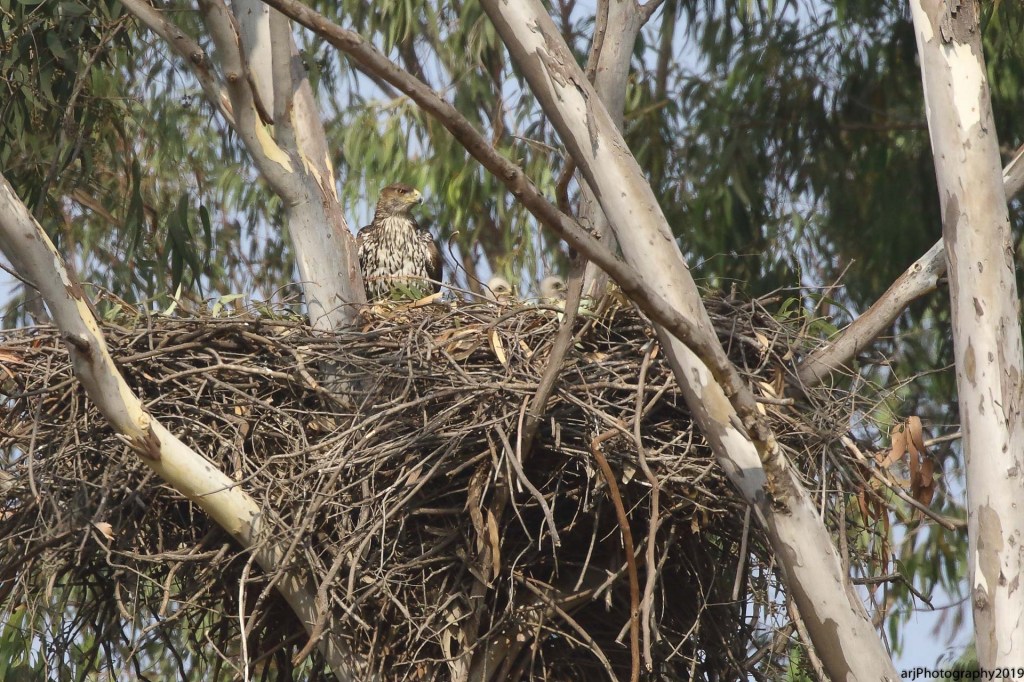
I literally jumped off my chair and exclaimed “Ooohhh!!”. He had told me about the nest earlier. But I had not expected to see it occupied with chicks. From the picture, I am guessing the chicks are only just a few days or a week old (I am no expert though). So I am going to call this as Week 1 (2nd Feb), just for a reference in time. And this is how it all started.
Week 2 (9th Feb)
I did not actually get to visit the nest. We instead decided to go and look for Sulphur-bellied Warblers in another location. I was being a little greedy as I wanted to tick off a species that I had been trying to see for a couple of years in Bangalore. But Rahul had visited the nest on 10th Feb. Here is a picture from his visit.

Week 3 (16th Feb)
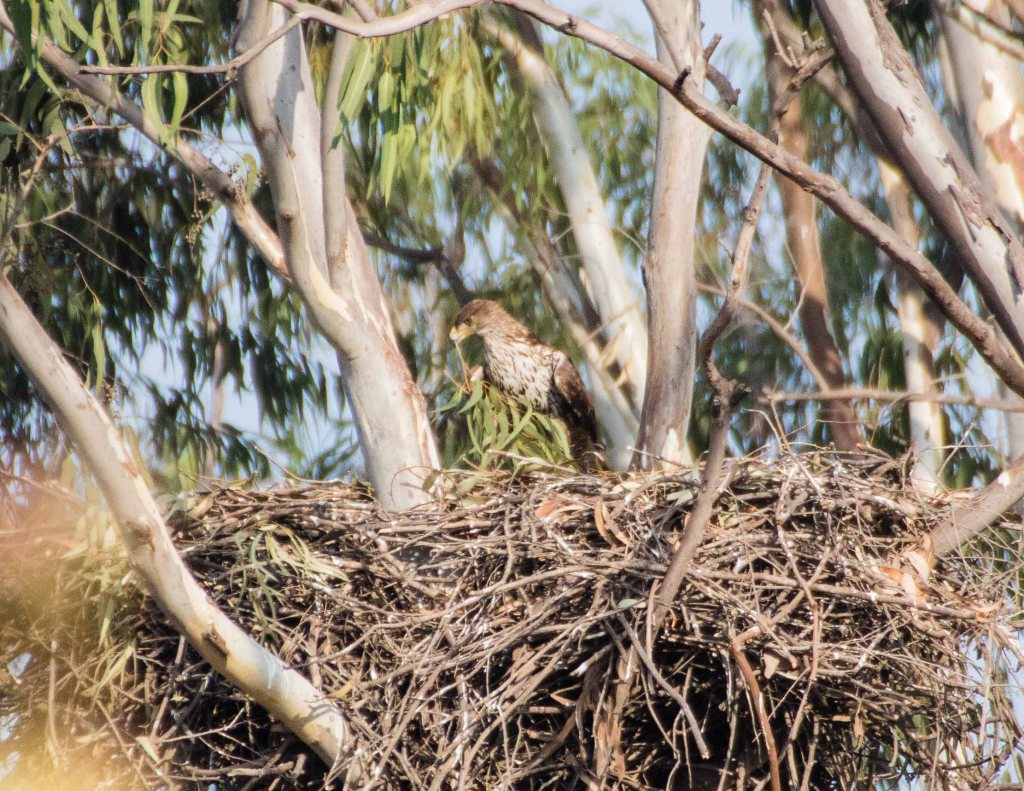
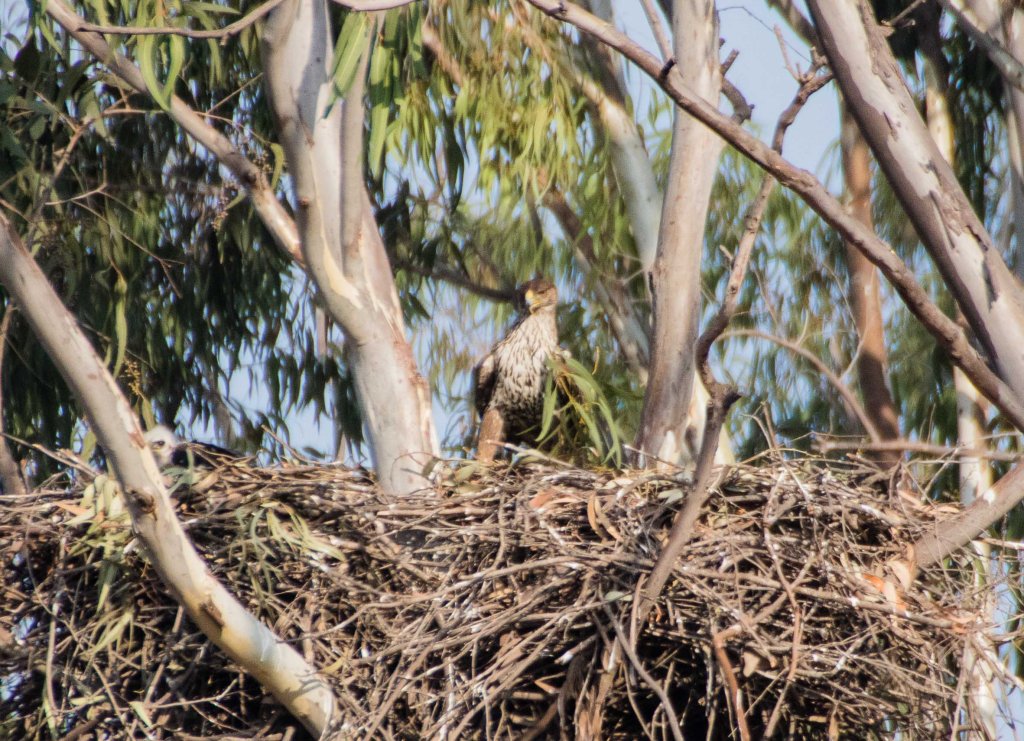
This is the first time that I got to see the nest and its occupant(s). Sadly we could observe only one of the chicks when we were there.
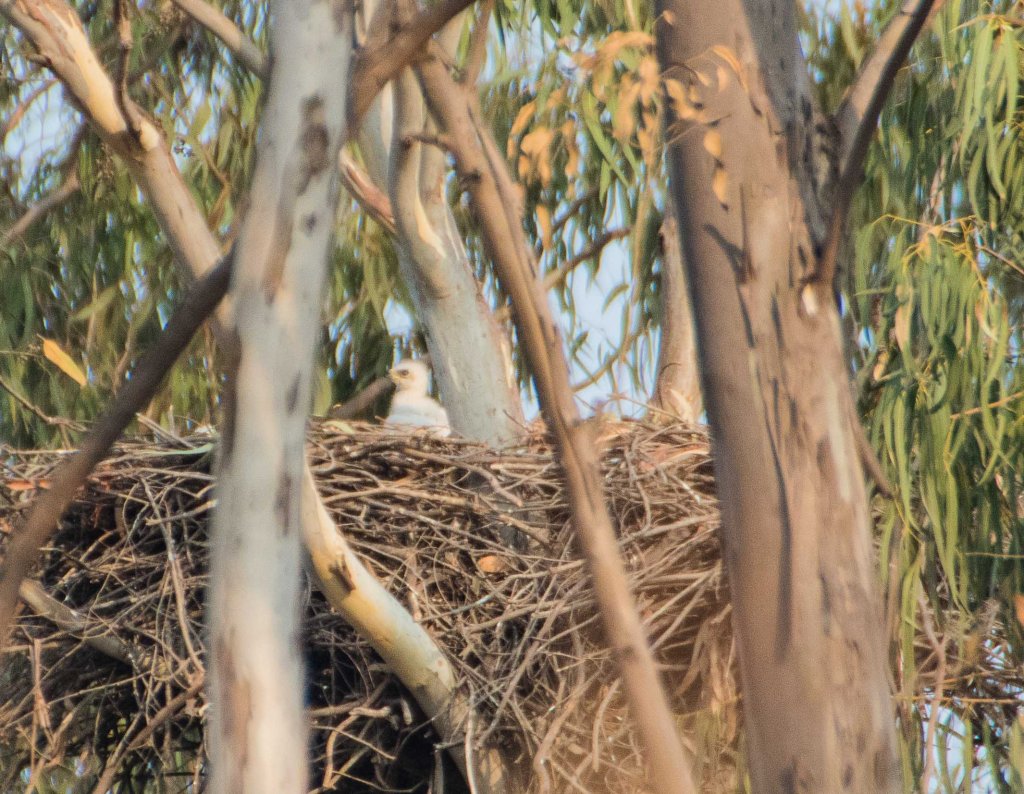
An inspection of other pictures, once we were back home, revealed that the other chick was just about visible on the other end of the nest. It had been huddled down and hence was barely visible.
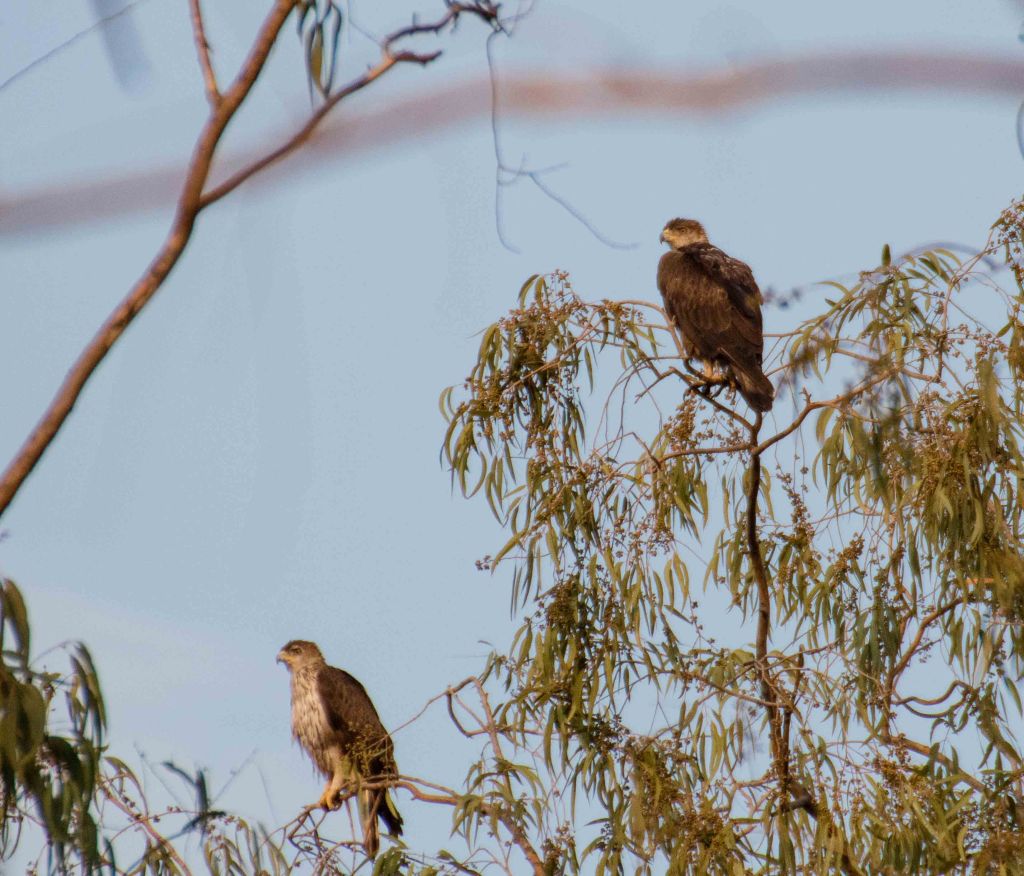
Here is a picture of the parents sitting on top of a nearby tree. Till the time that we were there (roughly 2.5 hours), we did not see the parents visit the nest.
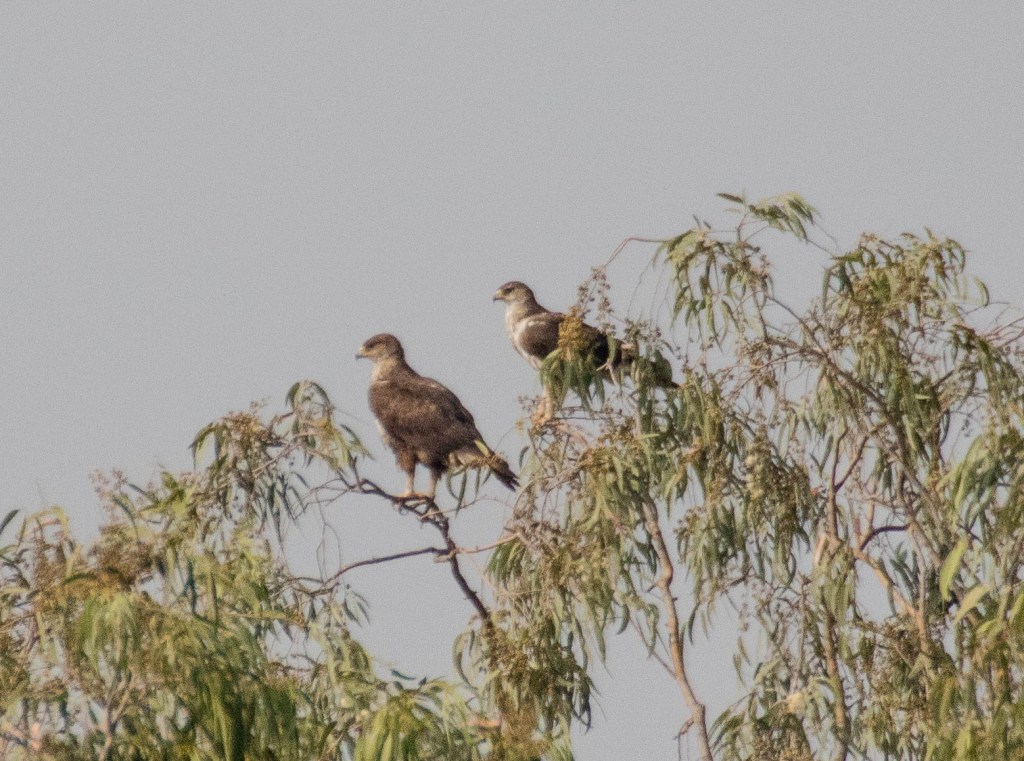
As is usually the case with other eagles, we could see that the female (on the left in the above picture) was slightly bigger than the male. They were both harassed by a pair of Red-wattled Lapwings for a while. Shortly after, both the parents took to flight. They were seen circling together above the area of the nest for while. They also made calls a couple of times when circling. A bit after, they flew off in the direction behind the nest.
As we started our walk back away from the nest, we got to see one of the chicks more exposed (picture below). We could see that it had grown larger over the two weeks. It was still mostly white. But it had started developing some black spots on the side of its wings.
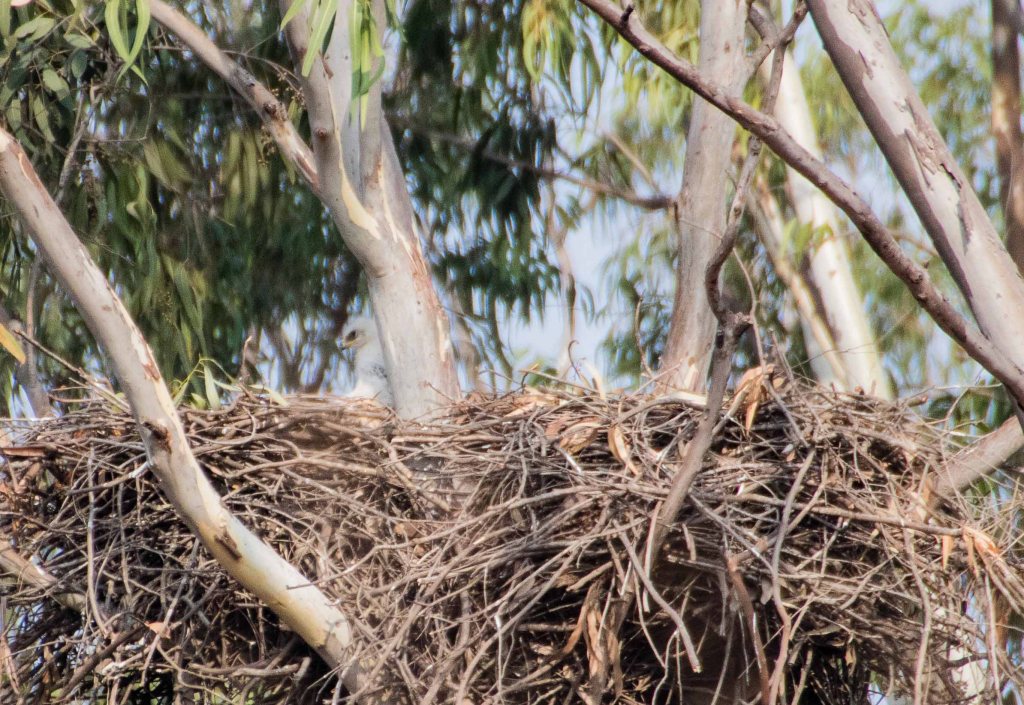
Week 4 (24th Feb)
In this visit, I got to see both the chicks. One was sitting almost fully exposed, near the ledge of the nest, and the other huddled down near it. The chicks had started to develop black patches on the wings and a bit of rufous coloration on its breast. They kind of looked like Black-shouldered Kites 🙂 .
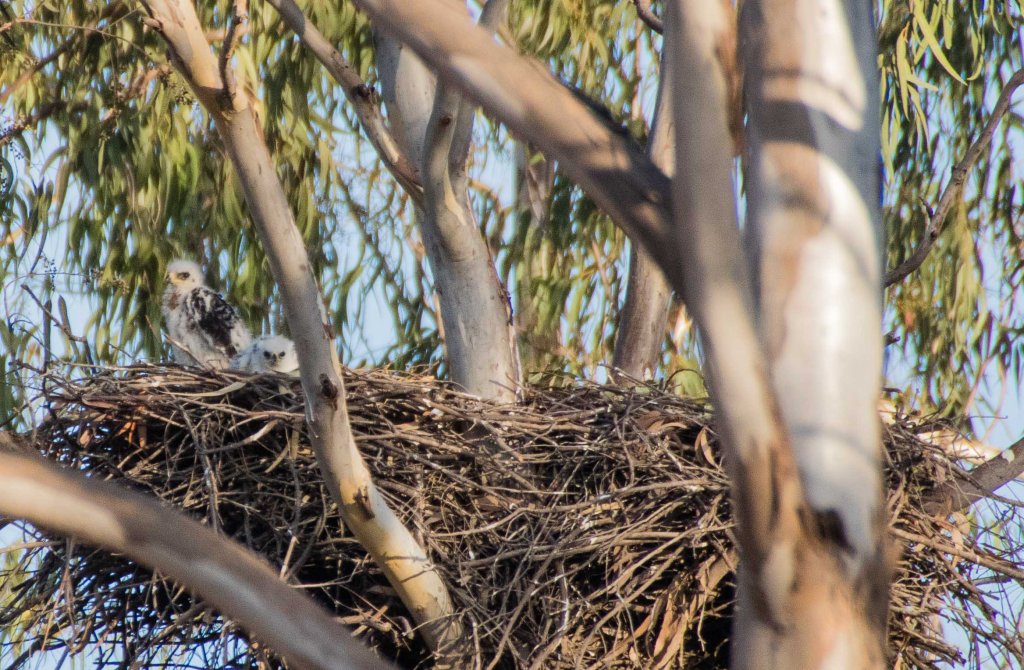
The parents were not at the nest. They also did not visit the nest for the 2 hours that I spent there. I saw one of them perched atop a tree left of the nest. Some time later I observed both of them in flight; both circled together above the nest for a while and then disappeared into the area behind it. One of them initially came close to where I was standing.
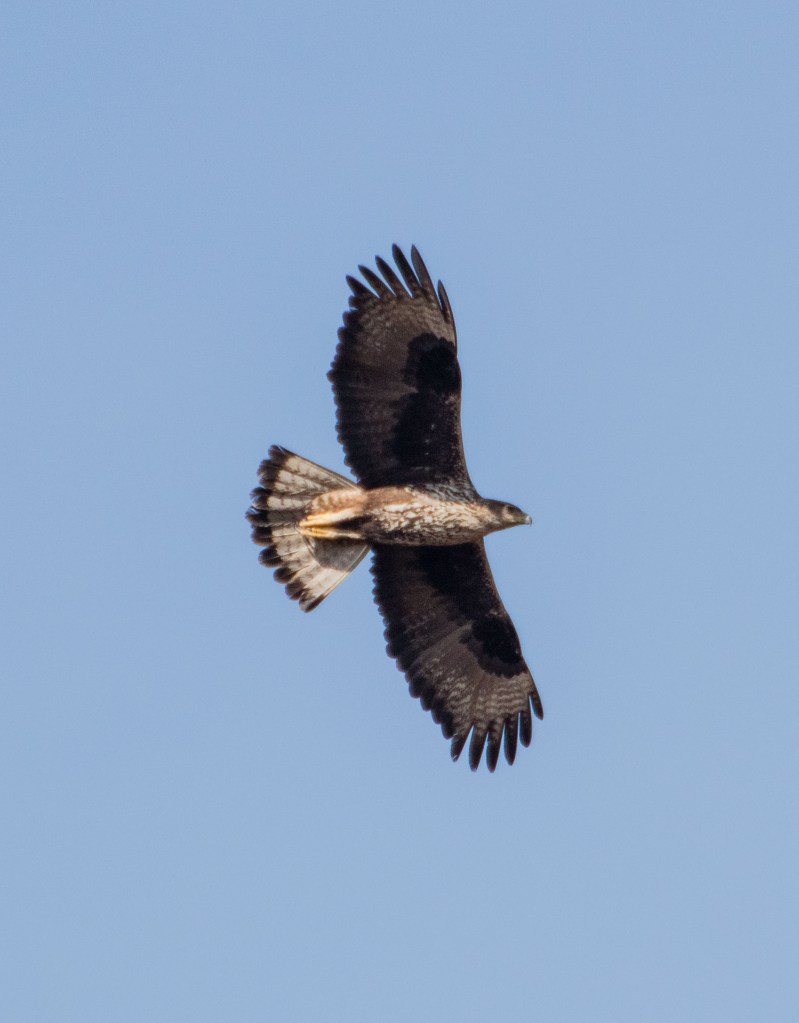
I could again see that the chicks had grown in size over the last week. Given the pace of growth, I told myself that I had only a limited period for observing them. So I decided on the below methodology.
Methodology
Owing to practical considerations, I could not do continuous monitoring of the nest. I decided to, however, visit the nest atleast once a week. The plan was to do this till the time that the chicks had fledged and were rarely seen at the nest. I would look to get to the nest area around 6:45am and be there till around noon. We had found a nice spot about 45m away from the nest, that gave us an unobstructed view. So I decided to base myself at this spot (or around this spot) all through the observation period on my visits.
I intended to capture all my observations digitally; take photographs and video recording as much as possible when interesting behaviour was seen. For this, as my observation gear, I had a folding chair, a Zeiss 8×42 binoculars (my primary gear to spot any interesting action) and Canon 80D DSLR with a Sigma 50-500mm lens (sadly the pictures are not sharp owing to a lens fault and significant cropping) and some food and water. Here is the gear that I took along on my visits:
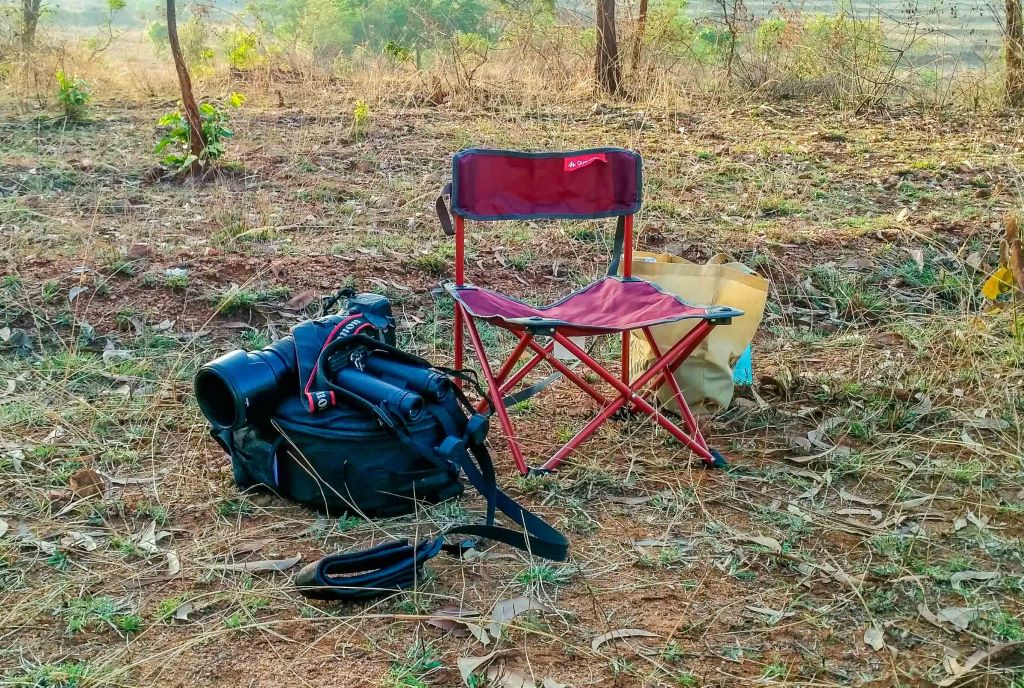
I had to limit the gear I carried since it was a long walk from where I parked my car to the observation spot. So no tripod, monopod or spotting scope was included.
Here is me at the observation spot 😀 .
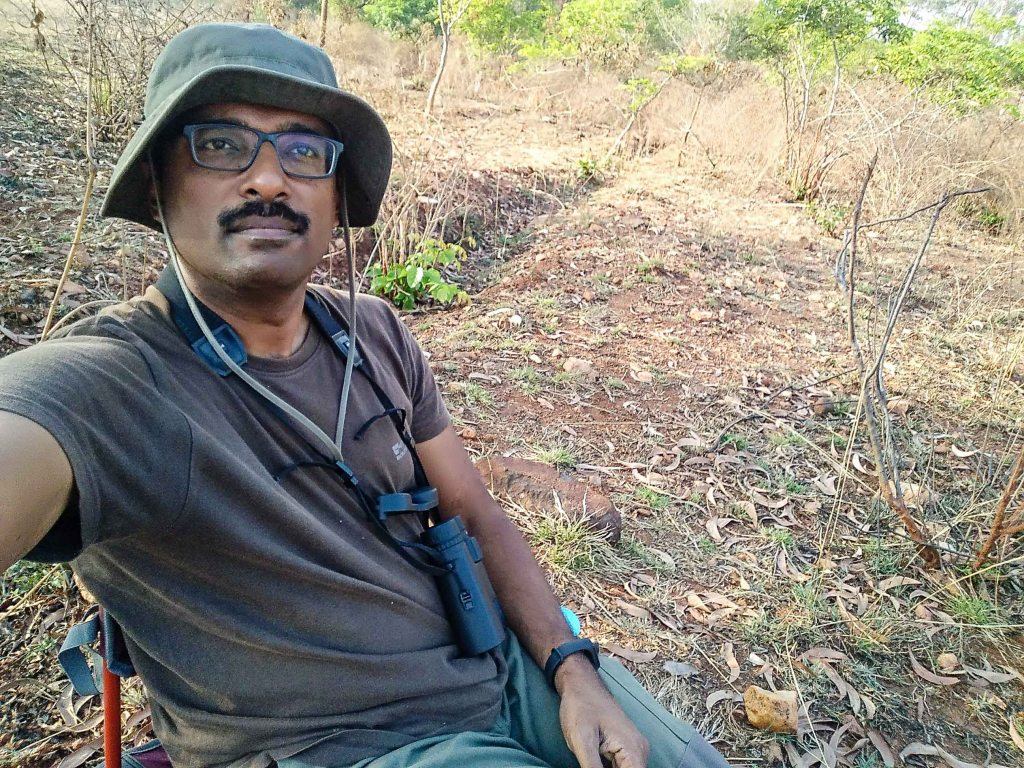
Once back home, I diligently made notes of all the observations from the day’s trip. This included scanning through all the pictures and videos taken to see if I am missed something on the field. The observations that follow in this post, are as a result of this.
In all my visits, based on the spot that I observed from, the birds did not show any visible sign of discomfort of me being there. This was my only gauge to assess if I should stop doing what I was doing. Also, at no point throughout my visits, did I make any attempt go near the nest, when it was occupied. The one time that I went, was after the chicks had fledged, left the nest and I had not seen them on it in my visit. The only reason to do so was to get a closer view of the nest itself for documentation.
Week 5 (1st Mar)
Only one chick was visible standing on the edge of the nest, as I settled myself at the observation spot. I could see that the other chick was huddled in the centre of the nest.
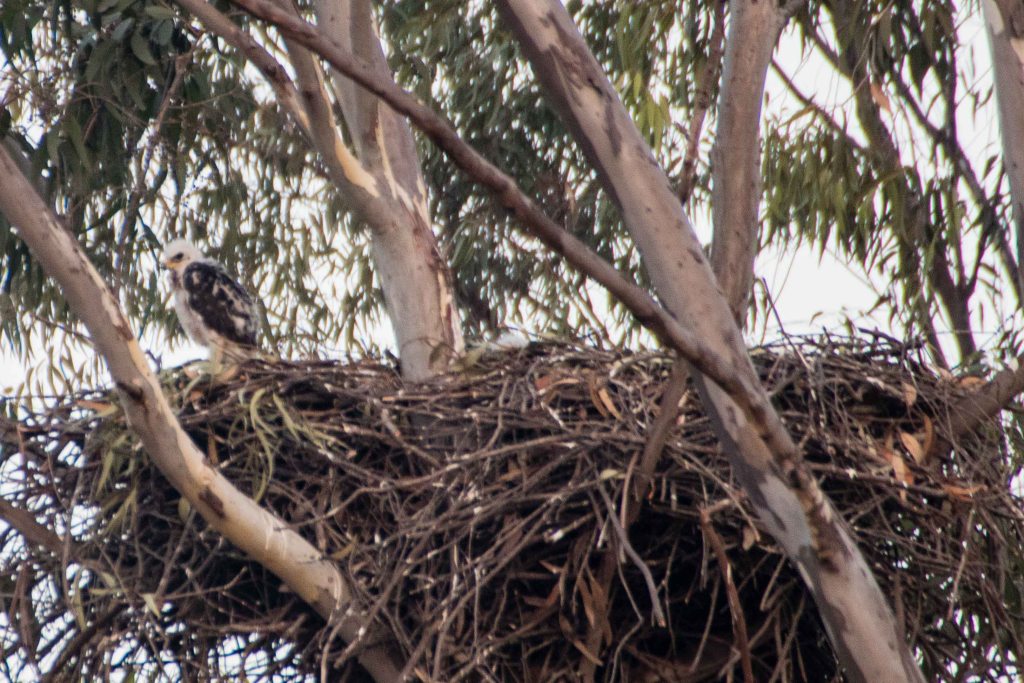
Well, that one too, soon stood up bringing it into my full view.
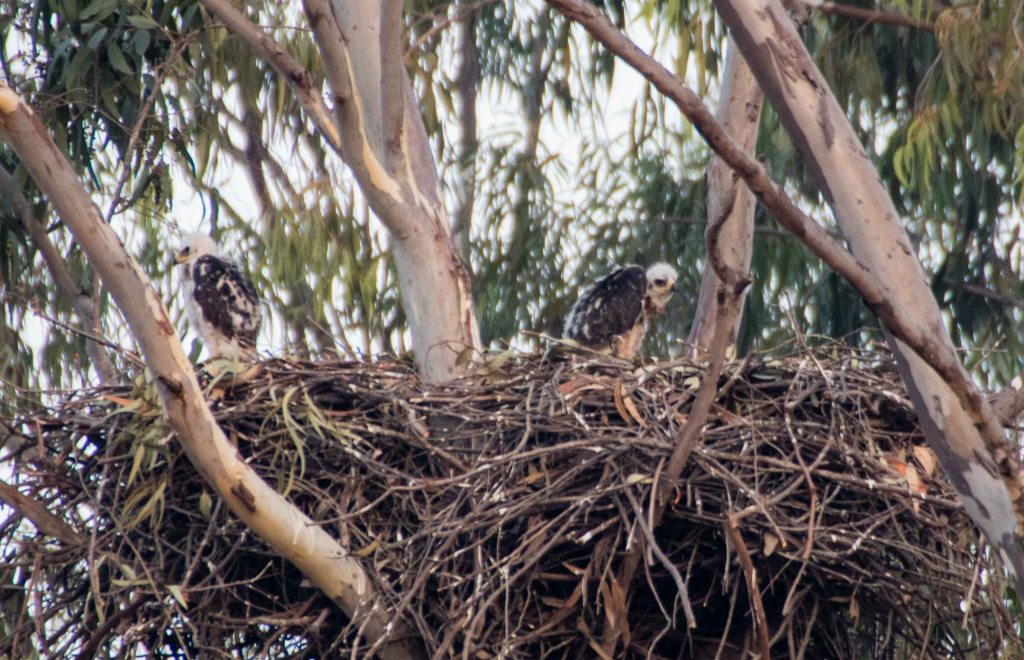
The black patches on their wings had definitely got more prominent from the previous week. The rufous colouration on their chest, was also getting bigger. I thought one of the chicks was looking slightly larger than the other.
This time too, the parents were not at the nest. Though I could not see them on the usual nearby tree tops either, I was pretty sure they were close by. Some time later, I noticed a juvenile Brahminy Kite circling above the nest. I then heard a “kluu” call from nearby. I suspect it was one of the adults; may be a warning call. A few seconds later it flew into the view and quickly chased the Kite away. Here is the adult briefly flying over my head after chasing the Kite away.
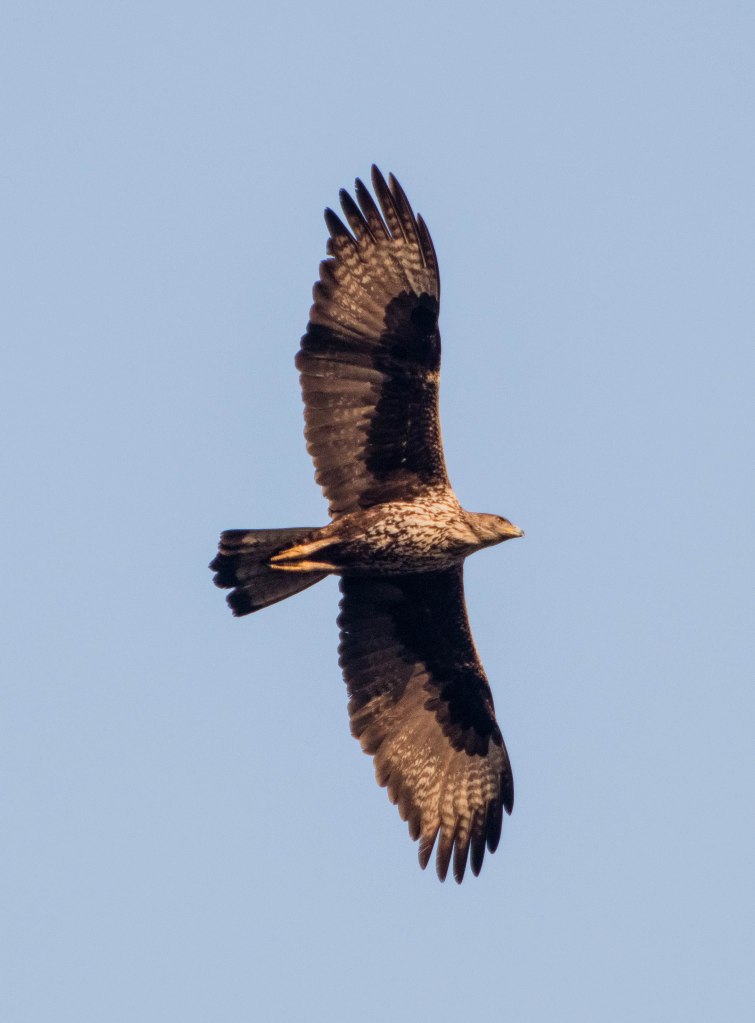
The adult vanished as well. Very soon a Black Kite appeared and circled above and the response was a repeat of the earlier instance with Brahminy Kite. But this time a flock of crows saw the adult Bonelli’s and stared to mob it. It was forced to fly further away from the nest area, with the crows continuing to “chase” it. However it called a few times as it flew away. Then I noticed the other adult fly in from behind me and landed on a tree top close to the nest. This seemed to me like a “protective formation” behaviour! Another 5 mins later, that adult too, flew out to the area behind the nest and disappeared. The day had indeed started interestingly!
A bit into the morning, I noticed an adult suddenly fly in from west of the nest, go across behind and then land on a branch east of the nest. It was closely followed by a Black Drongo. It too perched on a branch above the Eagle. The adult had an eucalyptus branch in its beak. Its large talons were clearly visible even from this distance!
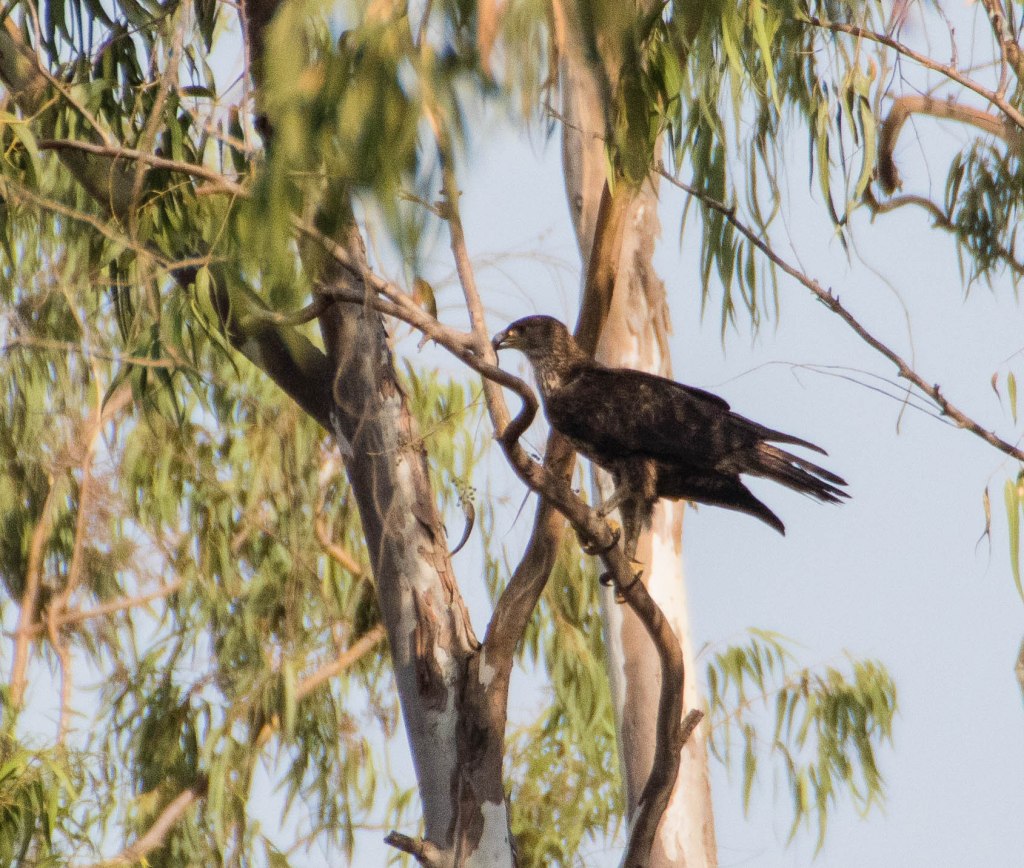
I was expecting it to fly onto the nest. Instead it flew past the nest and sat atop another tree to the west. The Drongo followed suit. This time I saw the Drongo trying to chase it off by “dive-bombing” it. Here are a couple of pictures I captured.
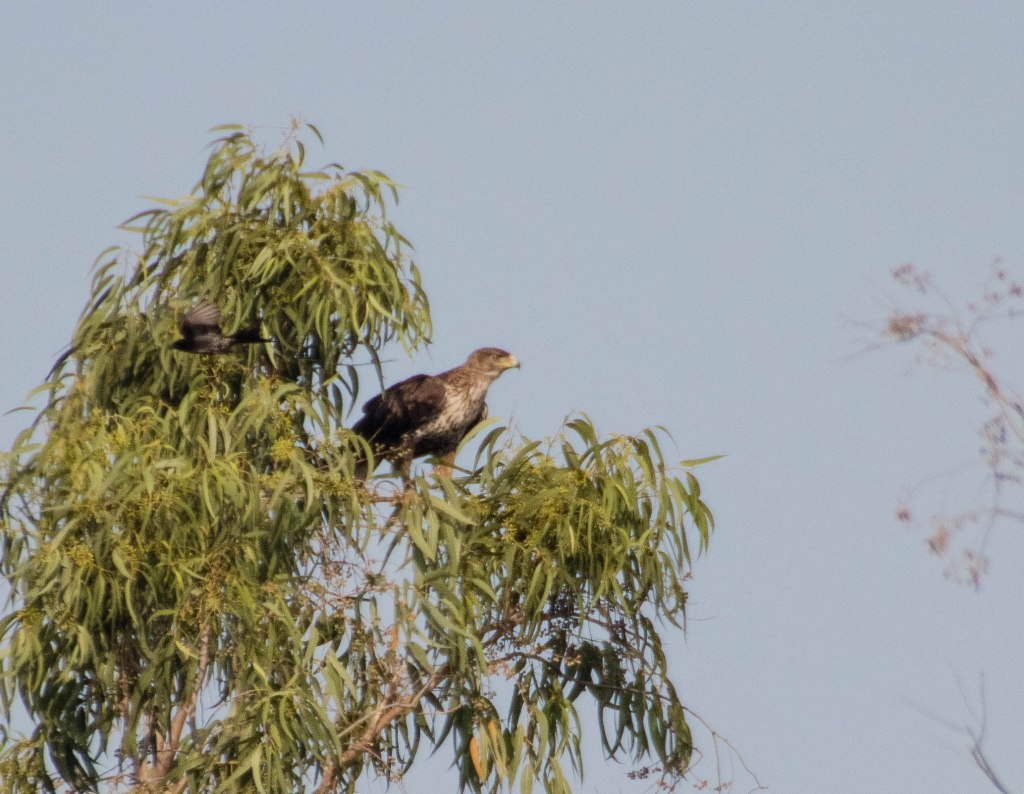
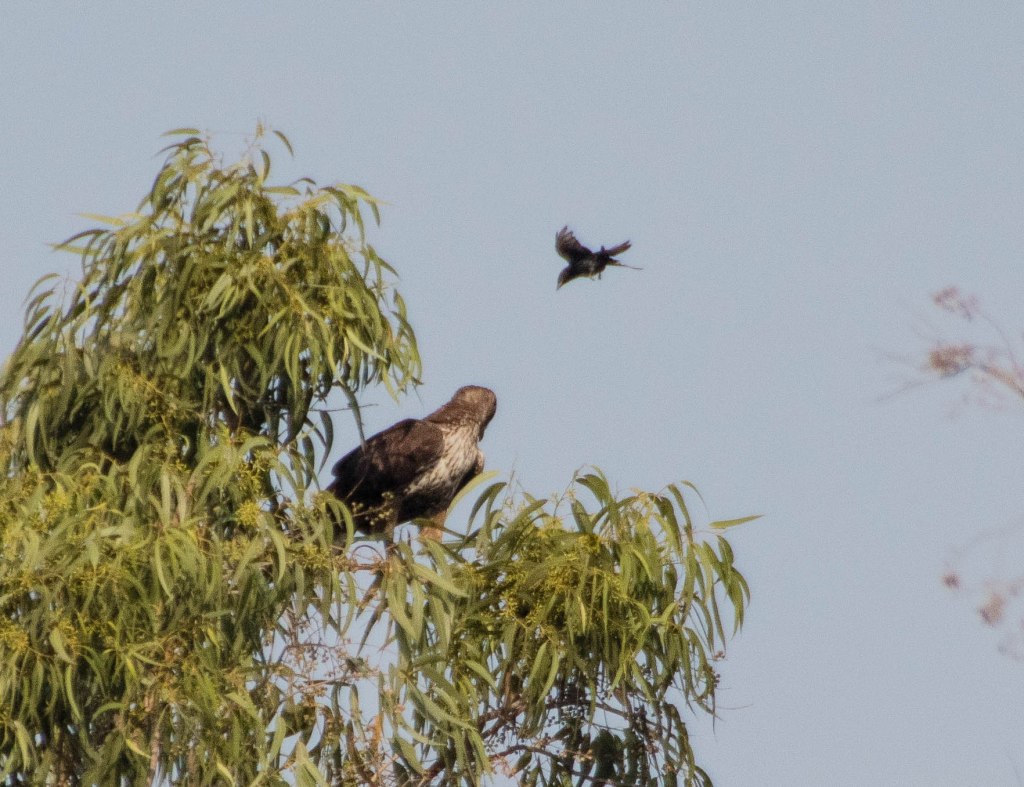
After the Drongo had given up and flown off, the adult flew onto the nest with a branch in its mouth.
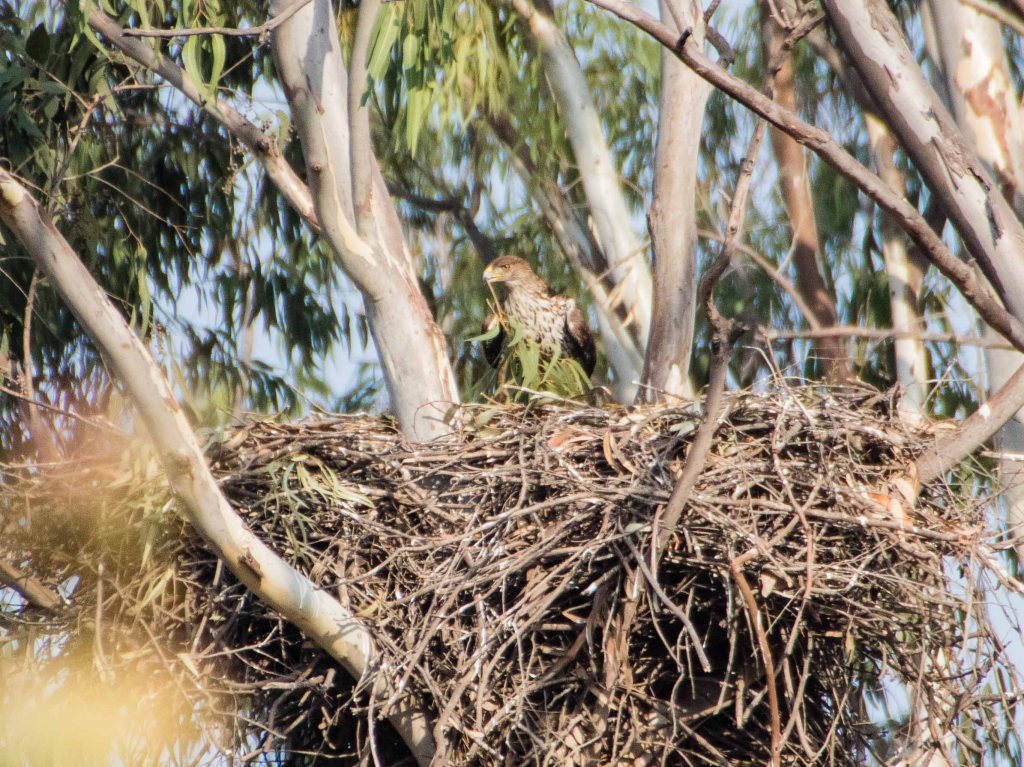
It did not however just drop it and fly off. It looked around, took a few steps and placed it after choosing the “right” spot.
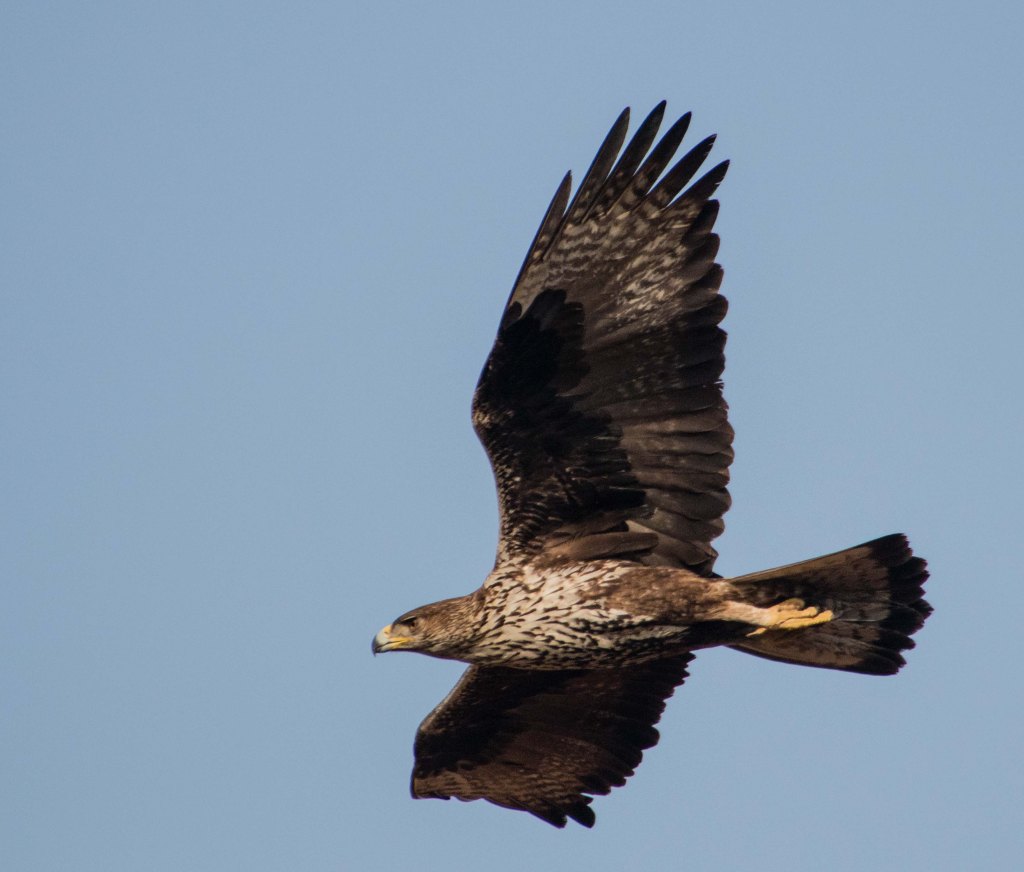
After placing the branch, it flew off the nest from the front (the side facing me) and came right over my head. I got what would be my closest view, from my many visits. May be it was even checking me out. But what a magnificent bird 😮 !
I left the area by around 9:30am as I had a personal commitment.
Week 6 (8th Mar)
Today was going to be my first “full length” session at the nest. So it was exciting not knowing what new to expect. Well, time would tell. And what a day it turned out to be!
Both the chicks were visible when I reached the nest area. I think both were enjoying soaking in the early morning sunlight.
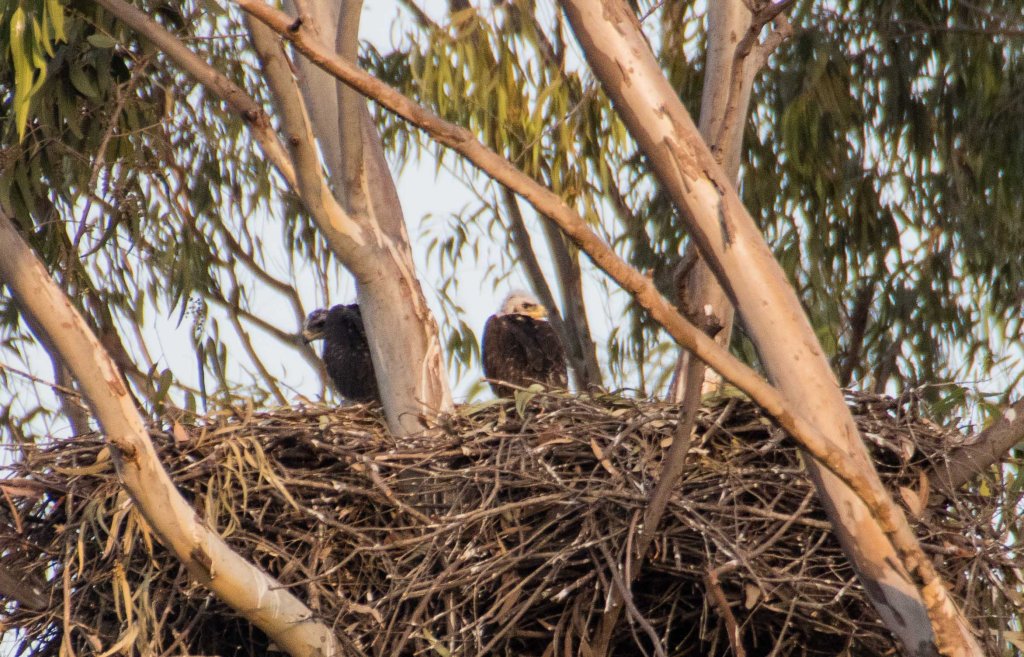
Though I could not see the adults on the usual tree tops to the west of the nest, I saw a Red-wattled Lapwing “screaming” and flying towards some trees a bit behind. It kept screaming for a while and finally flew back to where it had come from. I could guess that it was in that area of the tree cover where the adults were perched. In almost all of my visits going forward, this turned out to be routine of the Lapwing. It was actually an easy way to locate where the adults were perched when we came in the morning. It was also as if the Lapwing(s) wanted to remind the Eagles every morning, that they (Eagles) were being watched 😛 .
The first time I got to see the adults this morning, was when they took to the sky to chase away a crow. Once done, one of the adults flew off to the east side and the other one settled on a nearby tree top. A bit later, the other adult came flying in. This time the perched adult took off and both flew towards the area behind the nest. At around 8:30am, I saw them both take to the sky and kept circling together over and around the nest area for a while. This too, I would learn from my visits, was a regular ritual (may be a way to re-establish their bond?). It would always happen between 8:00 to 8:30am. May be the timing was determined by the heat, sunlight etc. Finally they flew off together to the west of the nest.
As the morning progressed, the sun started to shine brighter and stronger. The chicks were seen moving around the nest at times, I think, trying to get out of the sun. There were also seen preening themselves for a good amount of time.
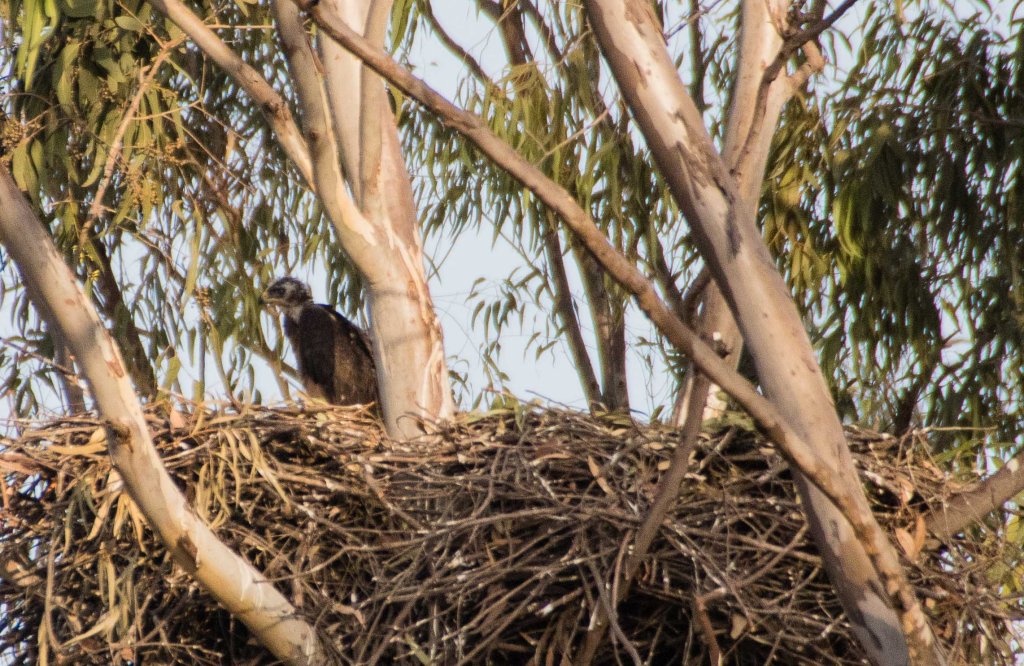
The chicks had certainly grown larger. Their wings and back was almost entirely dark now. Their head was also starting to get dark patches. Their underparts had a lot more rufous than the previous week. They were starting to show the “colour combination” of a juvenile Bonelli’s Eagle.
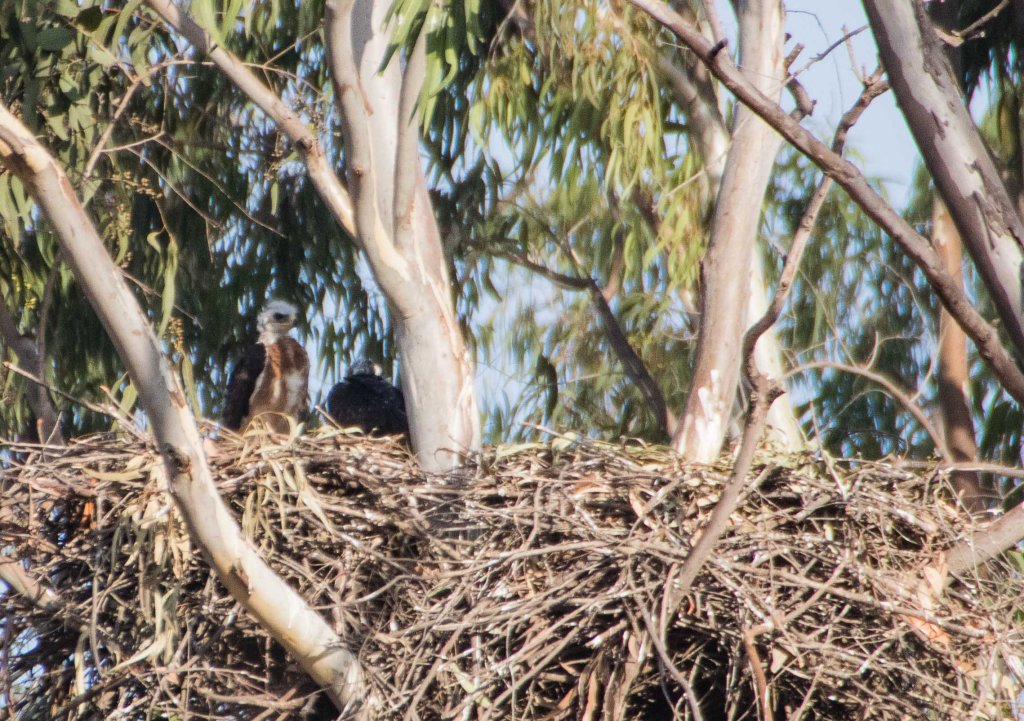
At around 10am, suddenly, I heard a lot of calling. The chicks turned alert and I saw one of the adults flying across behind the nest and land on the nest on the east side of the nest. It had come in with a kill. It left the kill in the centre of the nest, walked to the east edge, waited for a while observing the chicks and then flew off.
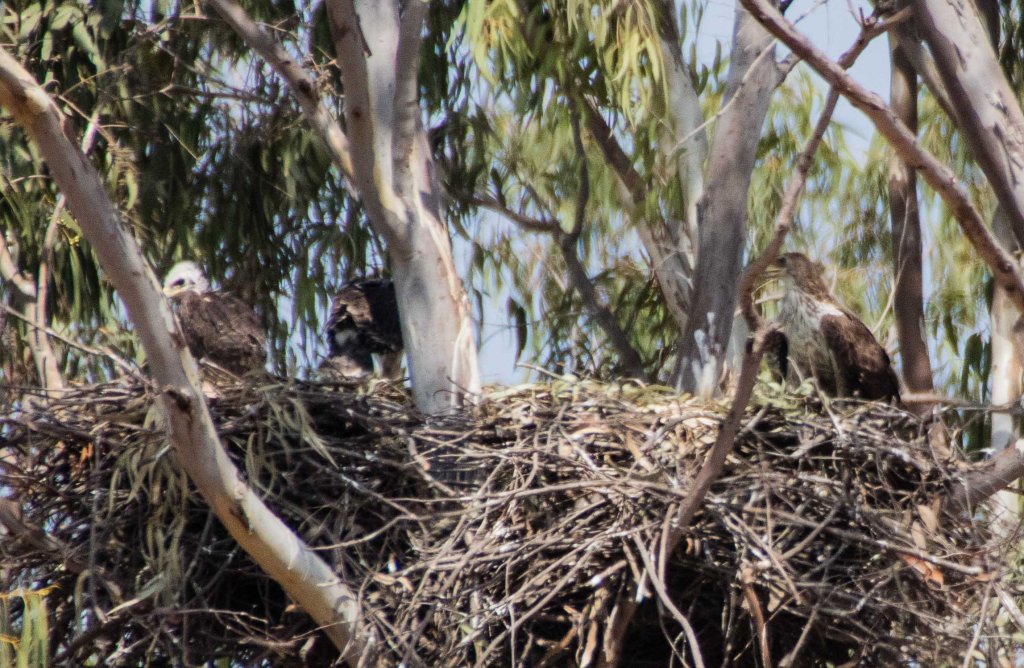
Not much later the adult landed on the eastern edge of the nest again, this time with a fresh tree branch in its beak. It placed it where it had landed. It just stood there for a while looking at the chicks. It seemed that it had come to check on the chicks and how they were eating the kill. Then it flew off again.
Only one chick was seen attempting to eat the kill at the start.
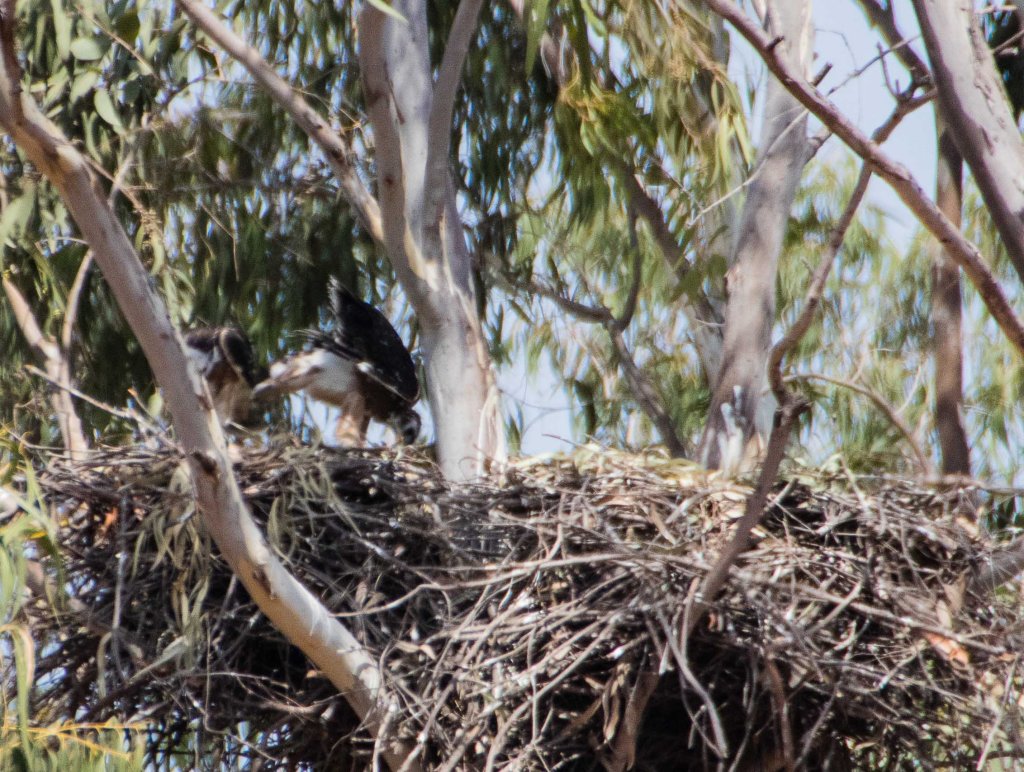
The chick that was attempting to eat the kill, kept trying to, what seemed to me, tear it. In doing so, it kept shifting its position as well. This allowed me to get the first glimpses of the full size of the chick as well as its wings opened out. They surely were growing fast 😮 !
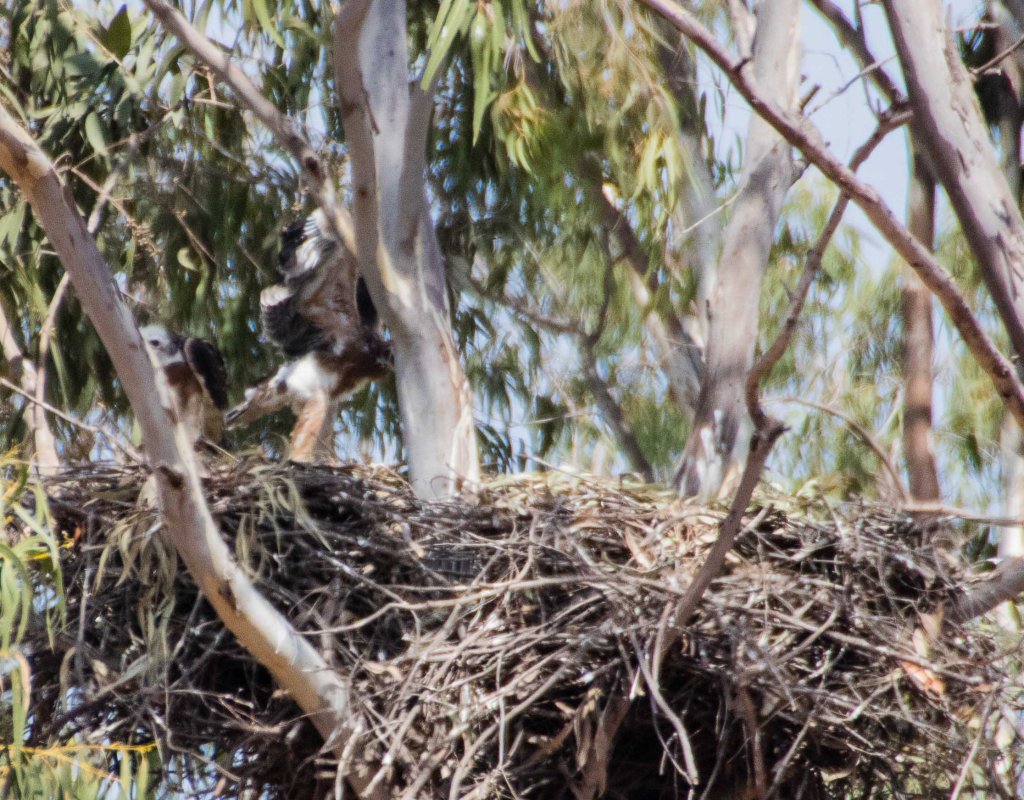
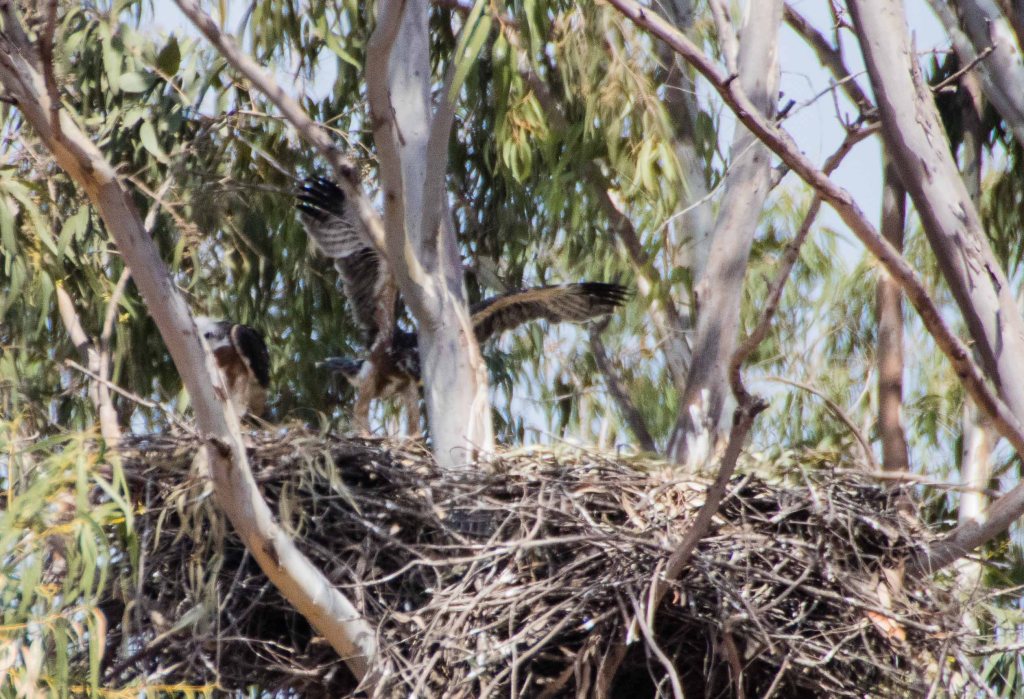
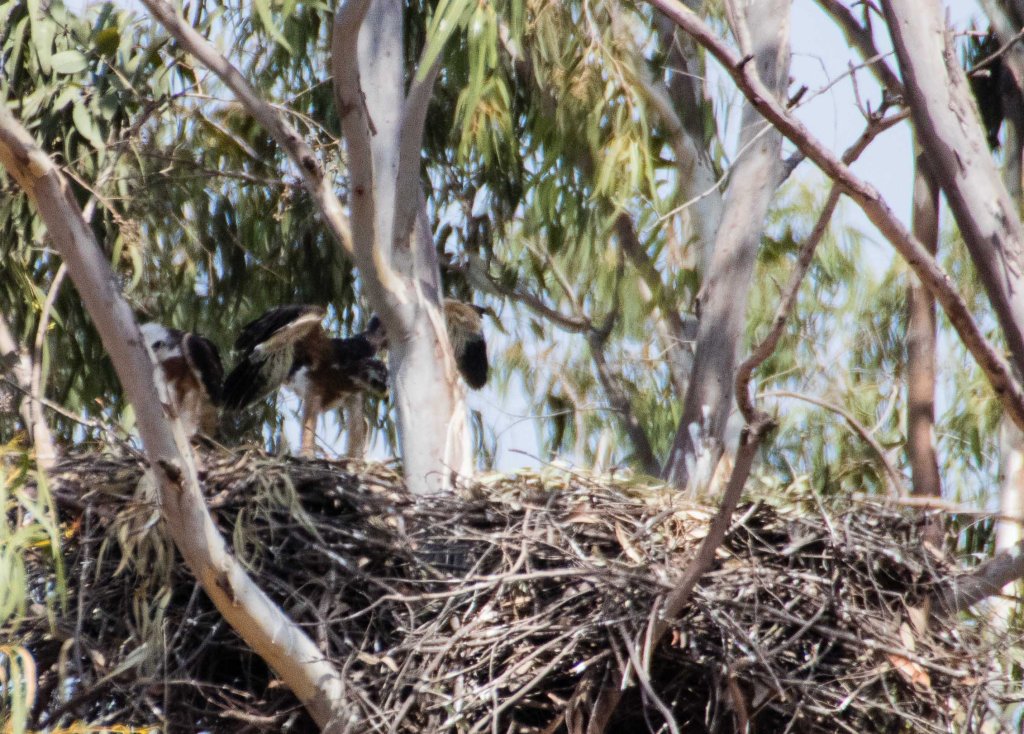
Strangely the other chick did not attempt to eat the kill at all. It just stood at the western edge of the nest looking out.
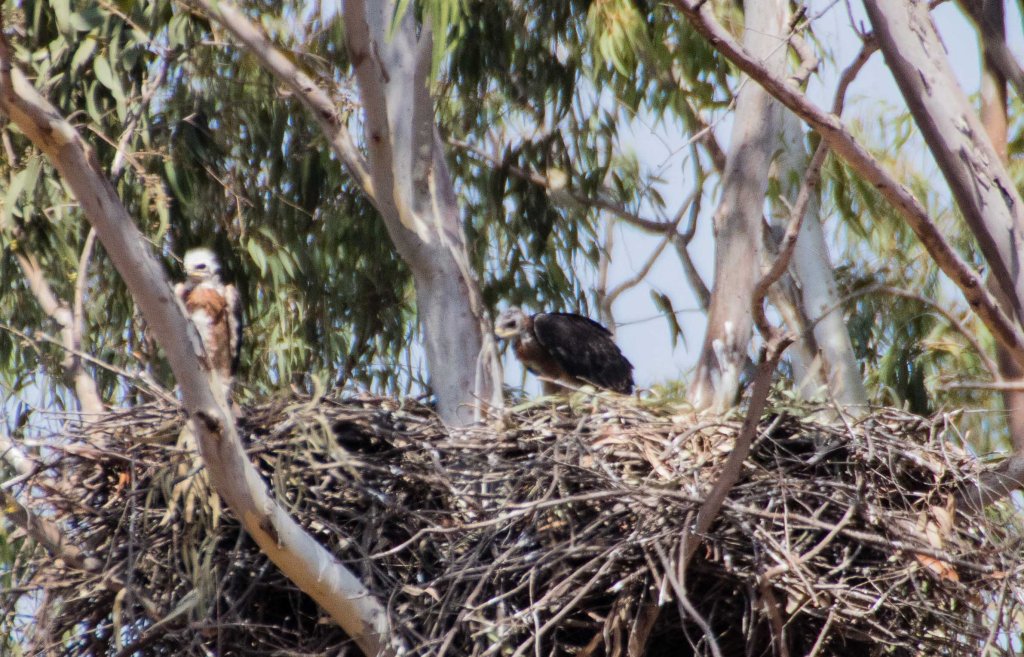
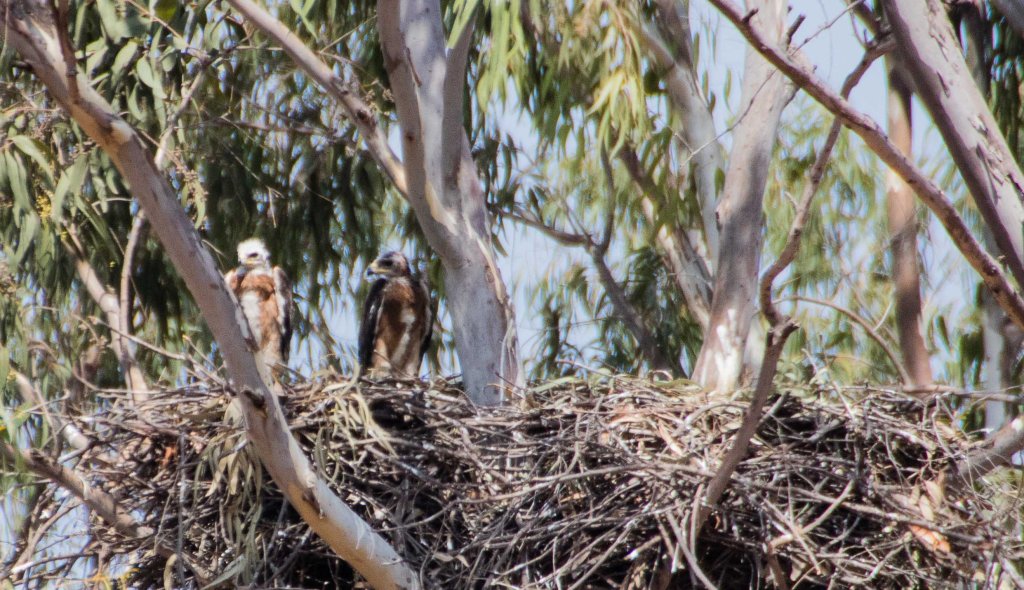
I suspect I was witnessing the case of one of the chicks being more dominant than its sibling. It also seemed slightly bigger and with a more “changed” plumage. Maybe it had hatched earlier.
Once the “dominant” chick had stopped tearing the kill, the other chick then moved to the centre of the nest. Then both of them were seen tearing at the kill. The adult came to the nest again. After a while, it moved to the centre of the nest, tore the prey and helped the chicks to eat.
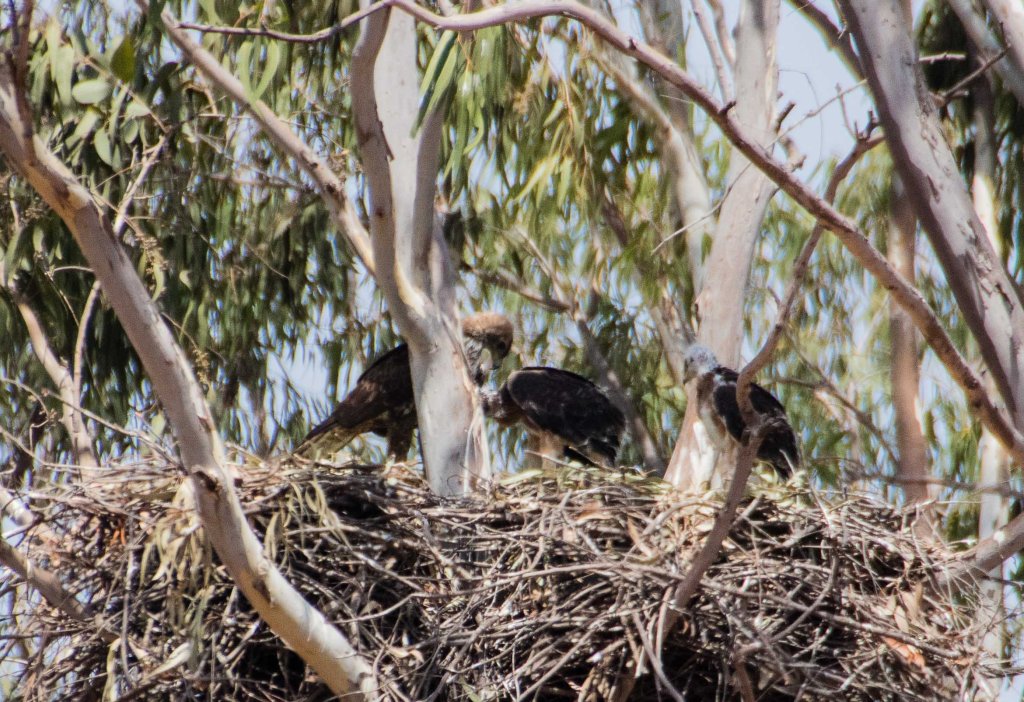
Once the chicks had eaten, it then proceeded to eat what was left of the kill. It then flew off towards the area behind the nest.
Alone in the nest, the chicks were seen doing a few flaps of the wings; maybe strengthening them or trying to cool themselves from the strong sun.
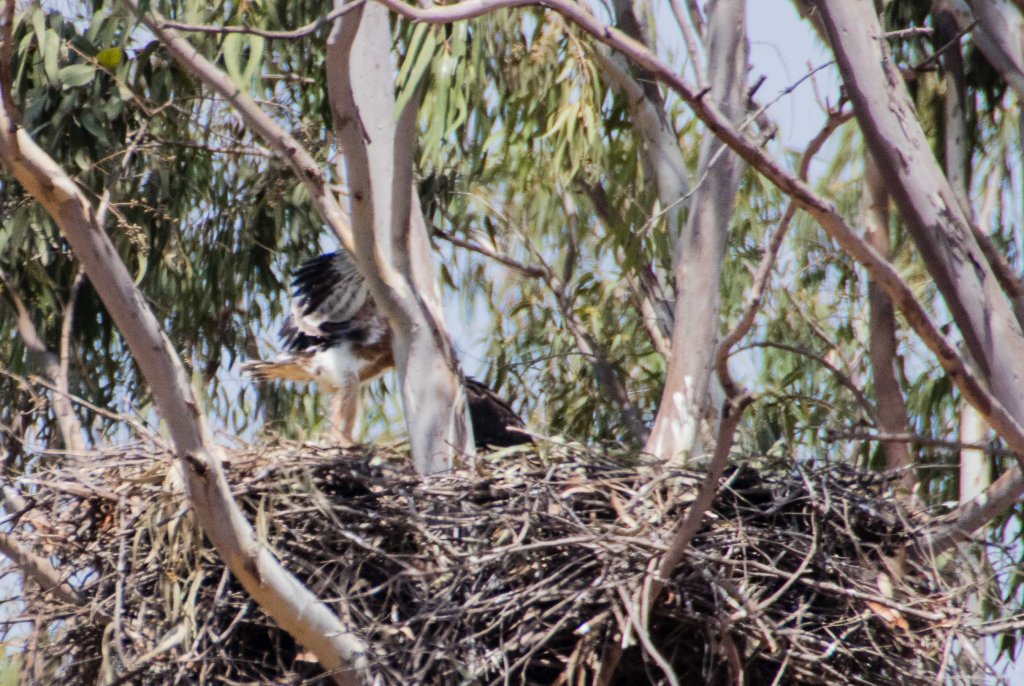
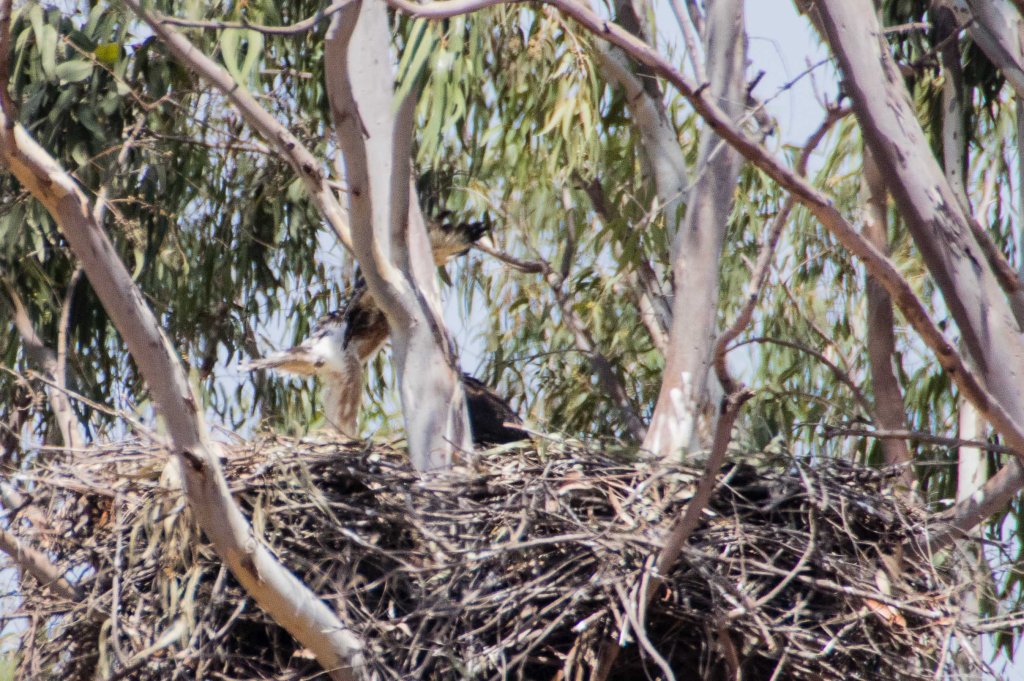
The adult reappeared soon after. It stayed at the eastern edge of the nest. This time both the chicks moved towards the adult. I noticed the adult picking up and moving, what looked like a large bone with some remaining flesh hanging on it. I wondered what it was. The birds were then seen eating from it for a brief bit.
It was almost noon and with the sun almost directly overhead, it was getting really hot. I myself was starting to run out of shade where I was sitting. The chicks were clearly in discomfort with the direct sun falling on most of the nest. So with the adult nearby, they were clearly complaining of it. The adult behaved like any caring parent; it tried to comfort its offsprings. It used it’s own body and wing to shade the chicks from the sun. I saw the chicks taking turns to get under the adult completely. It was cute to see just the head of chick peeping out from between the towering legs of the adult. The adult also made sure that both the chicks got their share of “the shade”. I am sure it was not an easy task for the parent to stay in the sun and do what it was doing. Here are some pictures I captured:
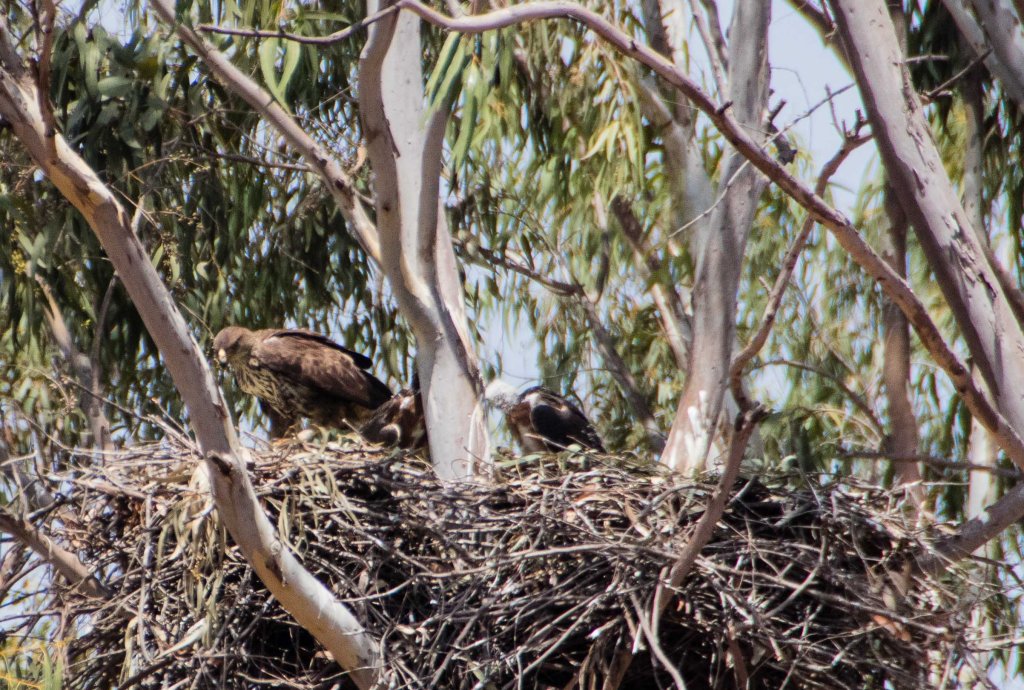
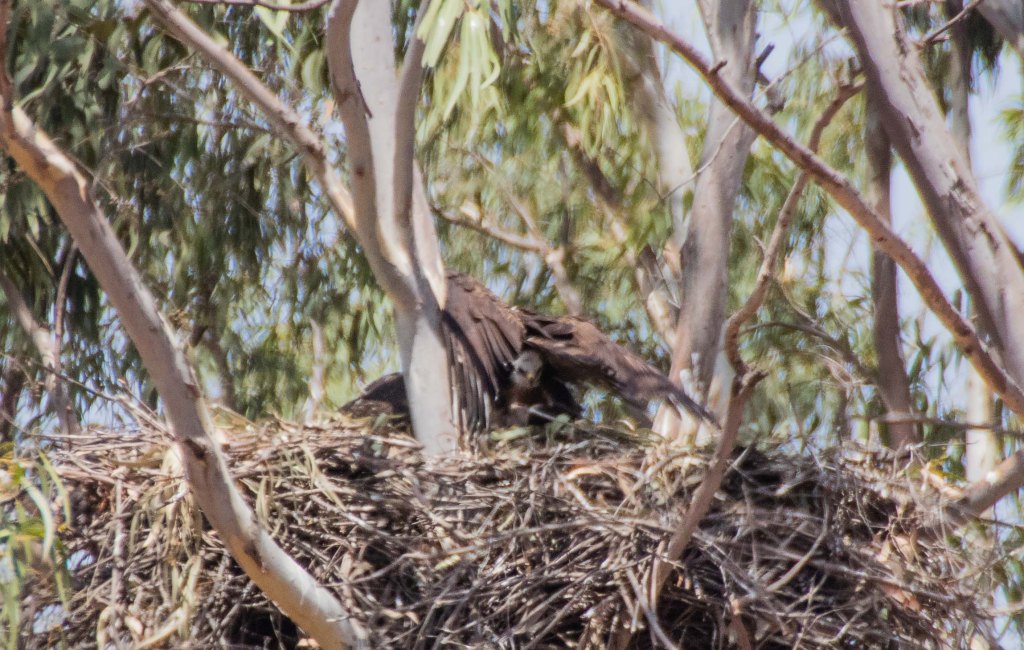
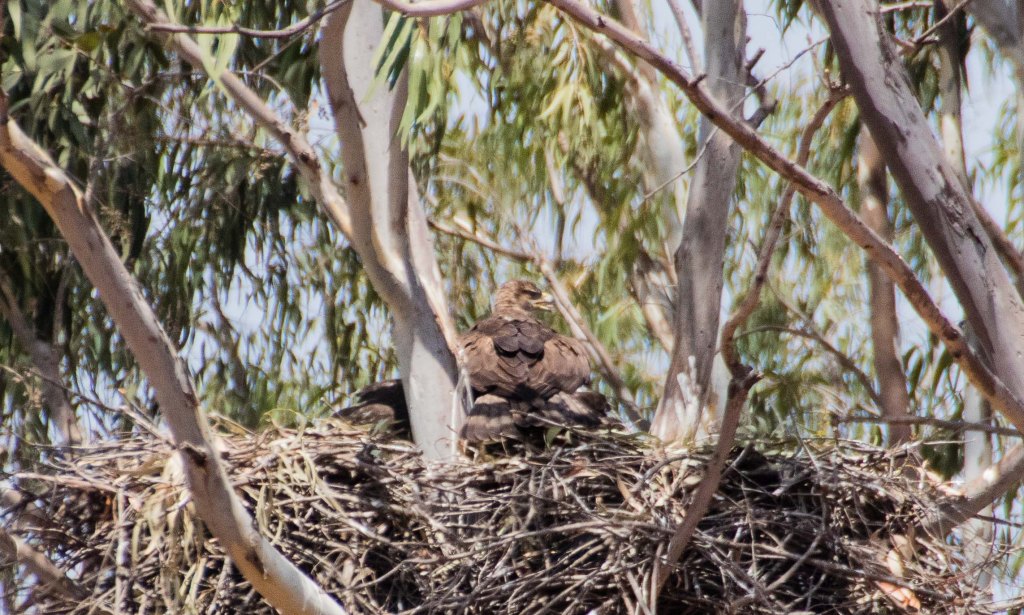
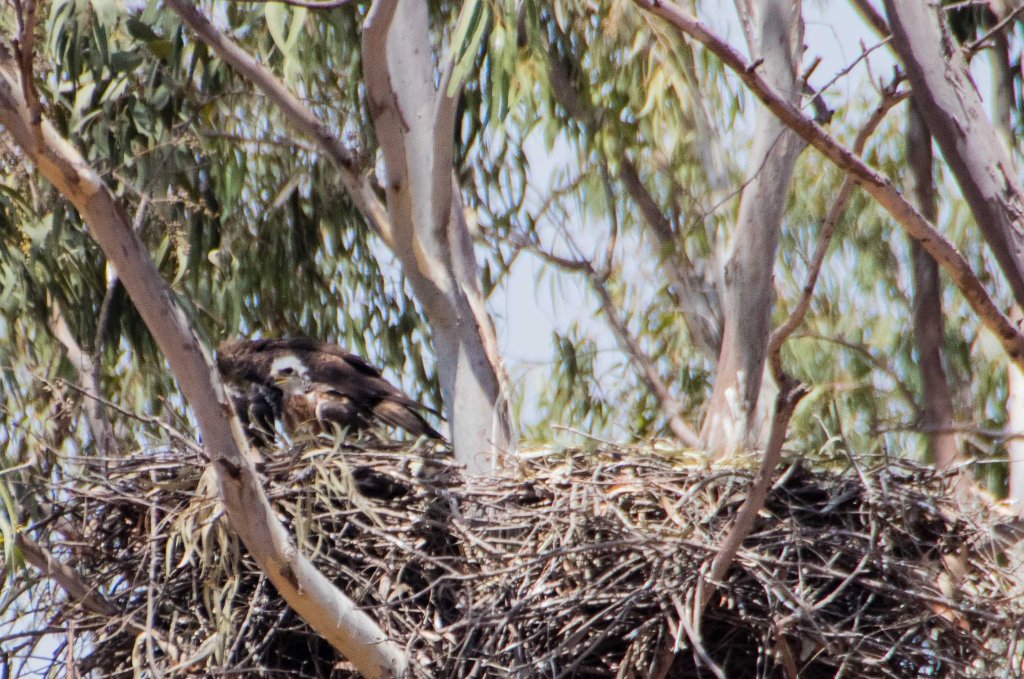
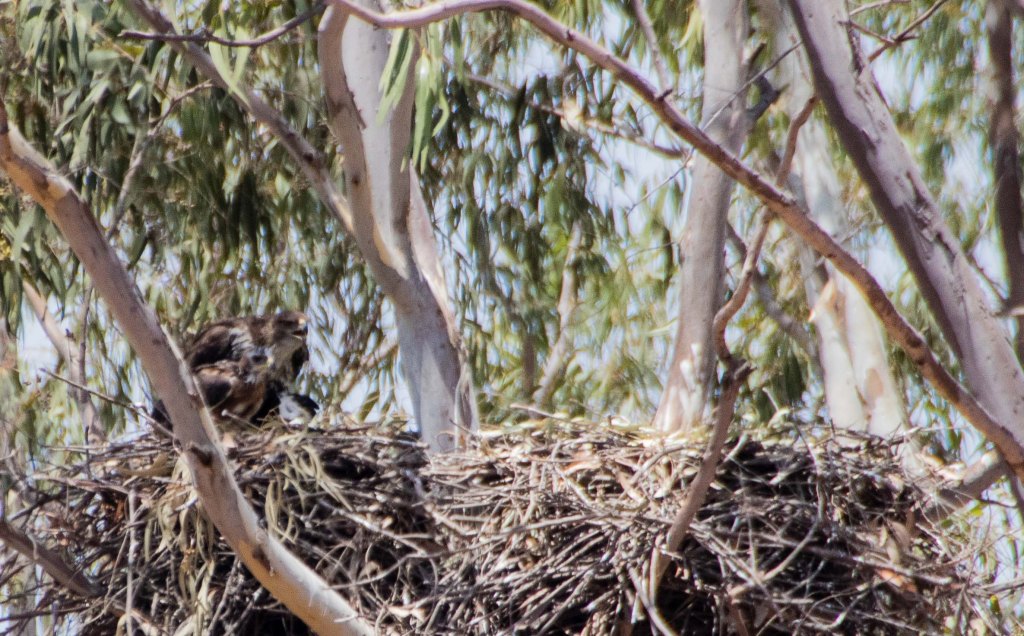
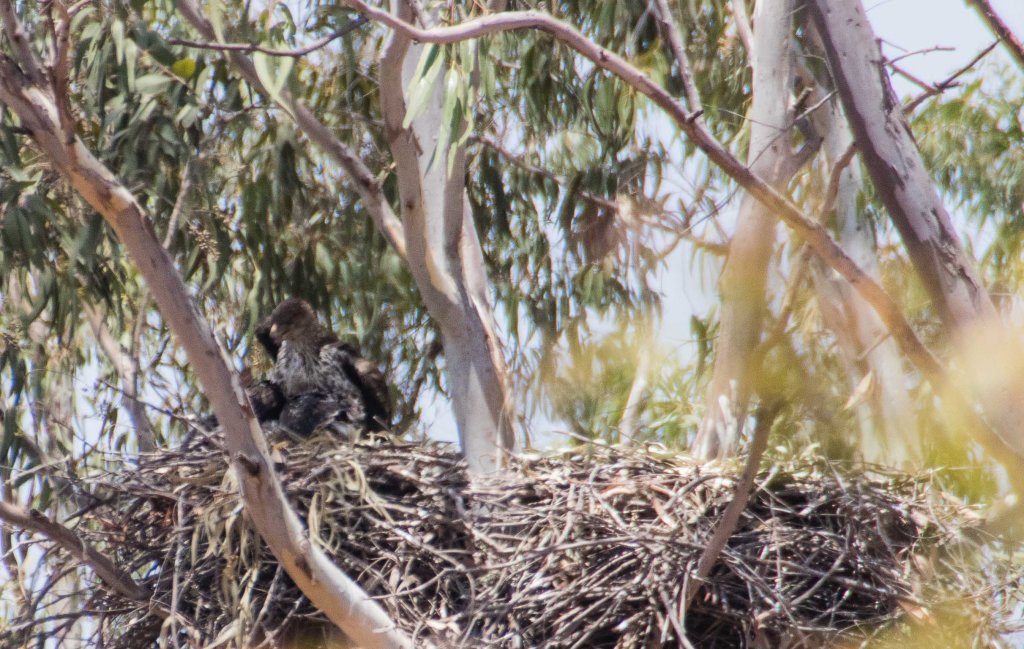
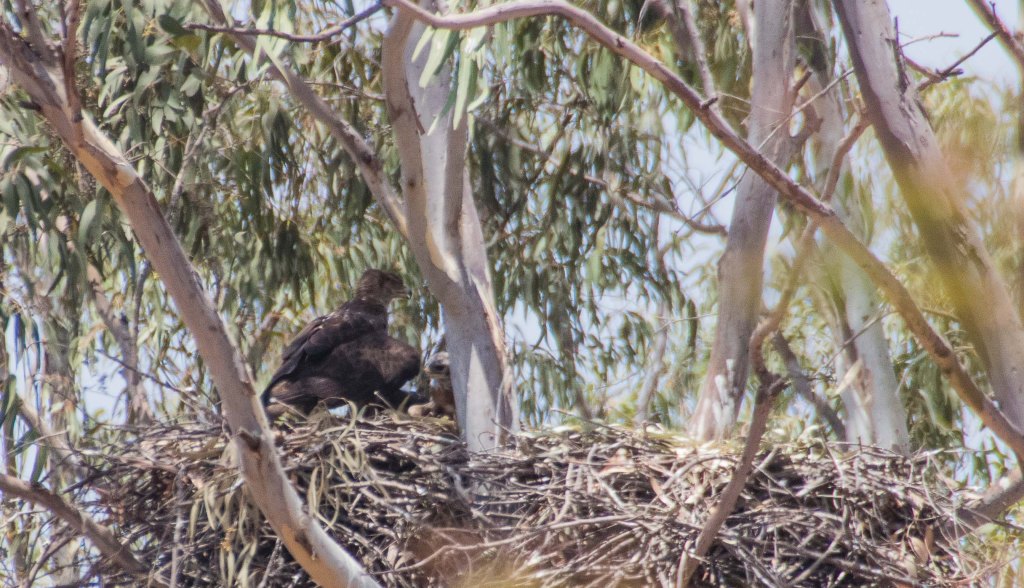
Around 12:15pm, the second adult (male) also came in and perched on the nest, at the eastern edge. There was a lot of calling from the chicks (maybe a bonding ritual?). This was to be, the only time that I got to see the entire family together in the nest. Family picture anyone 😛 ?
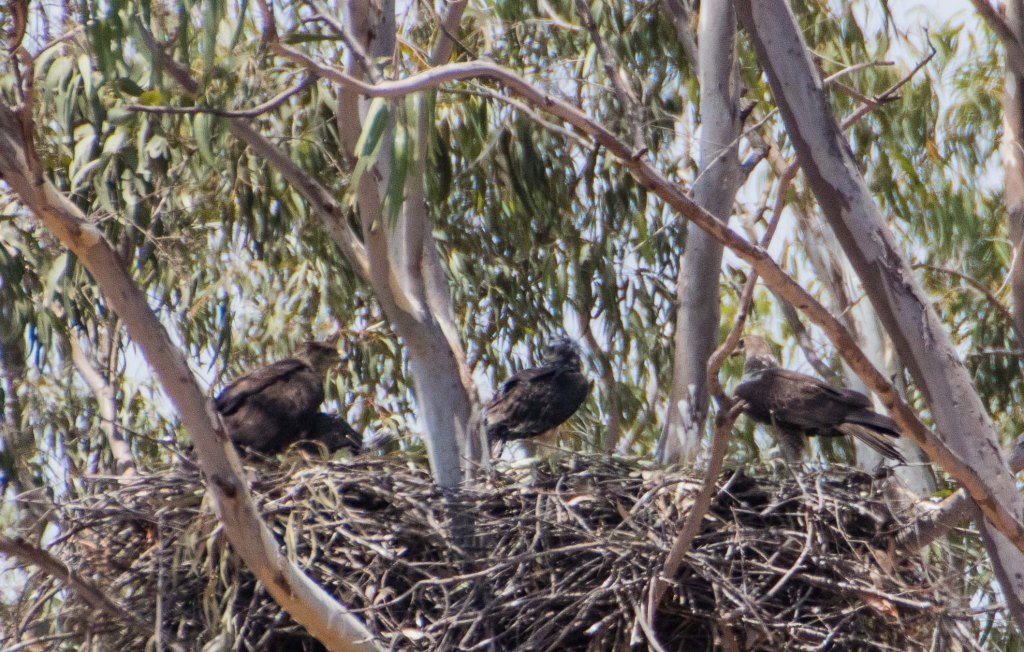
The male did not, however, move closer to the chicks. In around half a minute, it flew off. Not too much later, the adult female also flew off and sat on another tree to the west of the nest, in the shade.
Based on the few times that I had seen the adults come in onto the nest in the day, I derived that they always flew in onto the nest from the east side. They also almost never flew off the nest from the west side of edge of the nest. The other directions though, had been used. This pattern was further confirmed from my observations in the subsequent weeks.
I left the area by 12:45pm, given the heat.
Week 7 (18th Mar)
I was worried today. Rahul had informed me of reports that he had heard of fires in the area. As I walked to the spot, I could see the area around me had burn marks. I wished with all my heart, that no harm had come to the chicks and the nest.
It was indeed a big relief to see them both perched on the eastern edge of the nest. Thankfully, the area near the nest, had not been affected at all. And man, they had grown since I last saw them. Their plumage had almost reached that of juveniles.

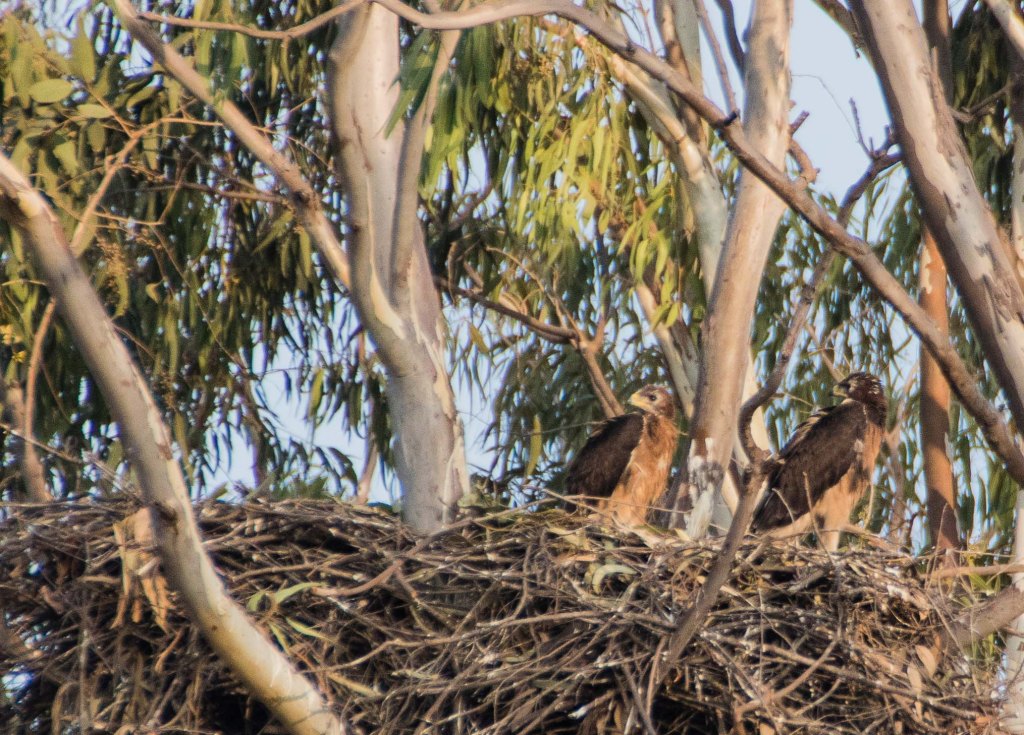
As usual, the adults took to the sky at around 8:05am. This time, however, they circled over the nest only a couple of times and then flew off to the area behind the nest.
The activity at the nest was fairly “light” till around 10am. The chicks kept periodically moving around the nest as well as were seen preening themselves. They were also seen sitting in sections of shade in the nest, at many times; I guess when it got too hot for them when in the sun.
There were some instances where there was deliberate practice of using their wings by the chicks.
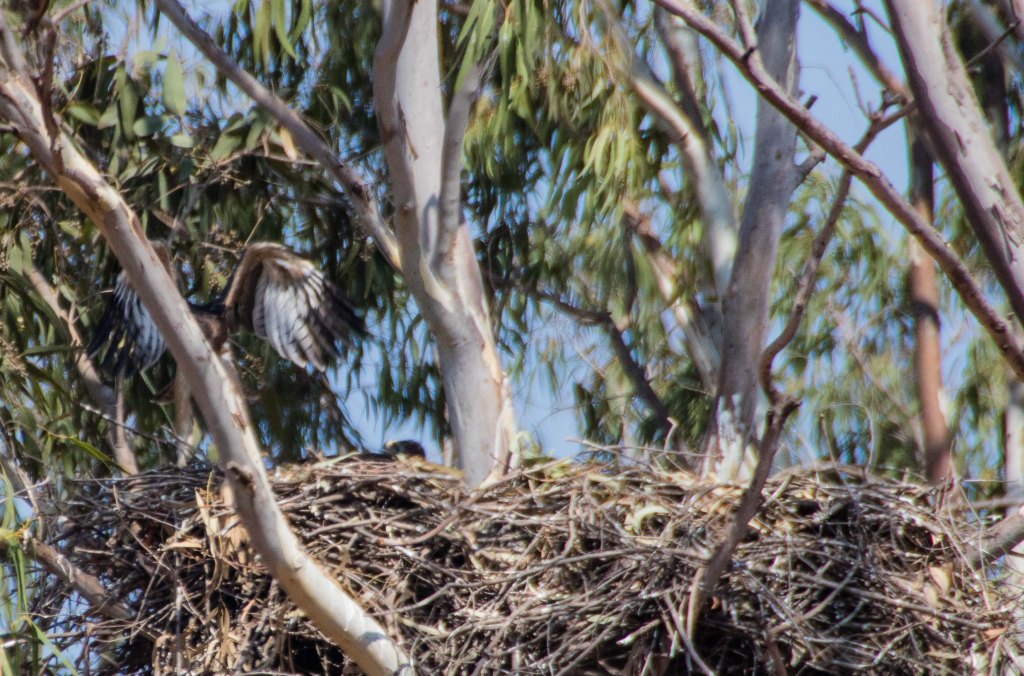
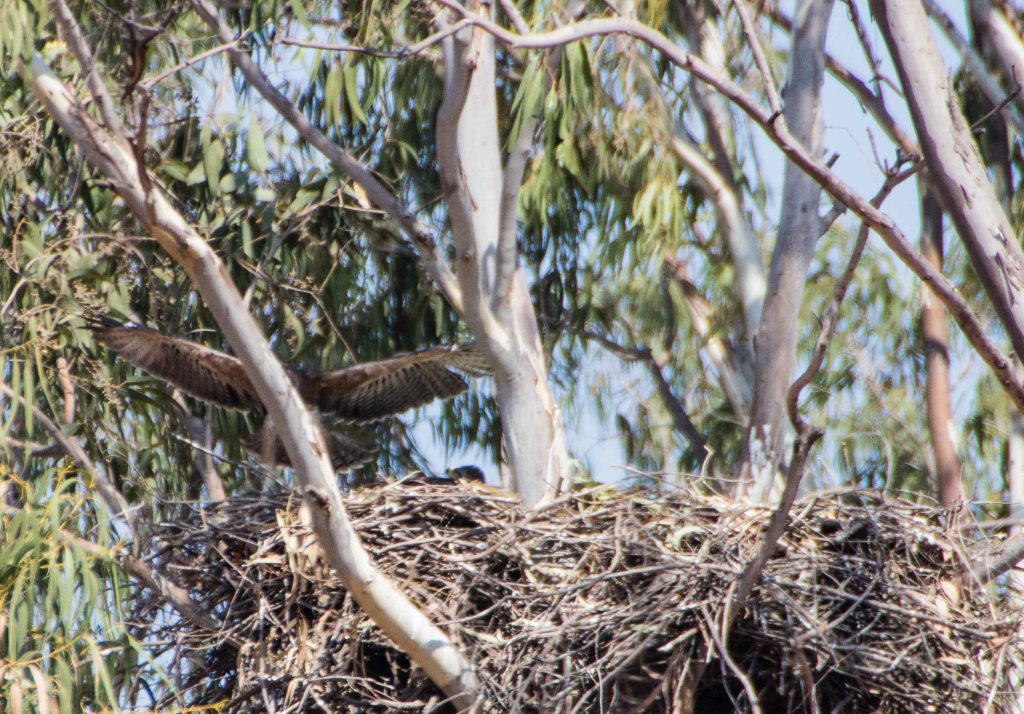
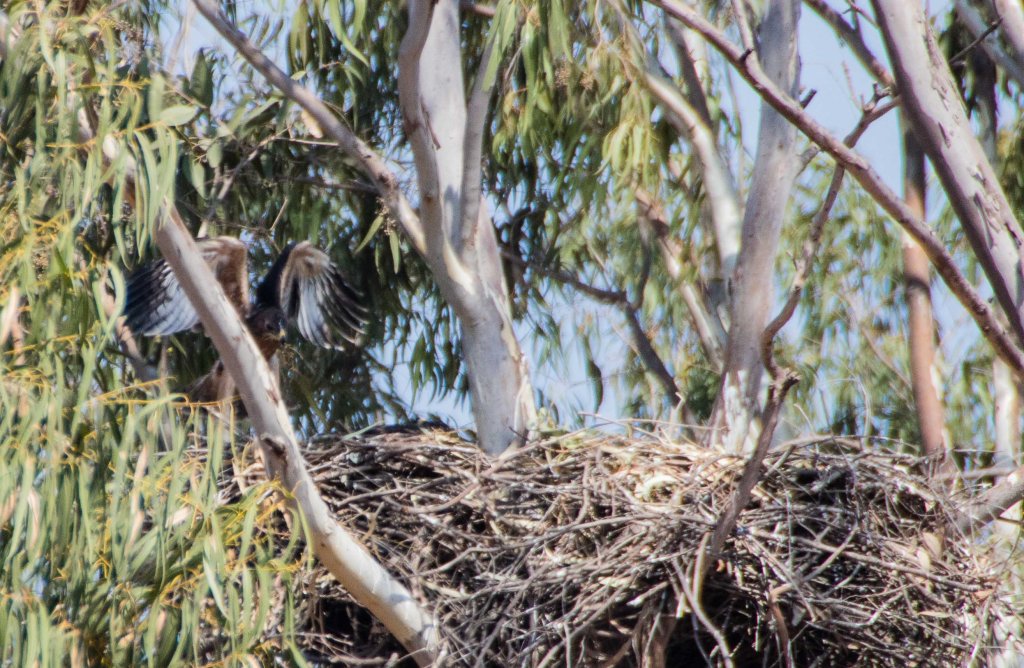
Similar to what I saw in my last visit, an adult came with a kill at around 10am (10:10am to be precise 🙂 ). It was interesting to observe the behaviour. The clues of a parent being nearby, were a few calls from one of the chicks. The chicks also positioned themselves nearer to the western part of the nest. They, however, stood facing the eastern side; the usual point of entry of the adults. This also confirmed my inference from last week. The chicks were more alert and kept moving their ahead looking above as well as other directions of the nest. But it was clear when the adult was about to come in. The calls became louder and their posture became more alert of the impending “landing”.
The kill looked to be a “pigeon-sized” bird. Both the chicks “ran” to the adult to get at the kill. While the non-dominant chick was the first to reach it, the dominant chick “bullied” it to get the kill. The non-dominant chick moved away and walked all the way to the western edge of the nest. The dominant chick then started to try and eat the kill. The non-dominant chick, however, continued to sit on the western edge of the nest.
There was a bit of unease in the environment though. I heard calls a couple of times. The adult in the nest also kept looking up several times. It then flew off the nest. The chicks were also periodically looking up. The calls also increased. Then I noticed it; there were four Black Kites circling above the nest. The adult that had earlier come to deliver the kill, almost immediately appeared to chase the Kites. As it actively chased one of them, there were again couple of calls heard. This time the other parent flew in to provide “air cover”. It then proceeded to sit on top of a nearby tree, keeping a close watch. What a pair!
The dominant chick continued to tear and trying to eat the kill. I was, however, not sure how successful it was.

I saw the adult fly onto the nest a bit later. This time from the front on the nest. I suspect it was the male given it size. It flew off in a short bit. I also noticed the other parent on a tree branch nearby. A short while later, an adult (female I think given its size) came onto the nest from the eastern edge, with a fresh branch of leaves. It walked and placed it on the western side of the nest, waited for a bit and then flew off.
An adult made a visit to the nest, I think with a kill and flew off. The good news was that the parents were adept in hunting and finding food. Also the fire does not seem to have affected them, atleast from the happenings at the nest. It is however unknown as to which area they generally hunt in and if that area had been impacted by the fires.
The adult female flew onto the nest some time later. This time the dominant chick feeding, left the kill and moved to the right edge. The other chick moved to the middle near the adult. The adult was seen tearing the kill and feeding this chick.
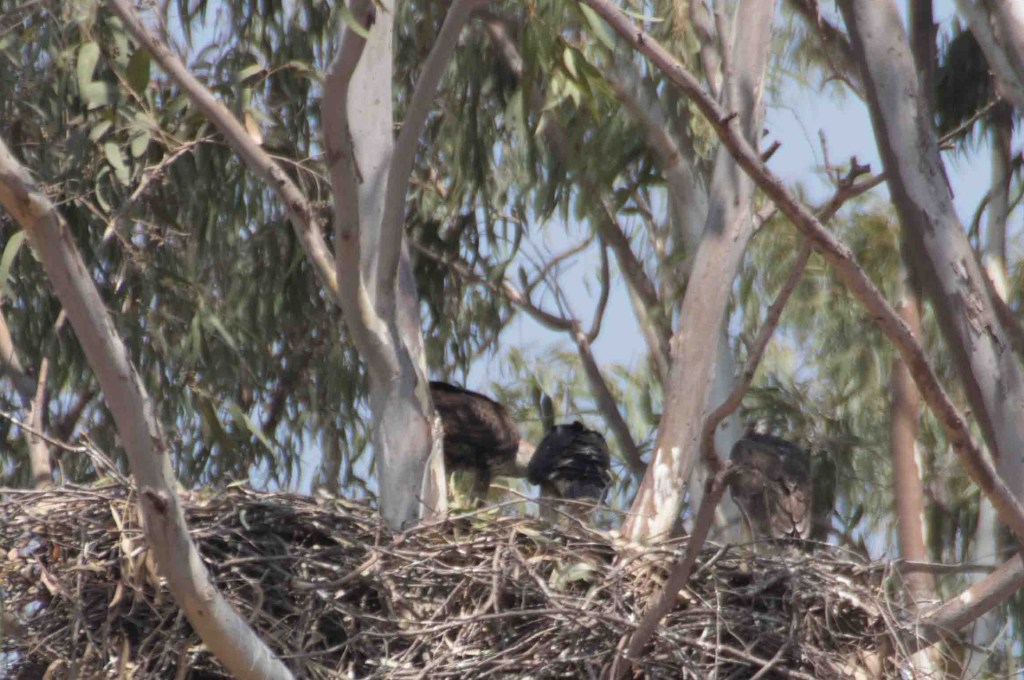
Around 10 minutes later, once this chick moved off, the other chick came towards to the centre and the parent was seen feeding it.
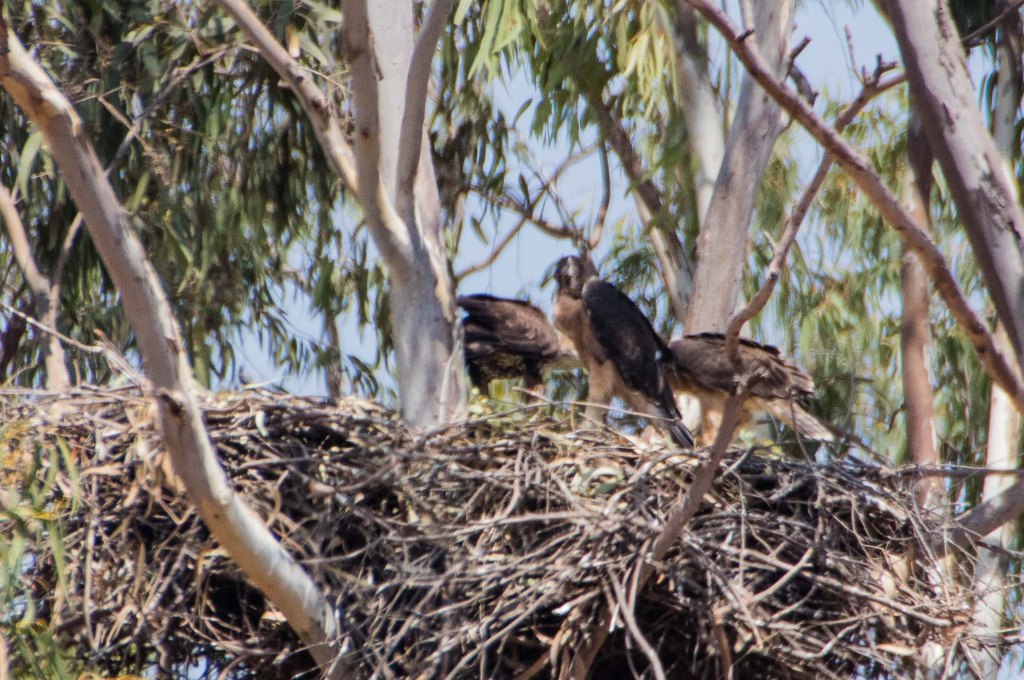
It was amazing to watch this parenting behavior. The adult was clearly aware and making sure that both chick got their share. When one chick was being fed, the other one would stay to one edge of the nest waiting patiently. Presumably this was how they were able to rear both the chicks well. Both chick were of almost same overall size.
Once both the chicks were fed, the adult proceed to eat for itself.
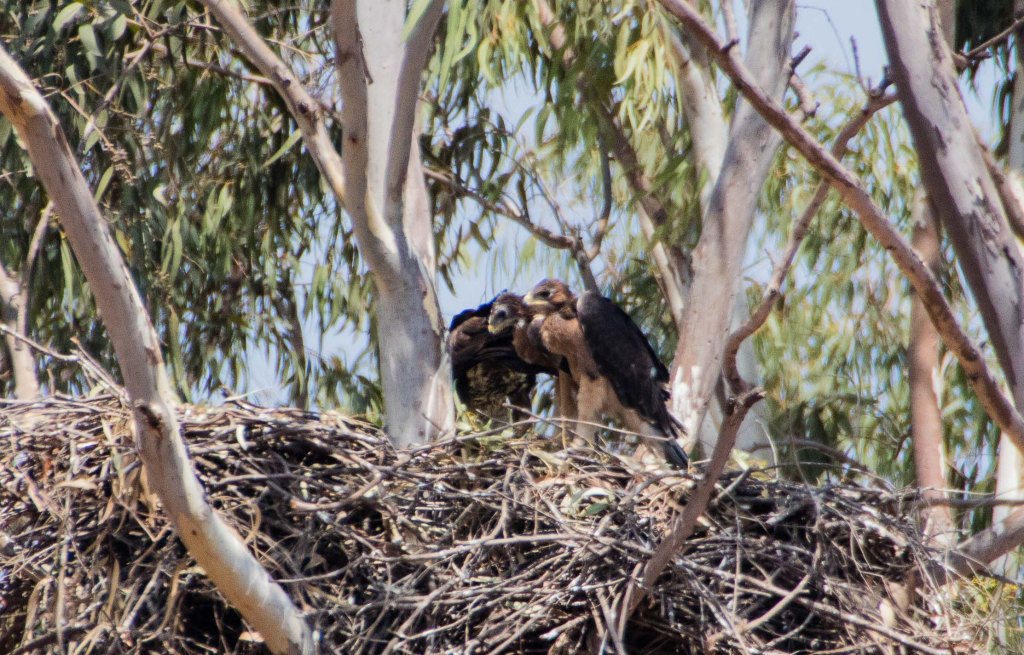
By around 11:15am the sun was pretty strong. The adult continued to stay in the nest with the chicks. But unlike what I saw last week, it did not attempt to provide shade to them using its wings; possibly owing to them having grown in size.
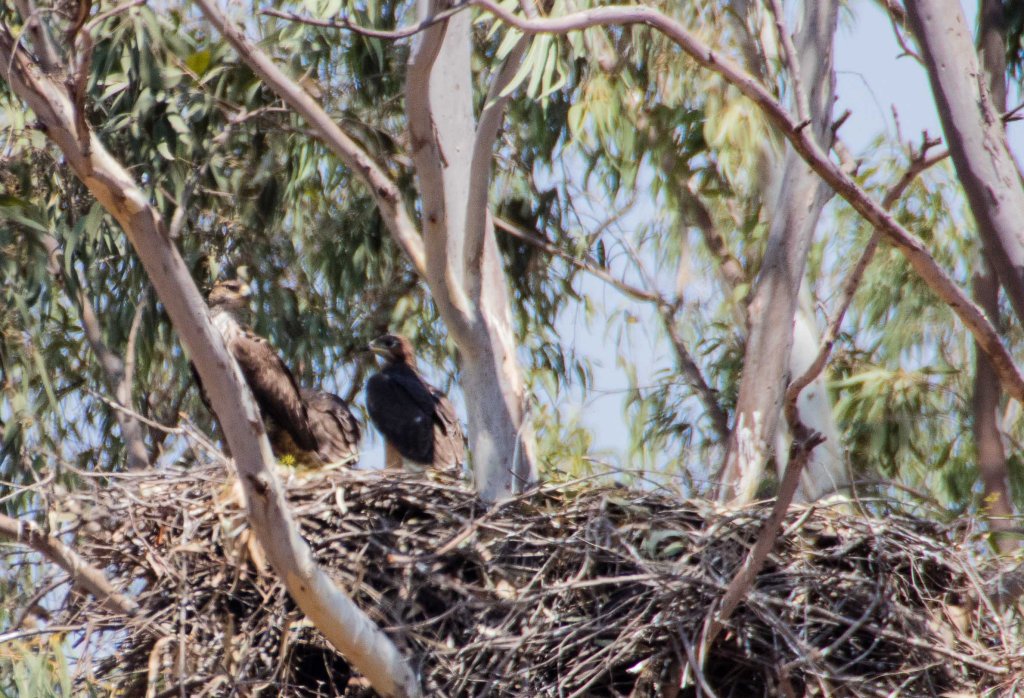
One chick however did try to sneak and put his head under the folded wing extension of the adult. At around 11:30am the adult flew to the left and sat on a tree branch (with shade) near by. The chicks were left to manage the heat on their own now.
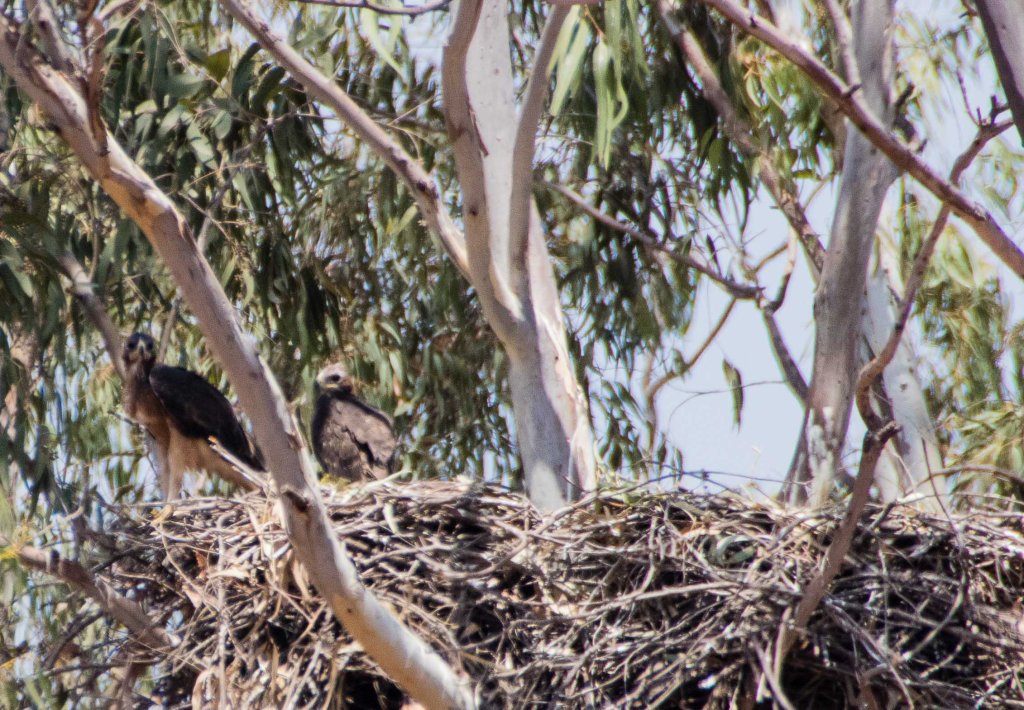
At around 11:40am, I saw the adult take to the sky again and circle over the nest. Given the heat, I also left the nest area at 11:45am.
Week 8 (24th Mar)
I was visiting along with Rahul this time. We reached the nest area at 7:15am. We saw one of the adults fly from the nest area as we neared our observation spot. Once we reached our spot, we noticed that there two people walking very close to the nesting tree, as part of their morning walk  ! This was the first time we had noticed such a presence. The adults had possibly flown off when seeing them approach. They were nowhere to be seen.
There was only one chick in the nest.
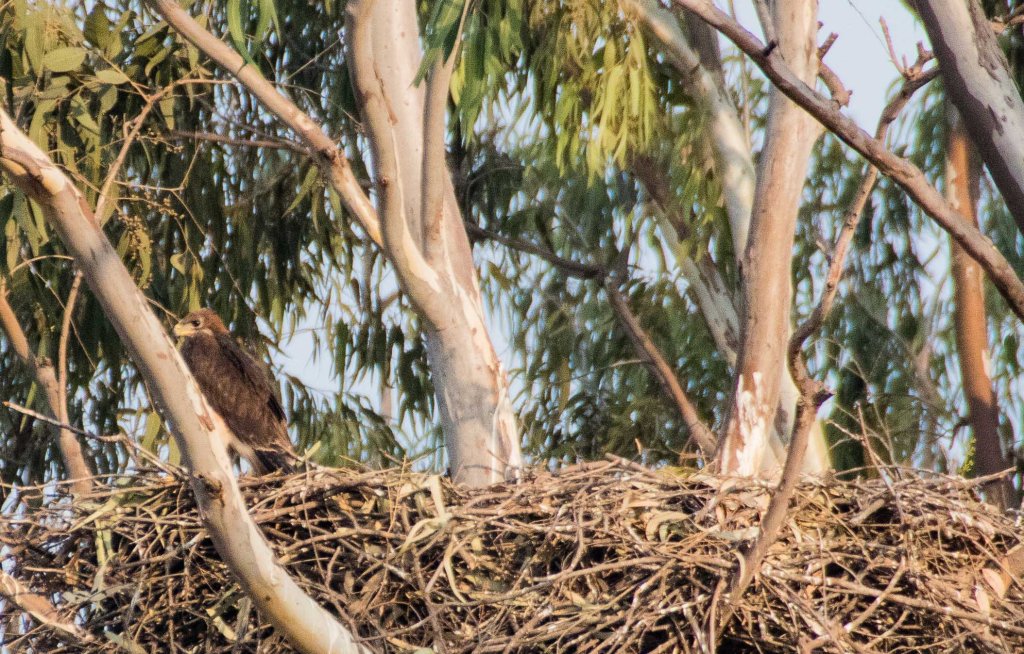
We hoped that the second chick was, maybe, huddled in the nest. But all attempts to see any part of it from various angles, did not yield positive results. What had happened to the other chick? Had it fallen prey to another raptor? Or fallen off the nest and got killed? Had the dominant chick killed its sibling? Damn! Why do negative thoughts always come first? Could it be that the chick had flown off? Hmm… But was it “aged” enough to have done so?
Unlike earlier times, the chick did not go about around the nest or preen. It stood in the left side for some time and then later sat in the left side, barely visible from where we waited. The plumage had also slightly changed. The head was completely rufous in colour.
As we sat at our observation spot, an adult Greater Spotted Eagle (GSE) was seen flying over the nest.
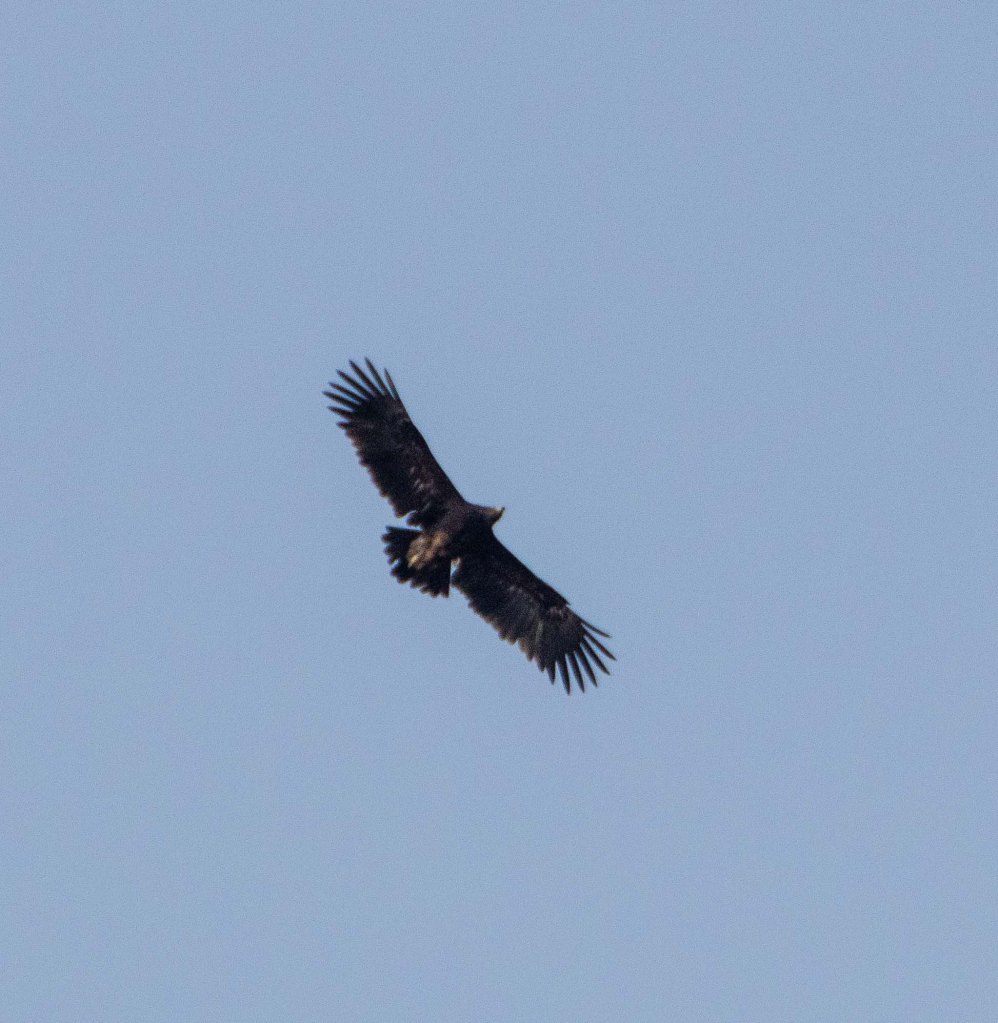
As we observed, one of the parents appeared in scene and attacked it.
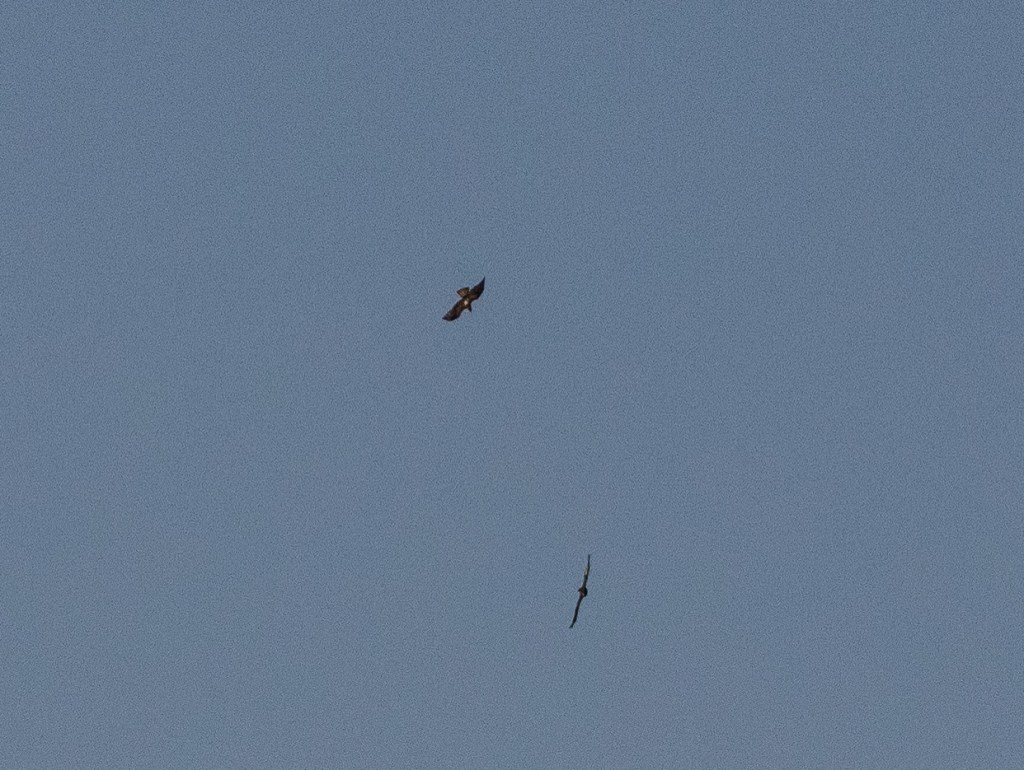
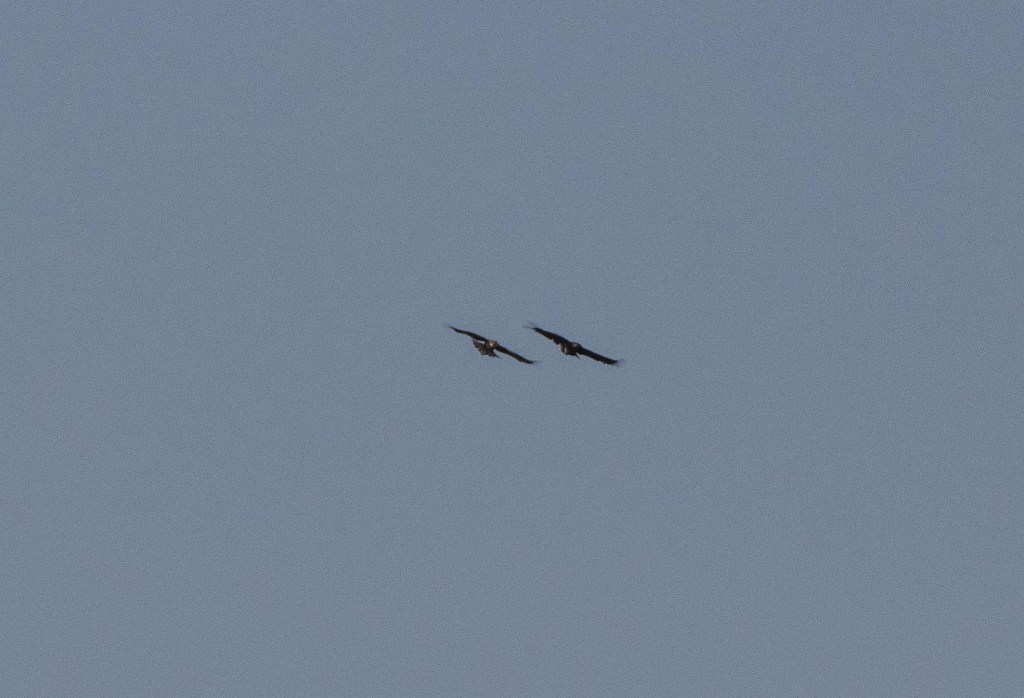
It was soon joined by the other adult. Aggressive lunges were made atleast twice at the GSE.
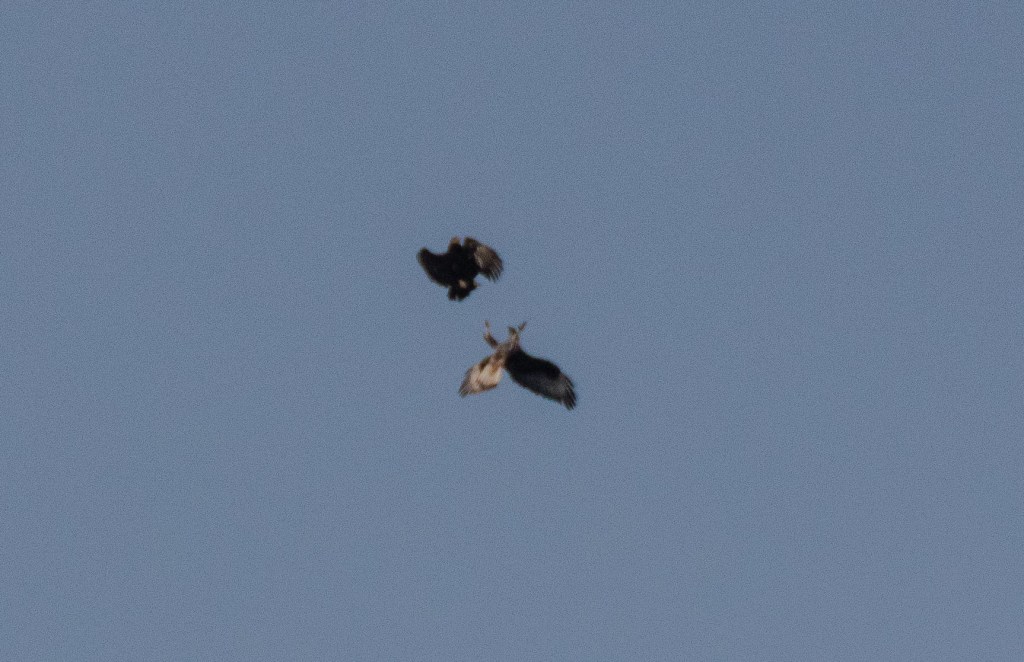
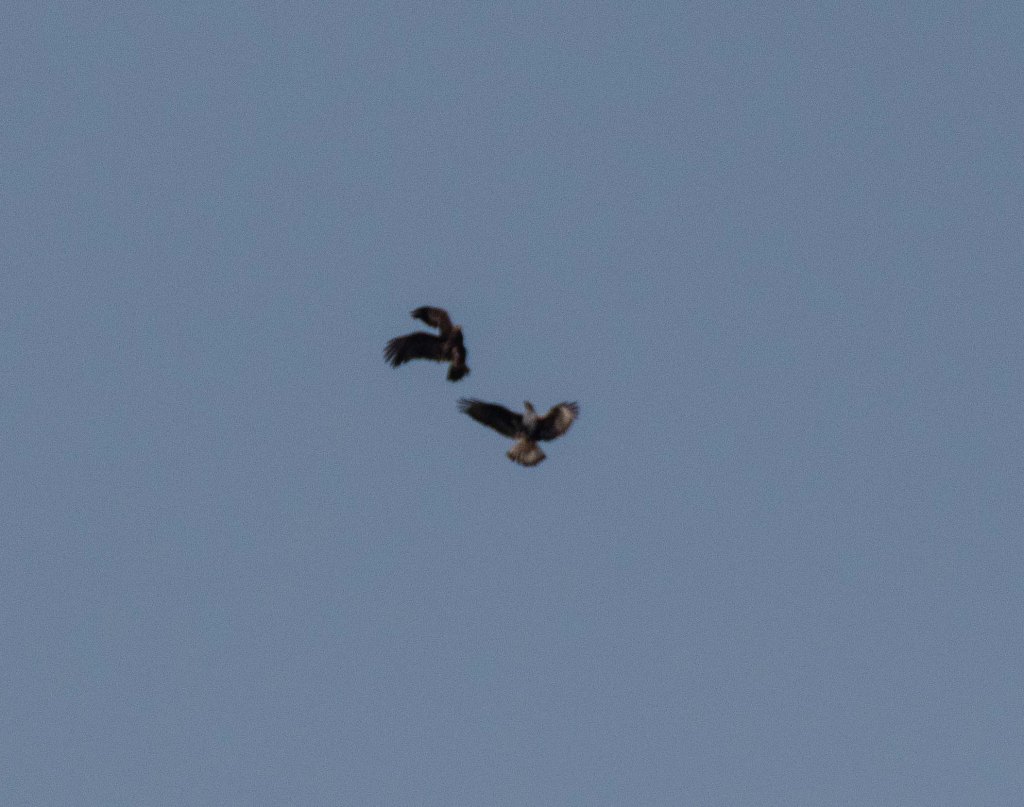
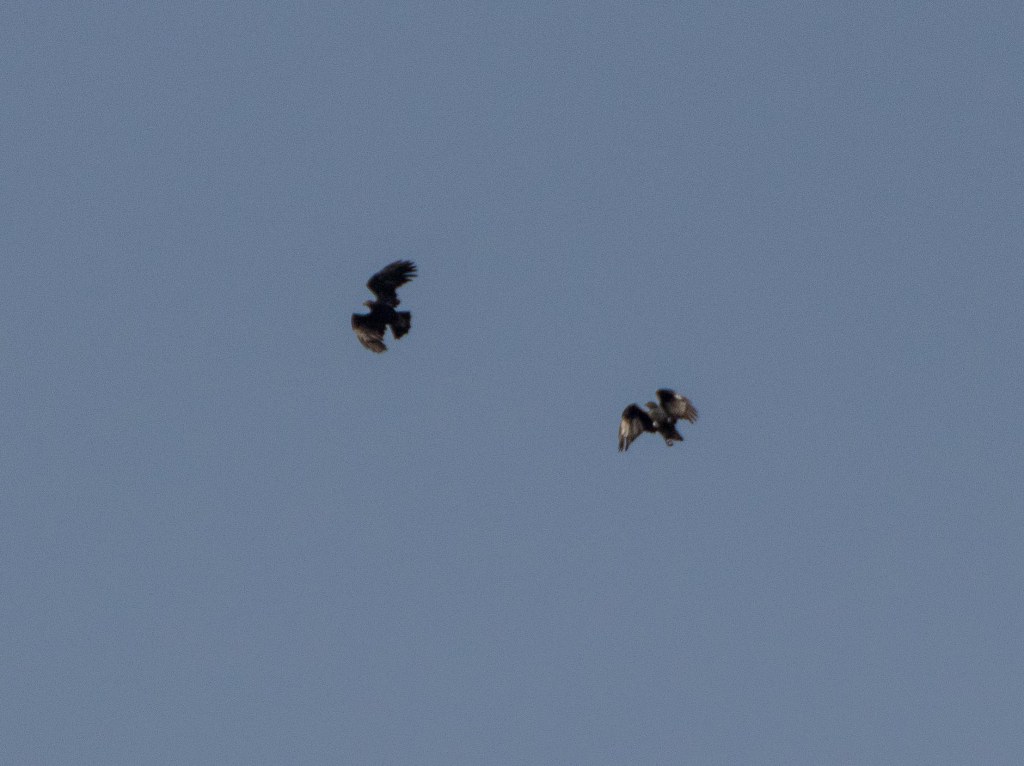
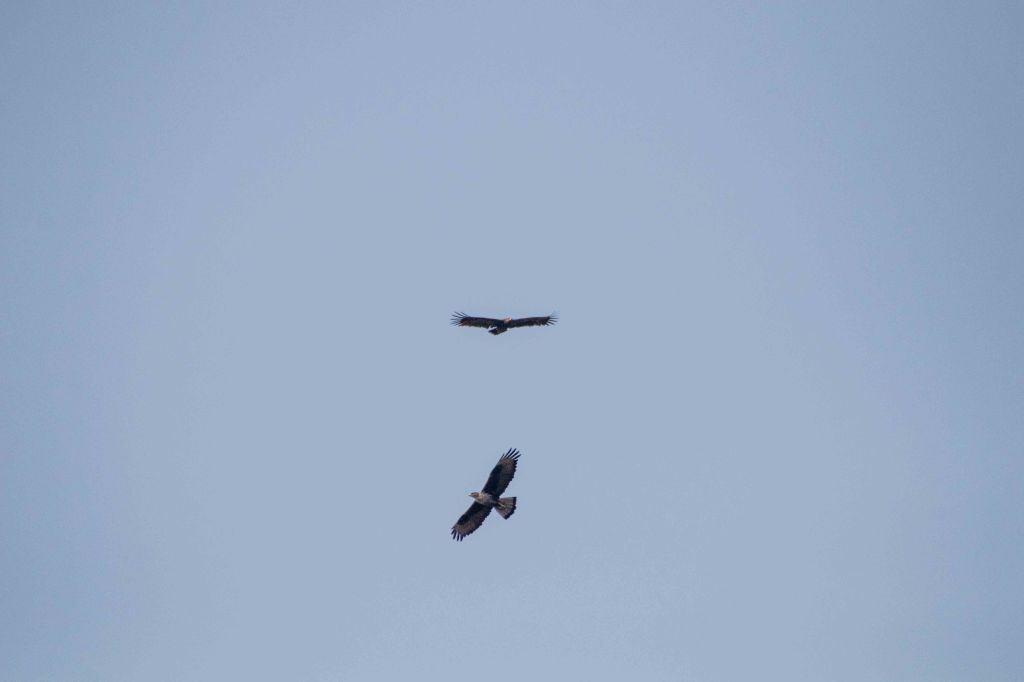
The GSE had clearly got the message. It circled once and then flew off away from the nest. The Bonelli’s adults also disappeared. We had witnessed that the parents were not going to tolerate any intrusion of the “safe zone” of their nest. It did not matter if the intruder was bigger than them (like had been the GSE).
An Oriental Honey-Buzzard was seen flying past some time later.
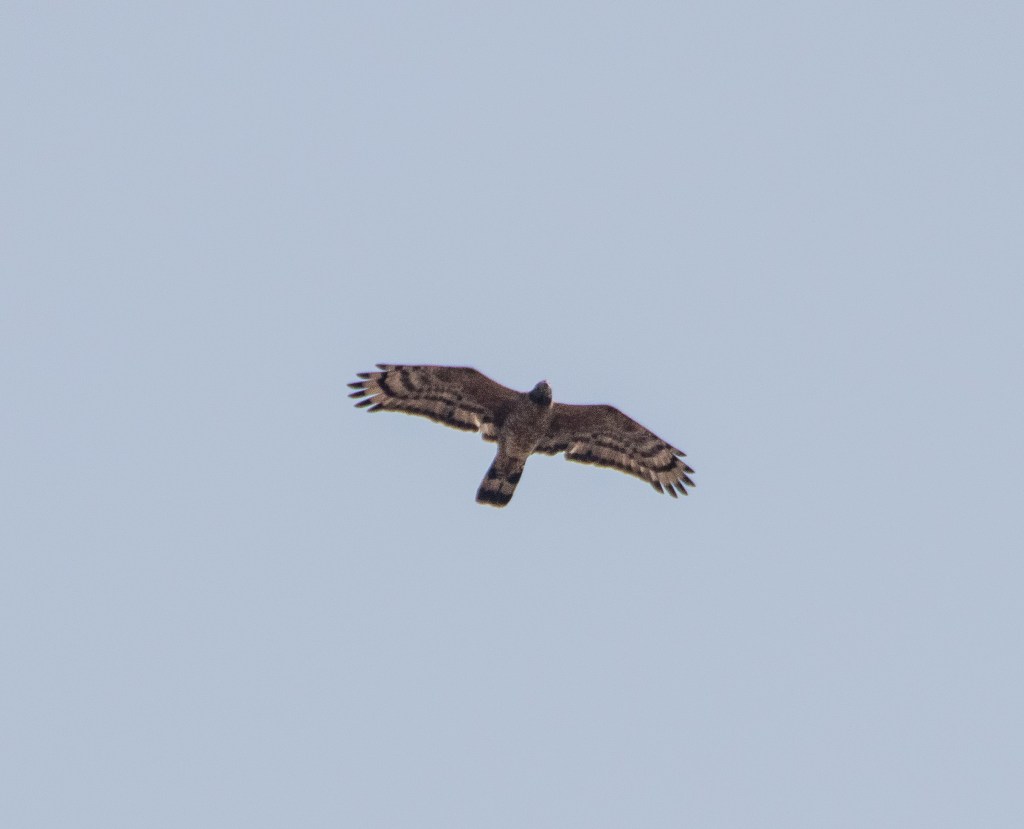
But this time, none of the adults appeared. May be they were away hunting. I guess these are risks that they had to take to in order to provide food for their chick(s).
A parent arrived at the nest at 10am (as usual) with a kill. I wondered what it was with the timing that the adult almost always came in around 10am with the first kill of the day. Anyway, the parents seemed really good at hunting and sourcing food.
This time it did not call before it came on the nest, as had been observed in my previous visits. What alerted me to look at the nest, were calls from the nest. But the adult was already in the nest.
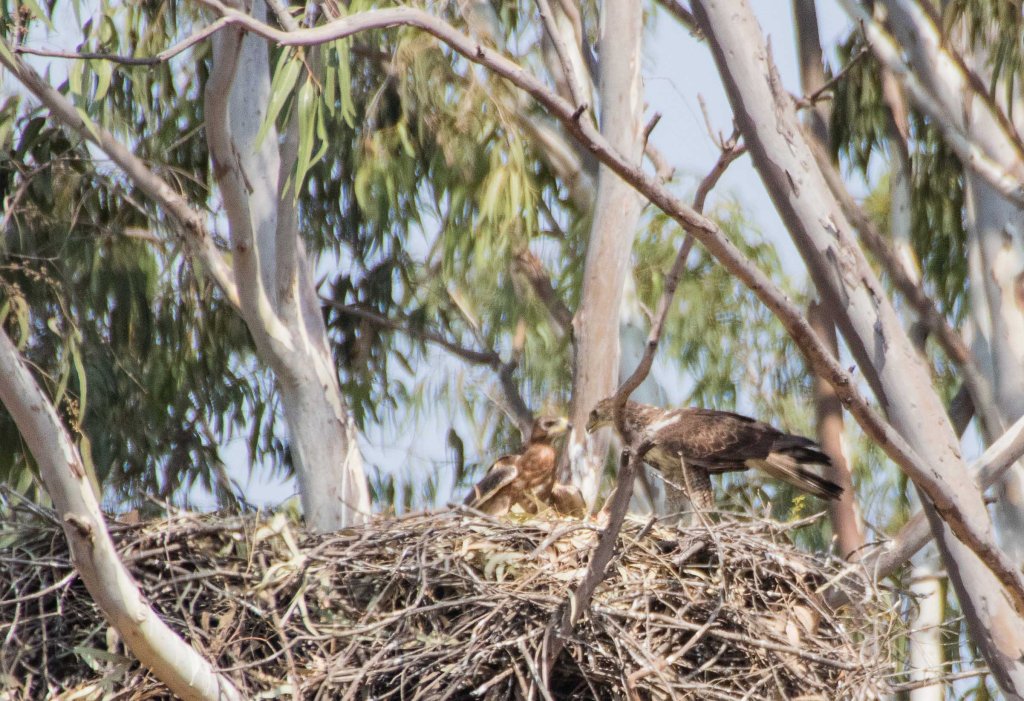
There was still only one chick. Surely the second chick would have shown itself now had it been in the nest. I had to accept that my fear had come true 😥 . The adult flew off in around half a minute.
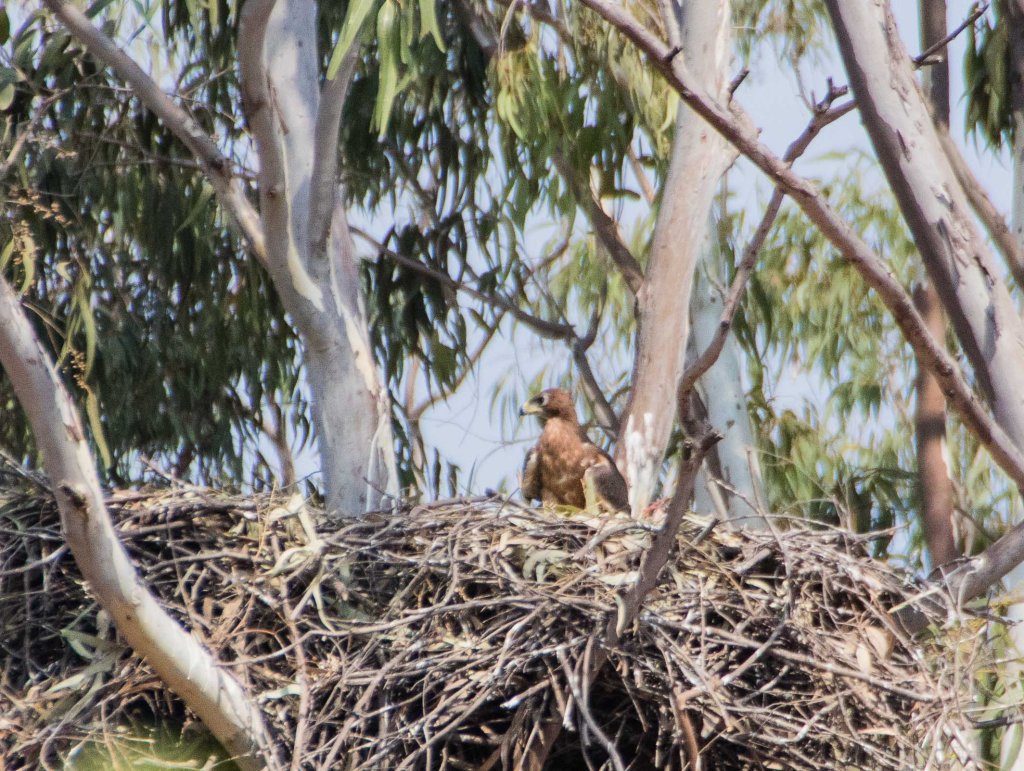
The chick was seen trying to eat on its own now. It was seen tearing and eating for quite a long time.
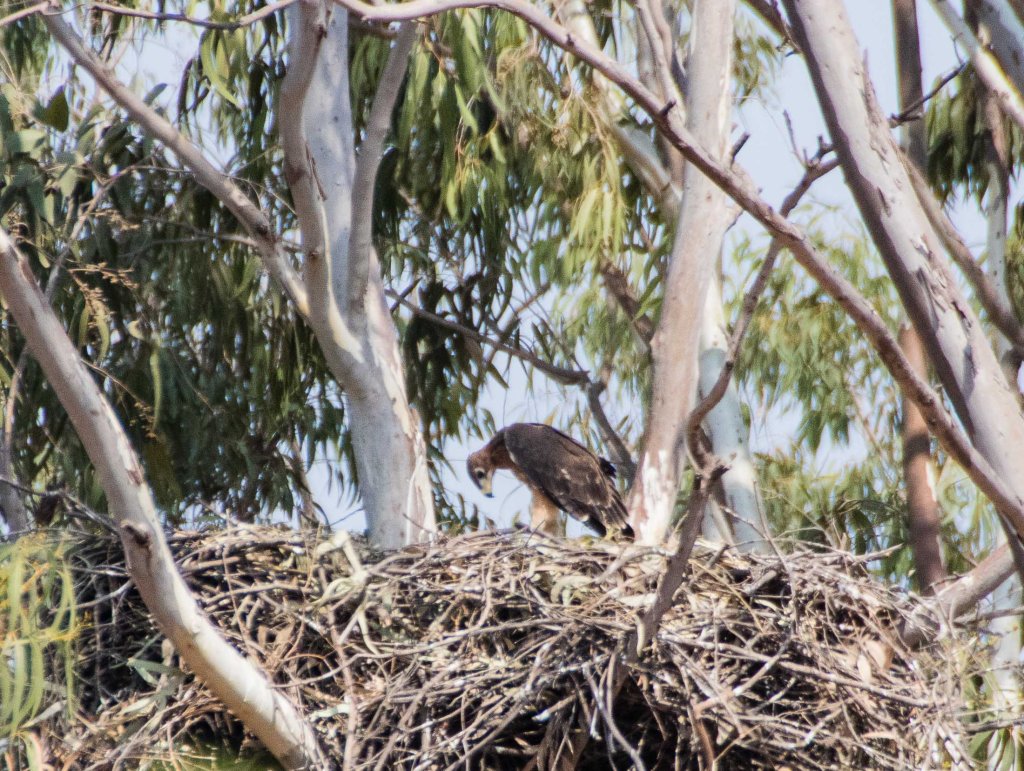
The adult did not return to nest for the remainder of the time that we were at the area. I inferred that the chick had now grown and was able to eat from the kill on its own. The kill was some thing rufous in colour.
During the remainder of the period we were there, we saw the chick “testing” out its wings. It had grown. I was also witnessing one of the behaviour that I hoped to see with my own eyes.
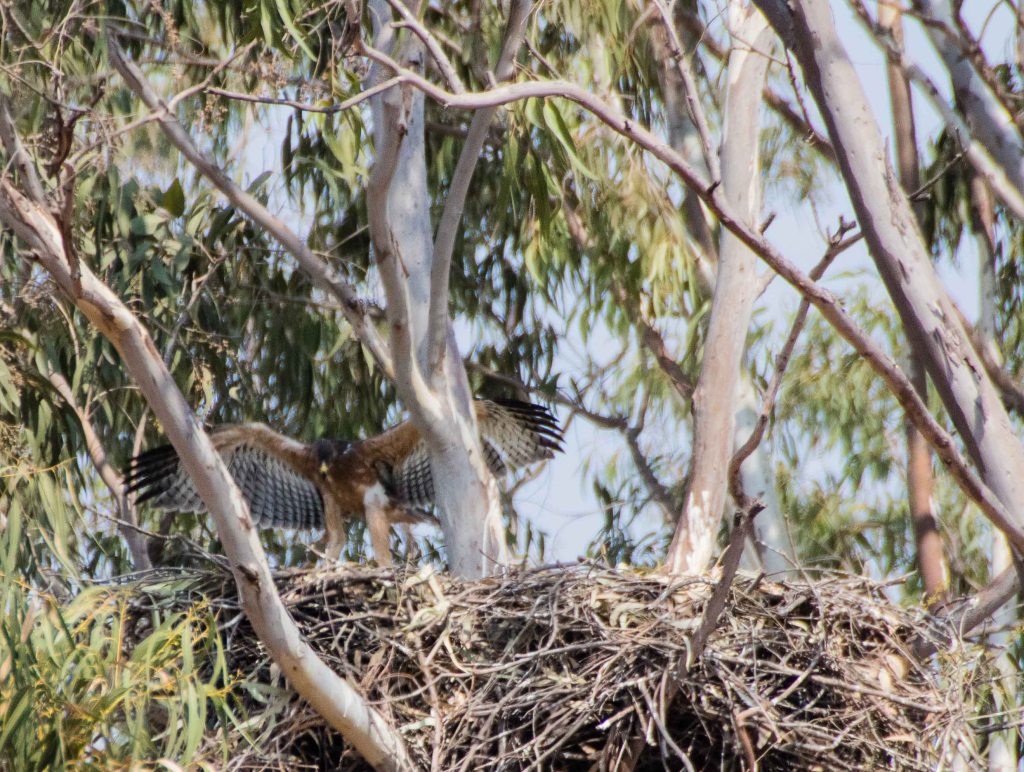

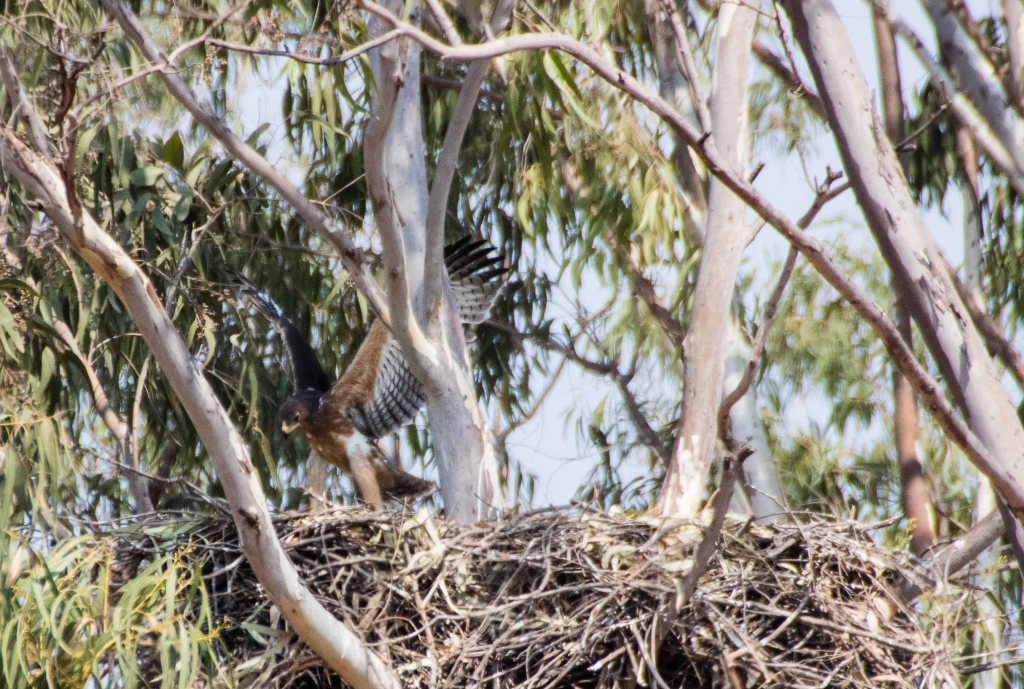
We left the place by 11:20am. The departing comment (or rather my wish) I made to Rahul was “What a pleasant surprise it would be if we get to see the other chick also when we visit next week”.
Week 9 (31st Mar)
Rahul and I reached the nest area by 7:10am. As usual, we were alerted of the presence of both the adults by the alarm flight calls of a Red-wattled Lapwing. We finally spotted them sitting together atop an Eucalyptus tree, by the Lapwing’s “dive bombing”. Some things don’t change 😀 . The adults took off and went and sat atop another nearby tree in a bit and the Lapwings flew off, seemingly satisfied they had proved their courage 😛 .
We saw the chick in the nest sitting on the edge. It was a relief to see it, given the bad news we had got during our visit the previous weekend. We settled in and as we starting recording the chick in the nest, a bird flew into the nest. At that time I thought it was one of the adults. After around 3 minutes, it flew off. When I went back home and was relooking at all the pictures and videos that I had captured from the outing, I noticed that the bird that had flown onto the nest did not look like an adult. It was actually the other “lost” chick 😀 . I literally jumped off my chair and called Rahul to tell the news. He was also overjoyed. My wishful comment from our last trip had come true; the chick, rather a fledgling, had just flown off the nest and not got lost as we had assumed! Here is a picture of BOTH the chicks in the nest:
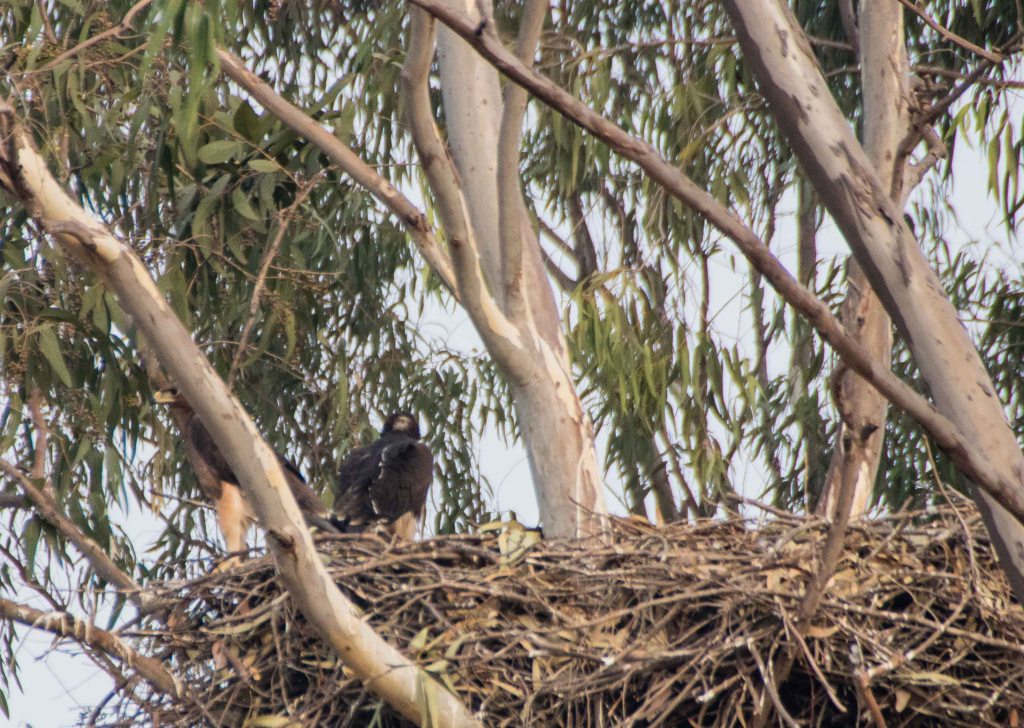
This also lent strength to my observation that one the chicks had indeed been the dominant one, had grown slightly faster and thus had been able to take to the wings also faster.
As Rahul and I were speculating on how much longer the second chick would need to take to its wings, we were in for a shock. We saw the chick dive and fly off towards the area behind the nest 😮 ! This was around 7:30am. Looks like the second chick had taken to its wings for several days now. We were just glad that it had been in the nest when we had reached in the morning. Otherwise we may have thought they it too may have been lost 😛 .
We saw the adults take to the sky with their ritual flight at around 8AM. We saw two bird sin flight above them. Our initial thought was if it could be the juveniles. It however, turned out to be two Brahminy Kites (an adult and a juvenile). Later we saw one of the juveniles fly behind some tree and sit on a tree branch to the west of the nest.

It returned to the nest at around 8:30am and continued to sit in it.
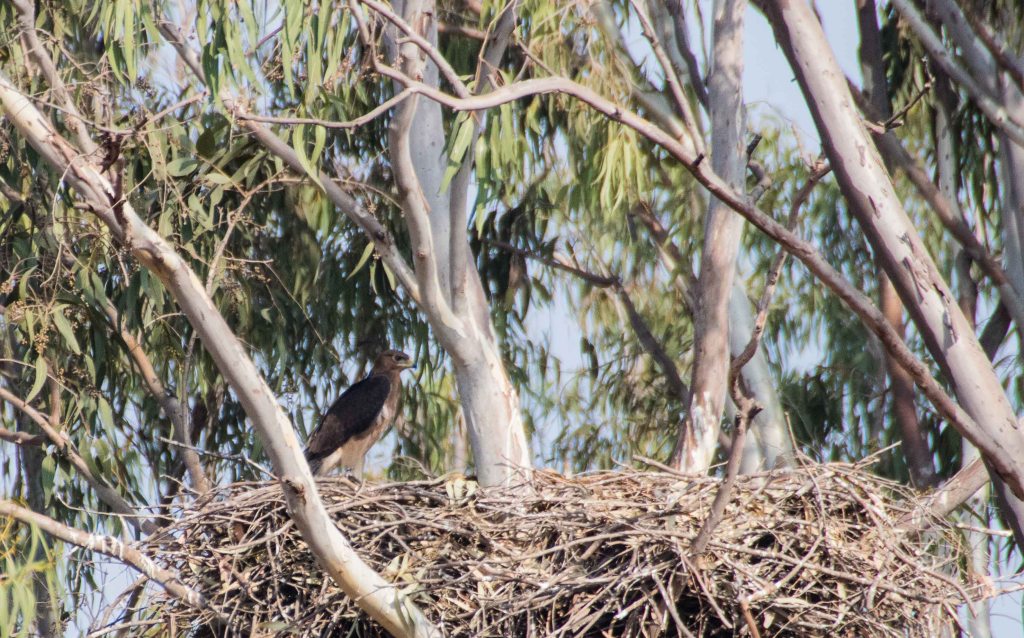
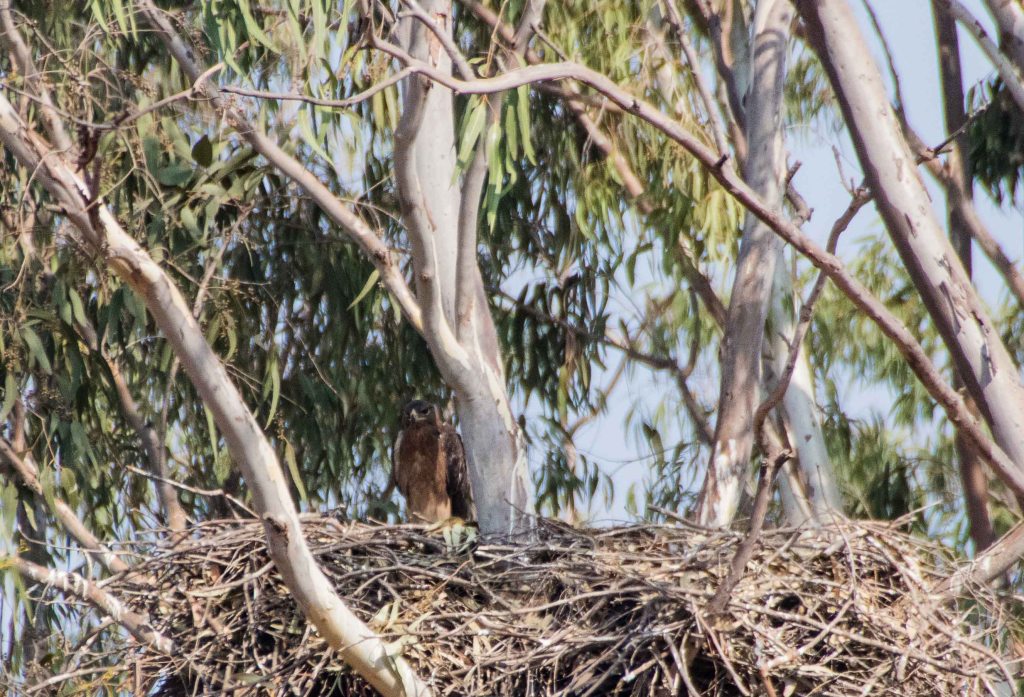
At around 9:15am we saw a man walking towards the area of the nest. We keenly watched to see the Juvenile’s behaviour. It flew off as the man reached close to the nest.
Around 9:20am we saw one of the adults fly in to the area near the nest. There were lot of calls coming now. The juvenile came back to the nest around 9:28am and kept calling from it. It finally flew off to the left of the nest. Scanning the area a bit, we finally managed to see the adult take off from the ground and land on a slanting tree trunk, sit for around 20 seconds and then take off and settle on a nearby tree top. We think the adult had brought a kill and the juvenile was now feeding off it on the ground near the tree. It was however out of sight for us.
Some time later, we saw a couple of Black Kites soaring over the nest area. Soon we could saw both the adults taking to the wing and soaring up using the thermals; still protective in behavior. The Kites soon disappeared on seeing the presence of the adults 🙂 .
We decided to call it a wrap by 10am. The juveniles did not return to the nest till we were there. As we walked off, we saw one of them fly off to a tree top further off and disappeared from our sight. Looks like it was explorative in nature now but did not wander too far from the nest. The comfort and safety of home was still important to them.
Week 10 (7th Apr)
I reached the nest area around 6:50am.
The fledglings were not in the nest. As I reached the usual observation spot, I saw one of them fly and a sit on a tree to the east of the nest. Shortly later, it took off from there along with an adult and flew to the area left of the nest. I however, could not locate where they went and perched.
I located the adults sitting on top of a tree top by observing a Red-wattled Lapwing “dive-bombing” continuously till the female flew off to another tree top. I then saw one of the juveniles come and try and perch on the same tree top as the female adult.
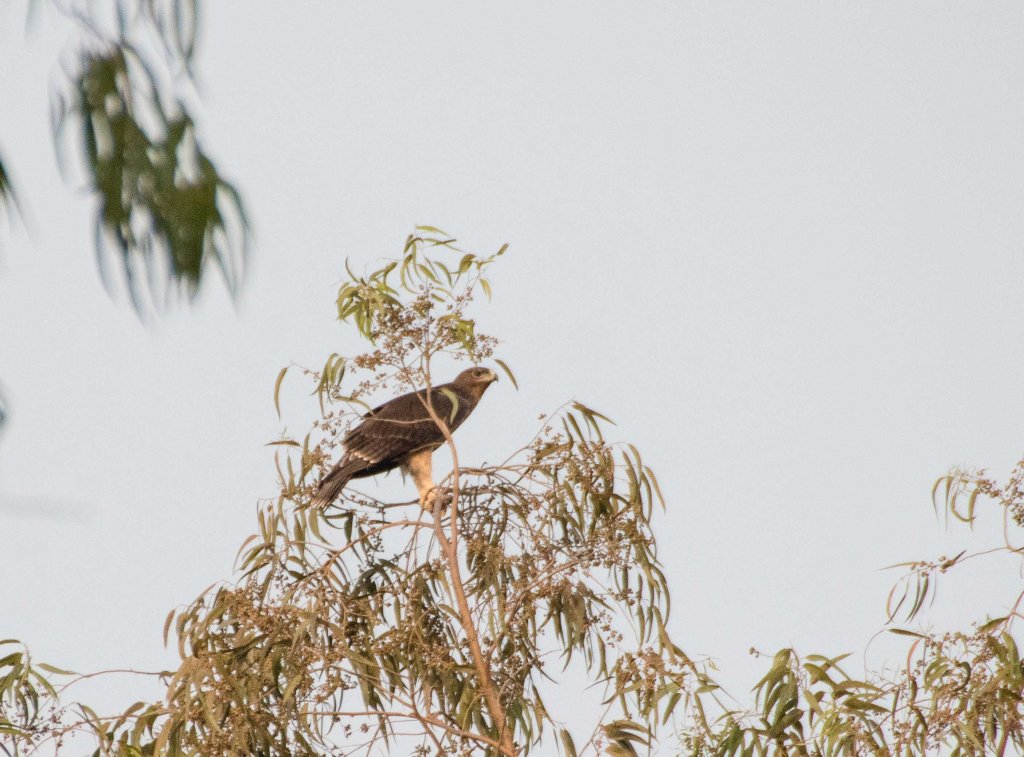
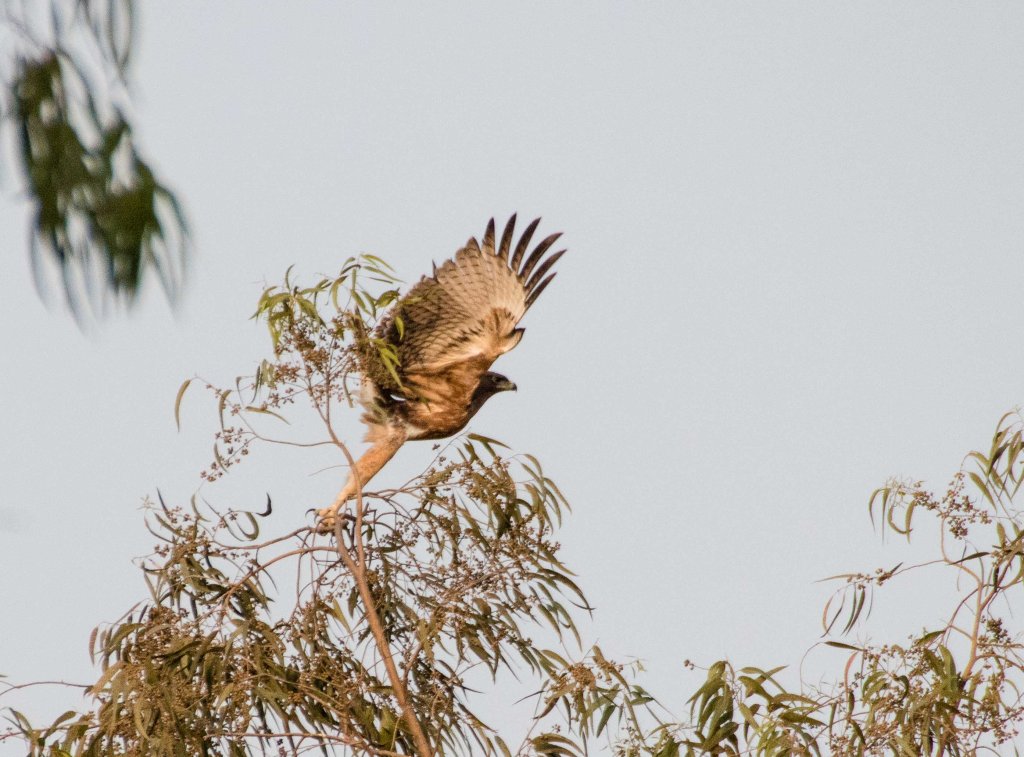
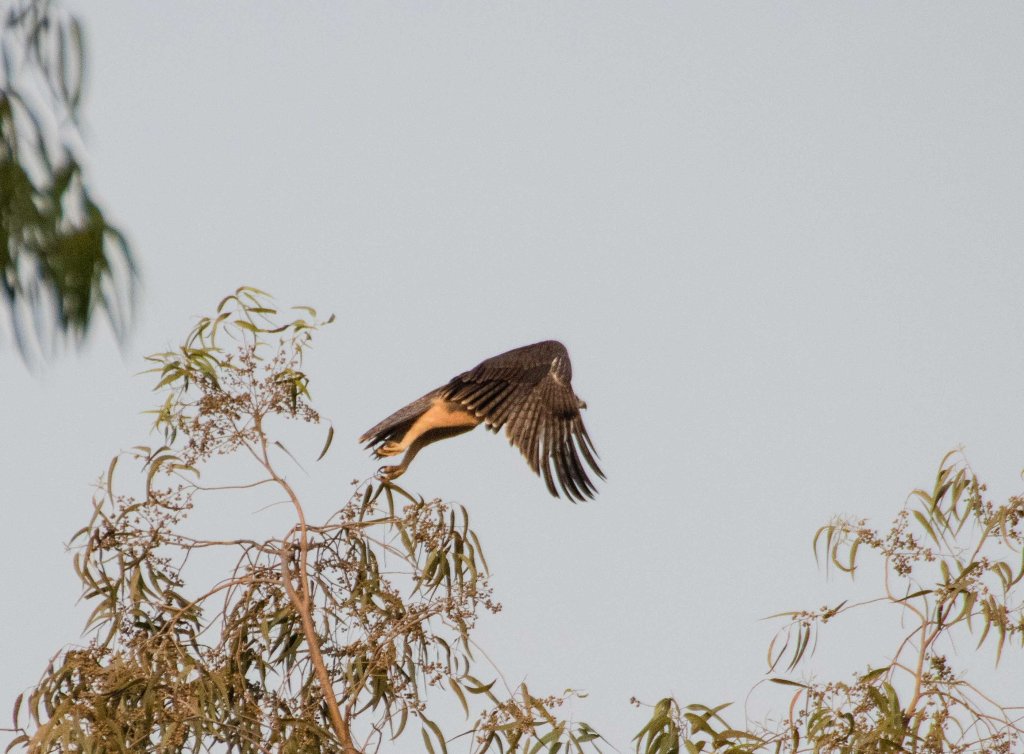
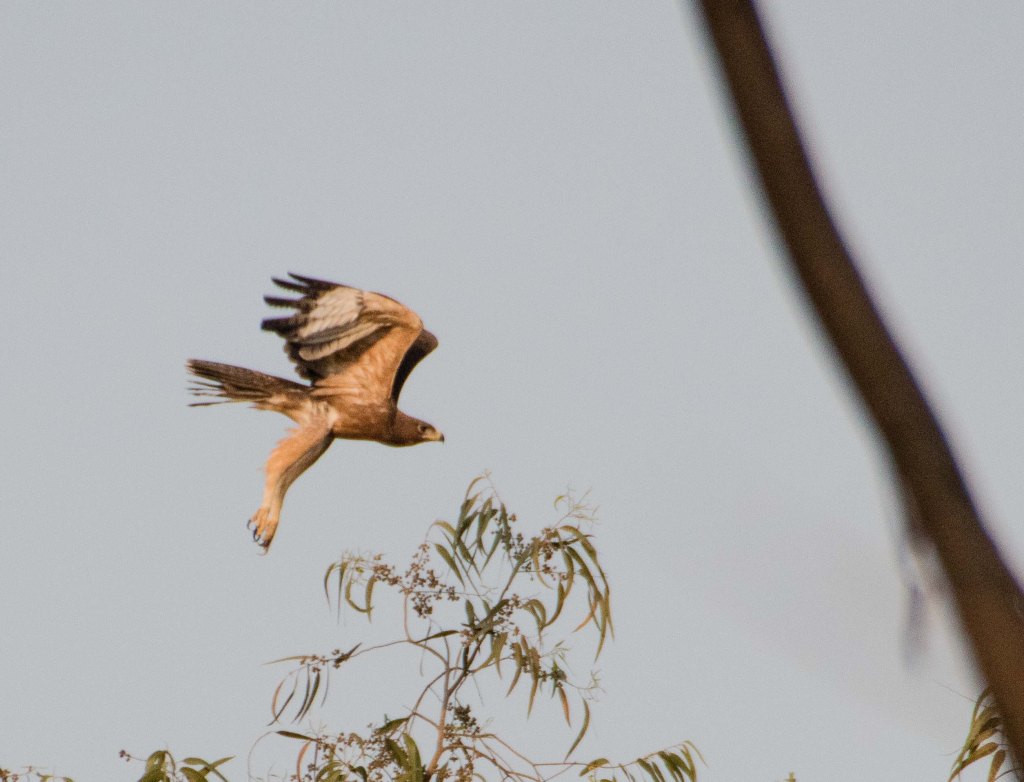
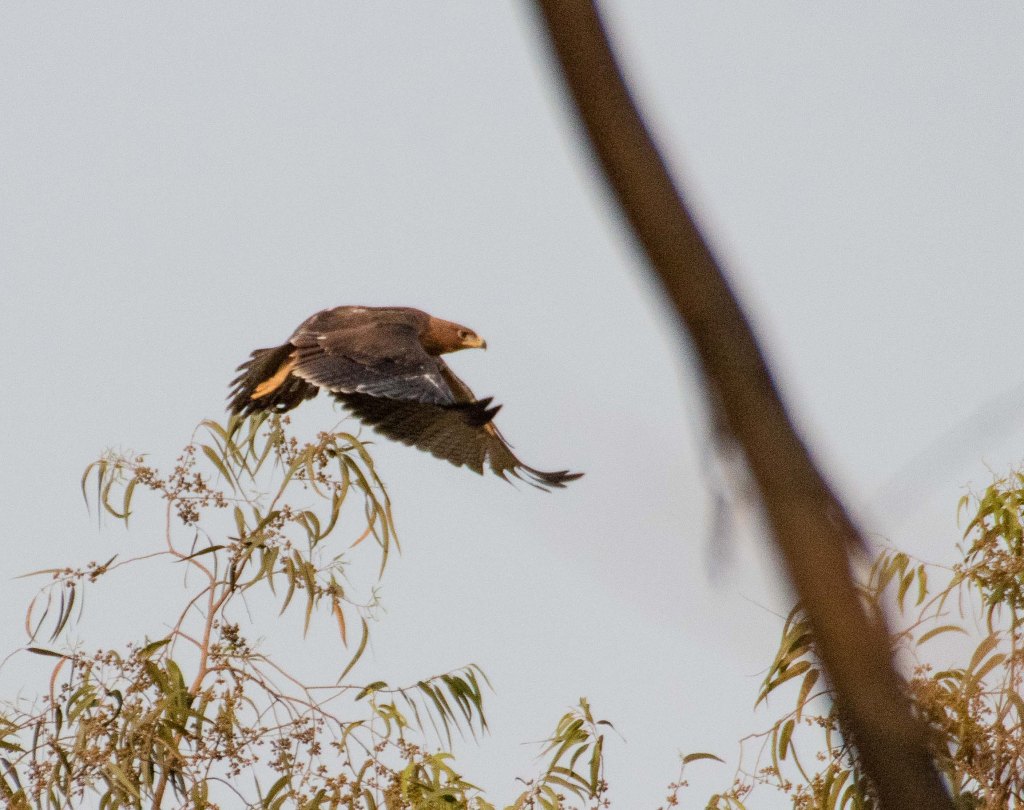
The female adult flew off from there and perched on a tree top close to the adult male.
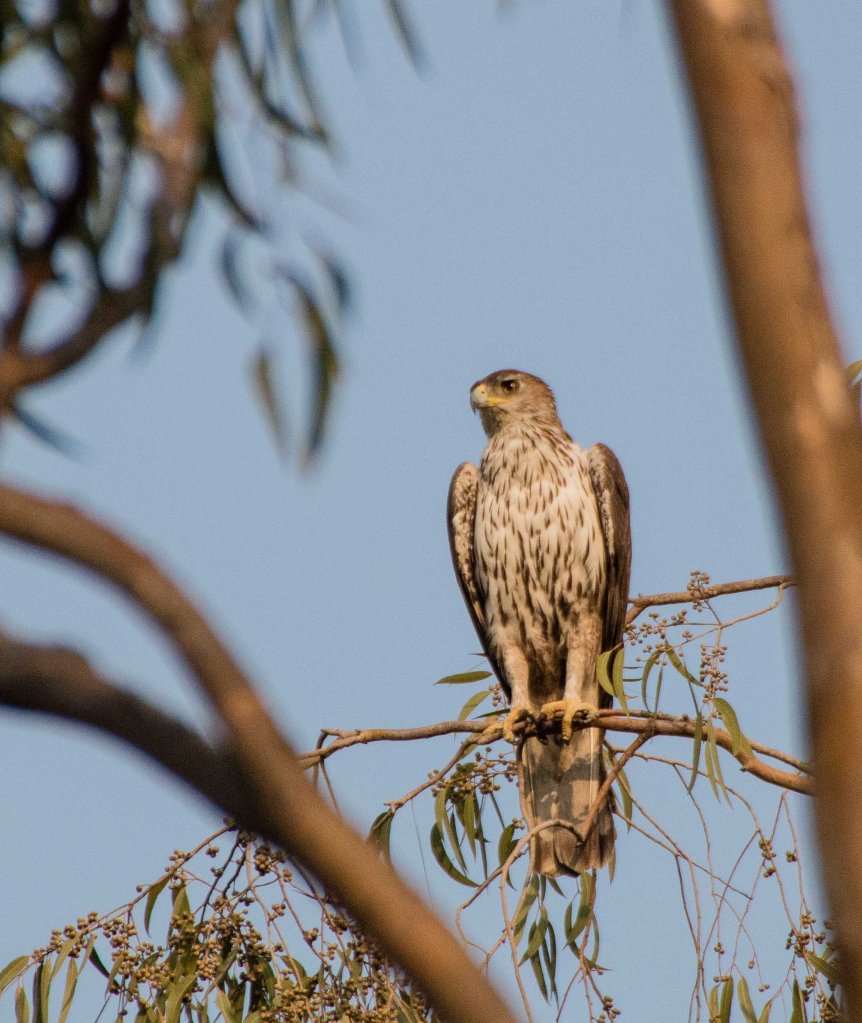
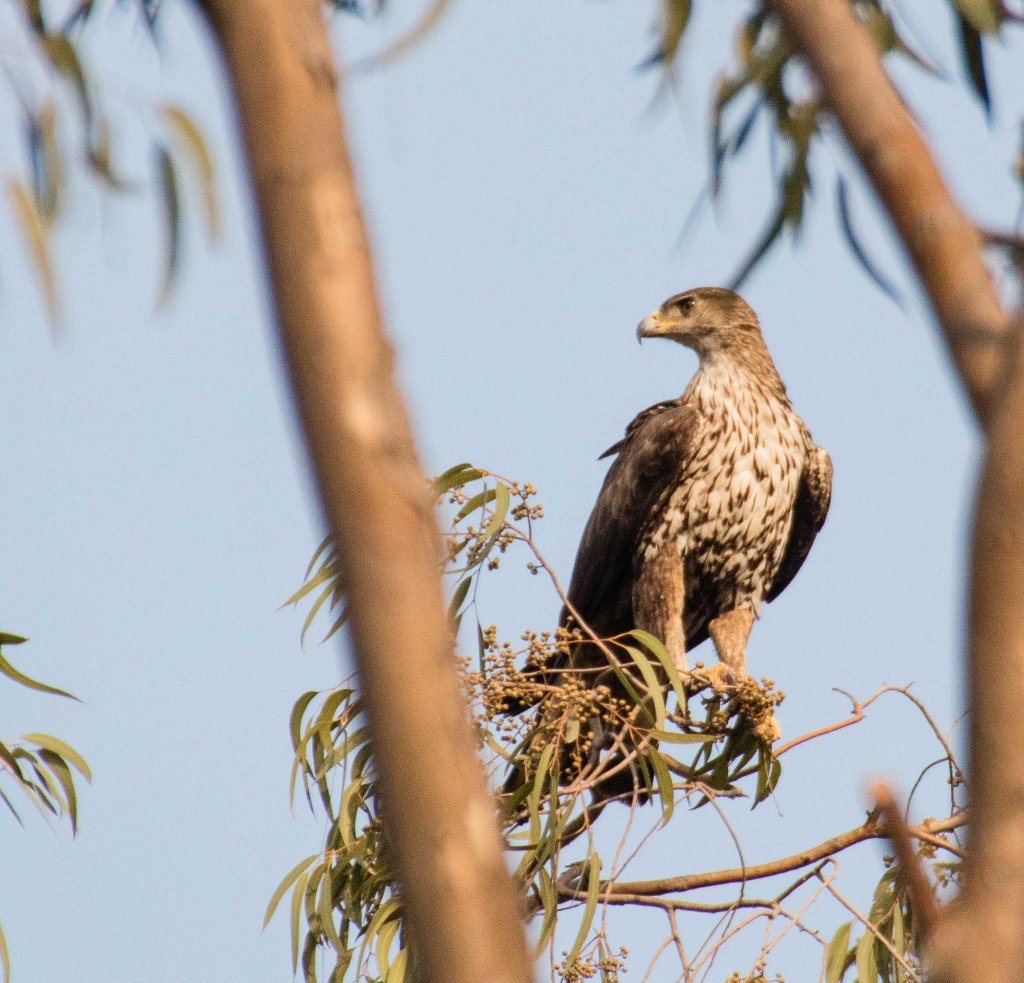
There was quite a bit of intermittent calling from the juvenile; a protest or maybe still seeking comfort from its parents being around?
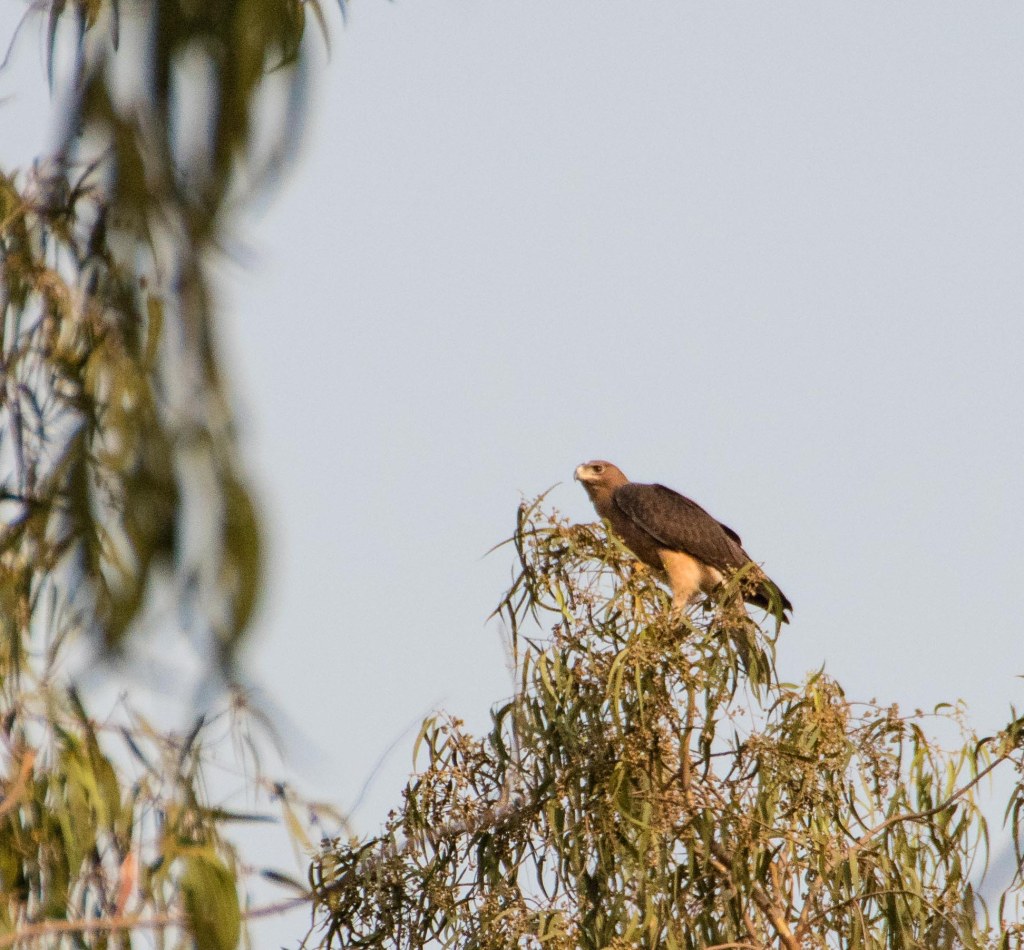
An Oriental Honey-Buzzard flew over where the juvenile was perched.
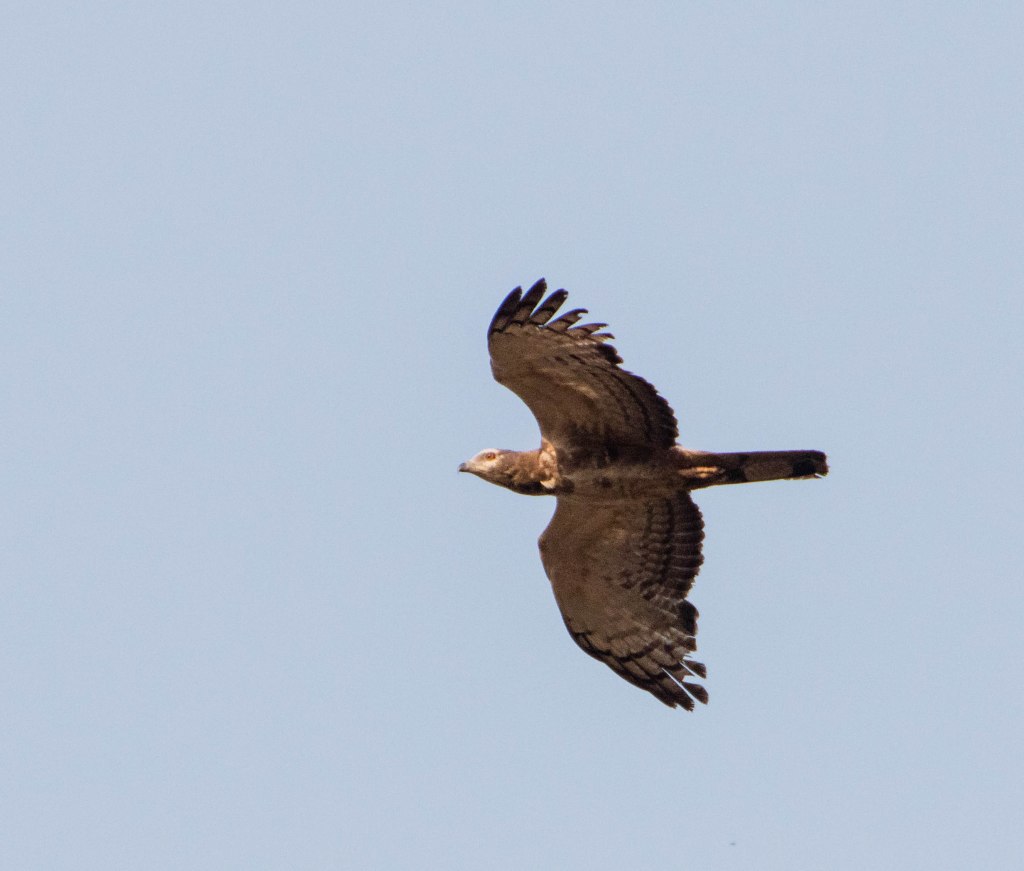
There was, however, no reaction from any of the adults nor the juvenile. Some time later, a Black Kite started to harass the juvenile perched on the tree top.
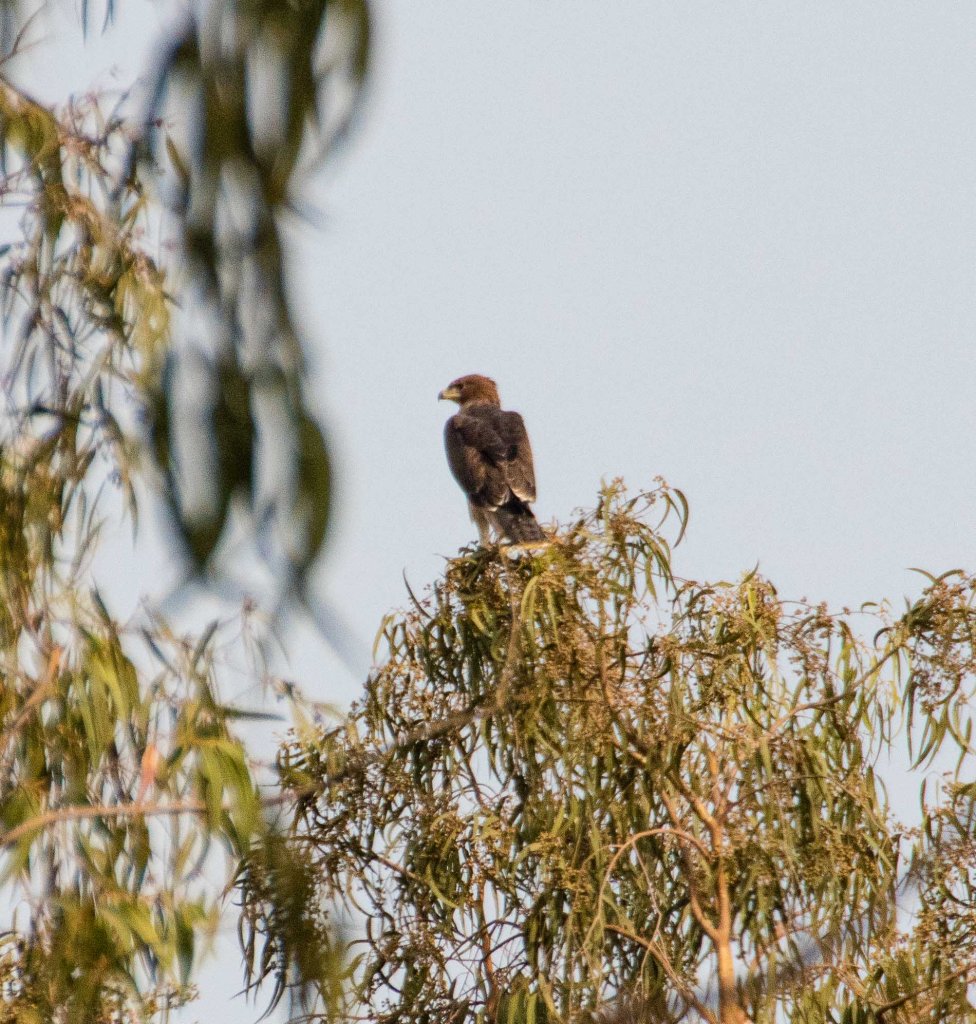
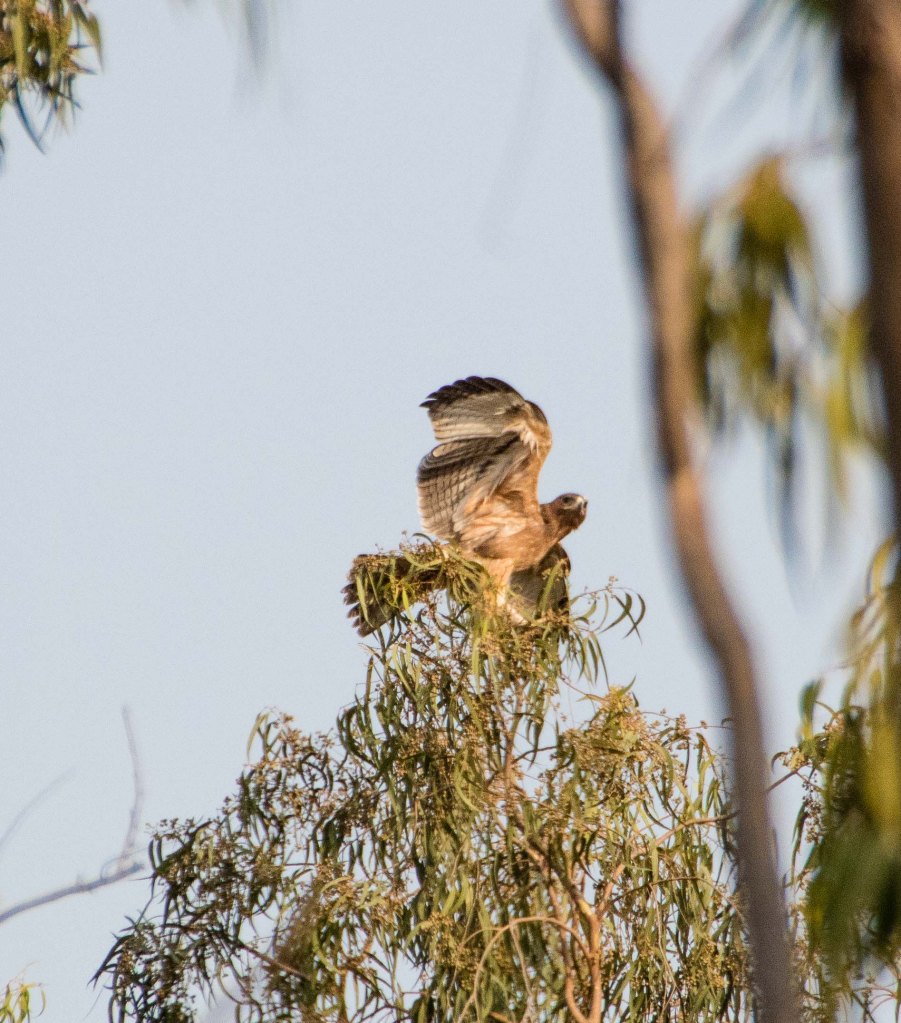
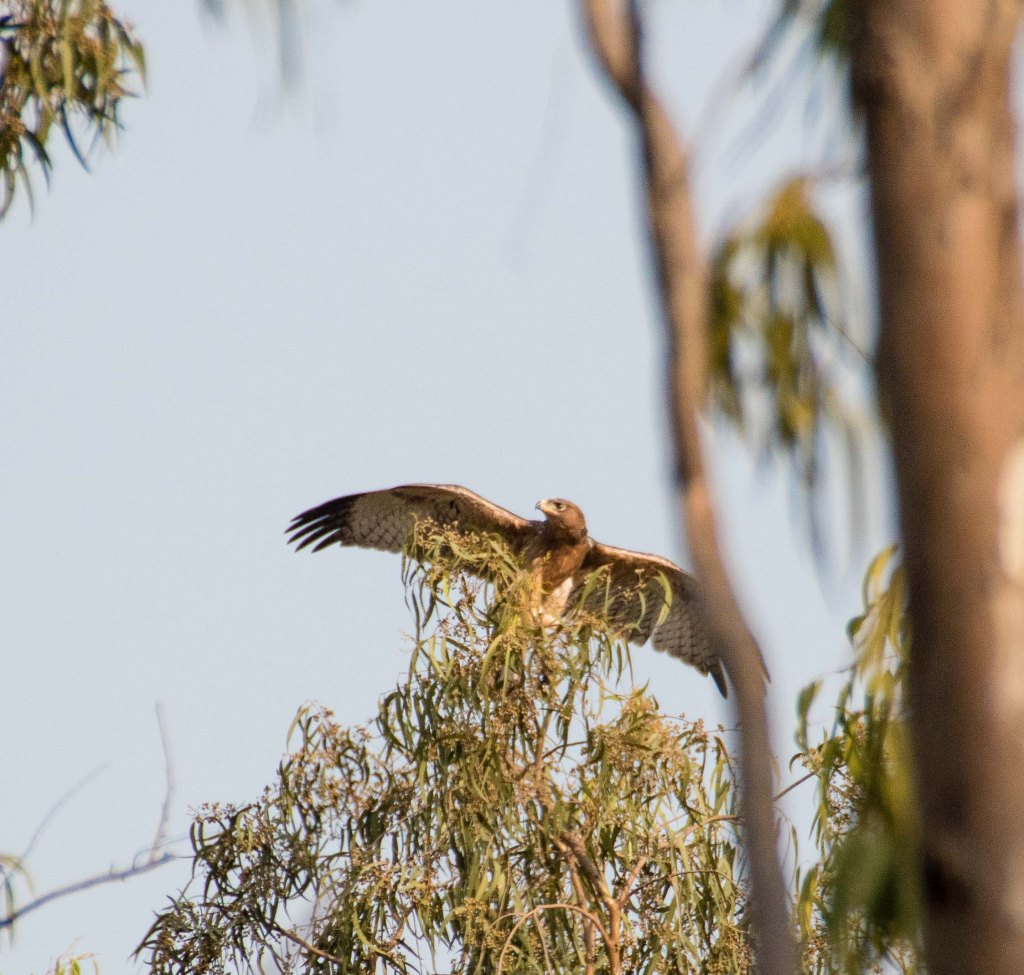
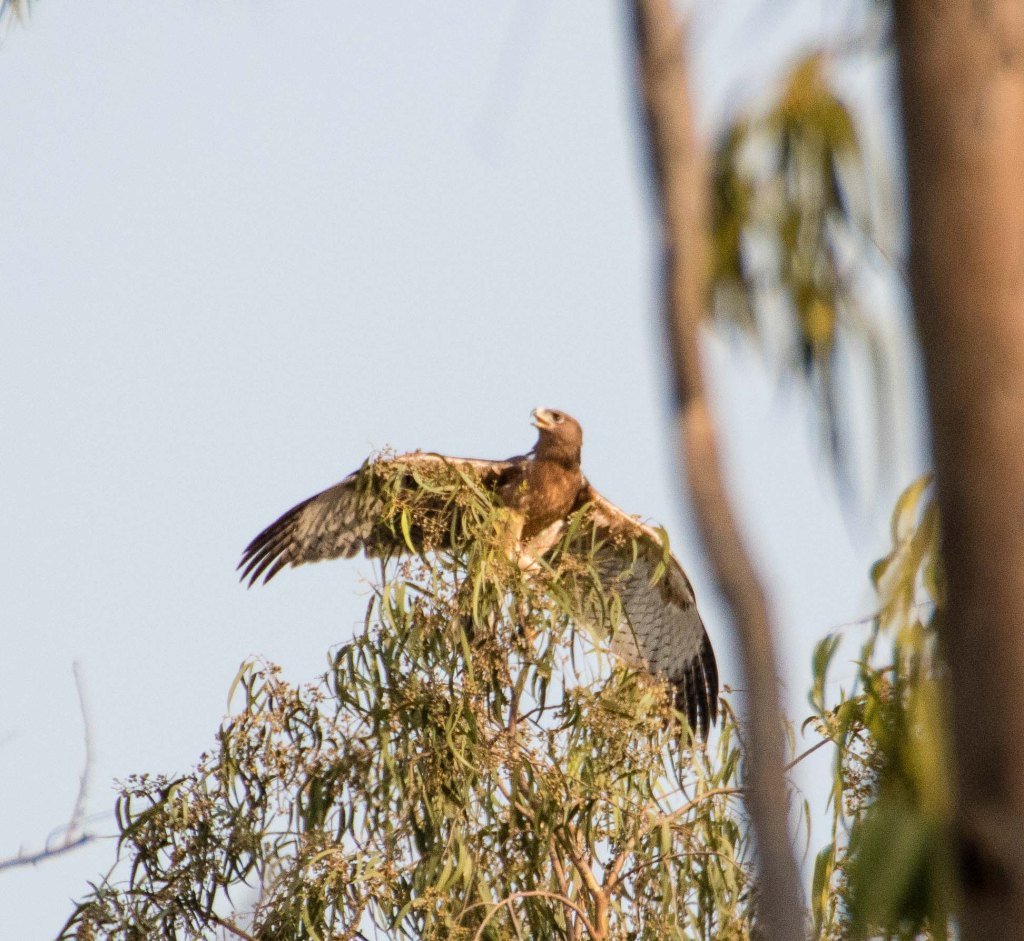
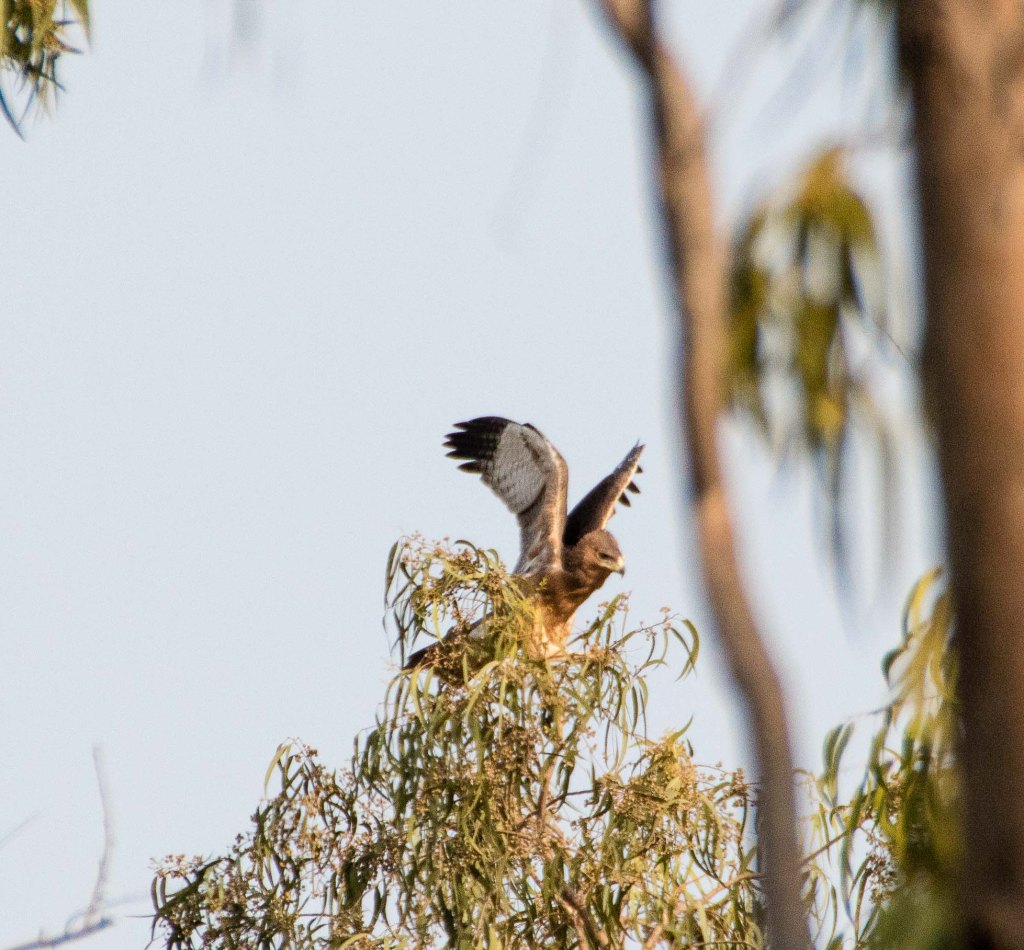
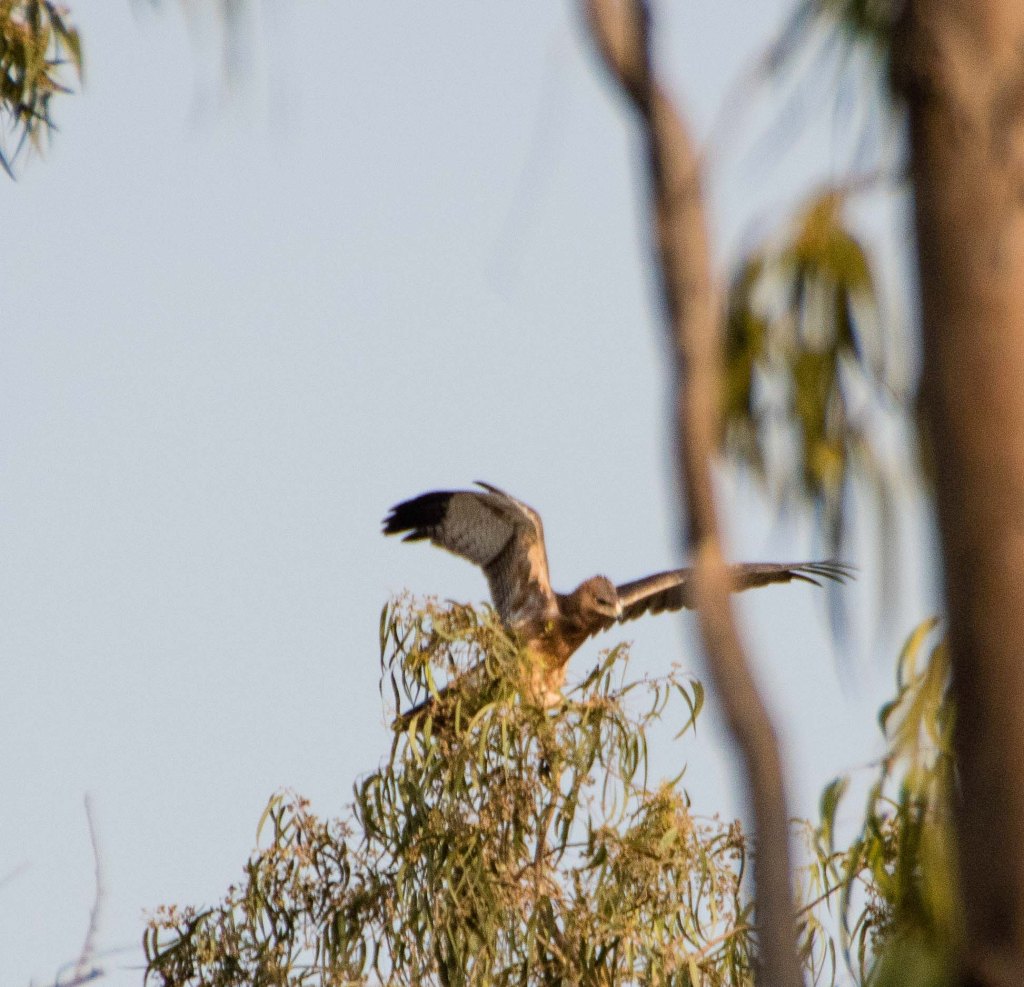
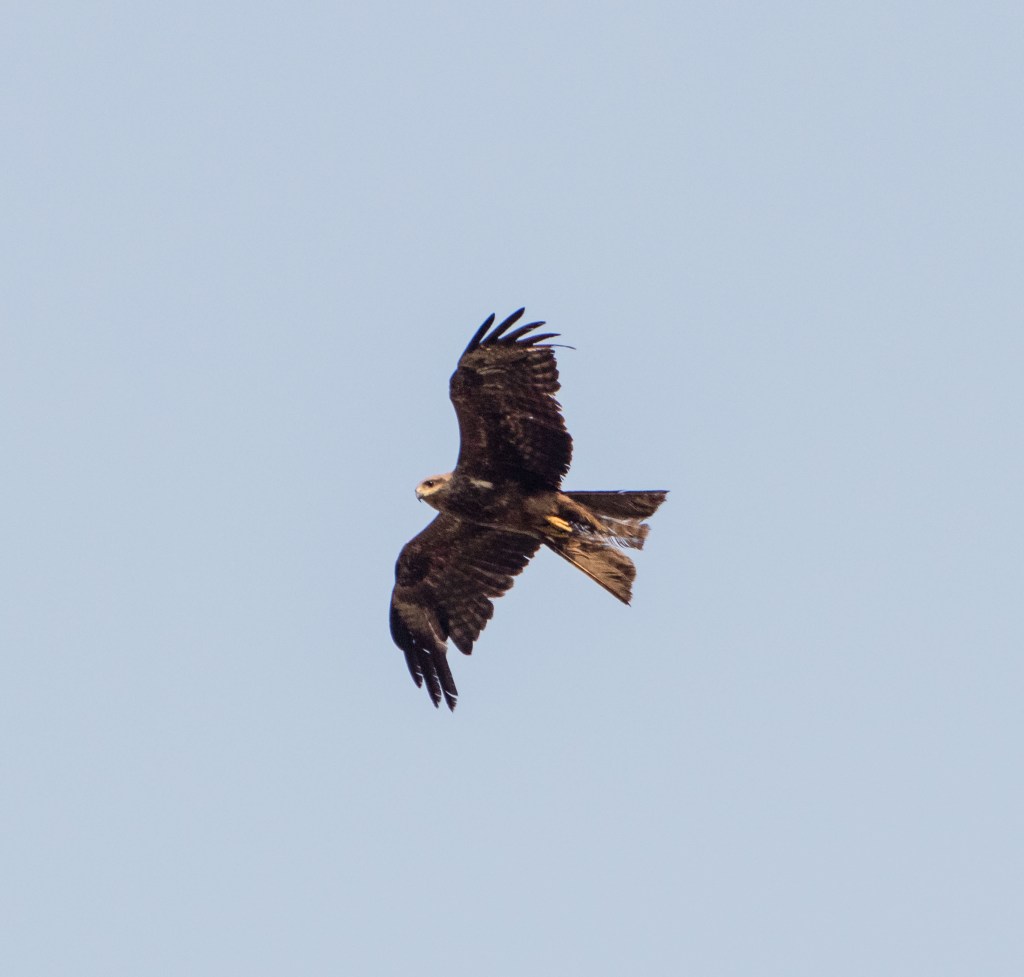
The juvenile took off and flew off calling.
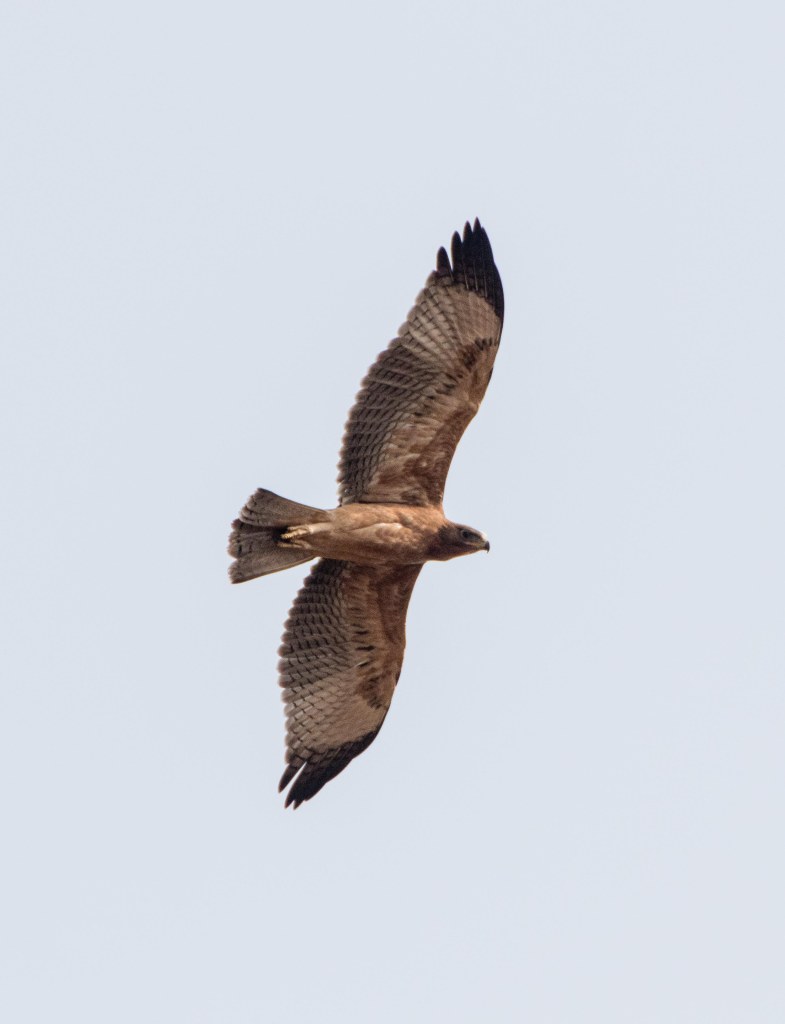
The Black Kite followed to harass it. A flock of crows also came to mob. The juvenile flew towards the direction of the nest. I saw an adult take to the sky to provide “air cover”. It managed to chase the Kite away.
As I reached the nest area, the crows had also gone. The juvenile was standing in the nest.
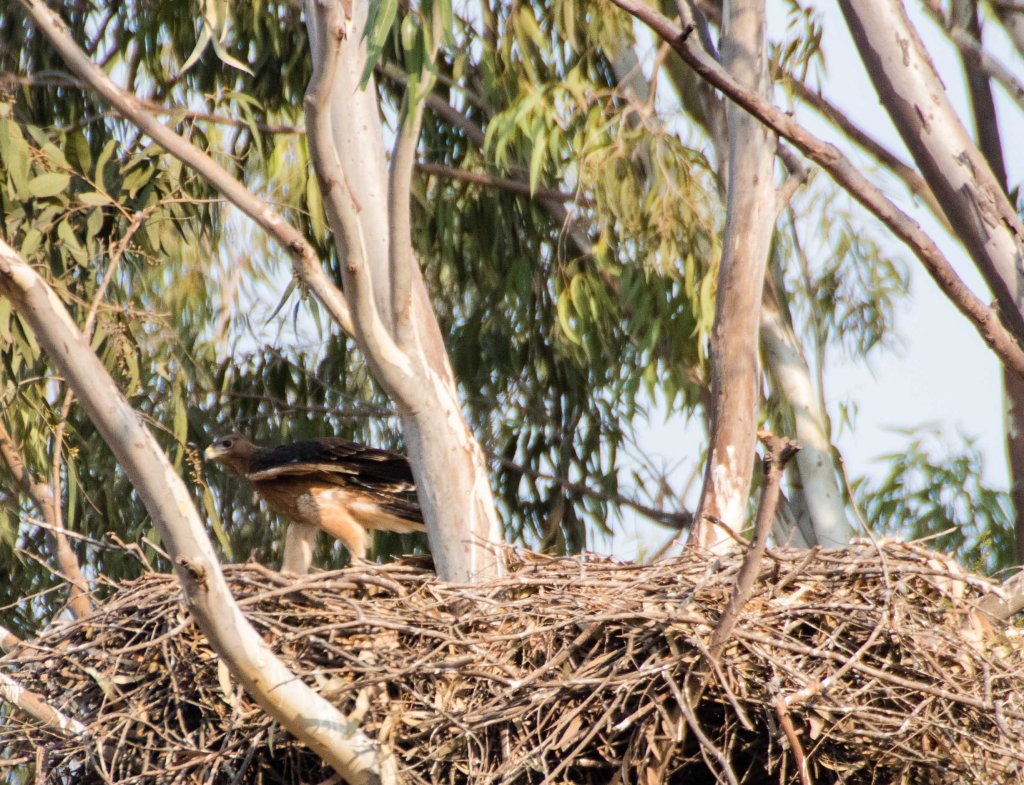
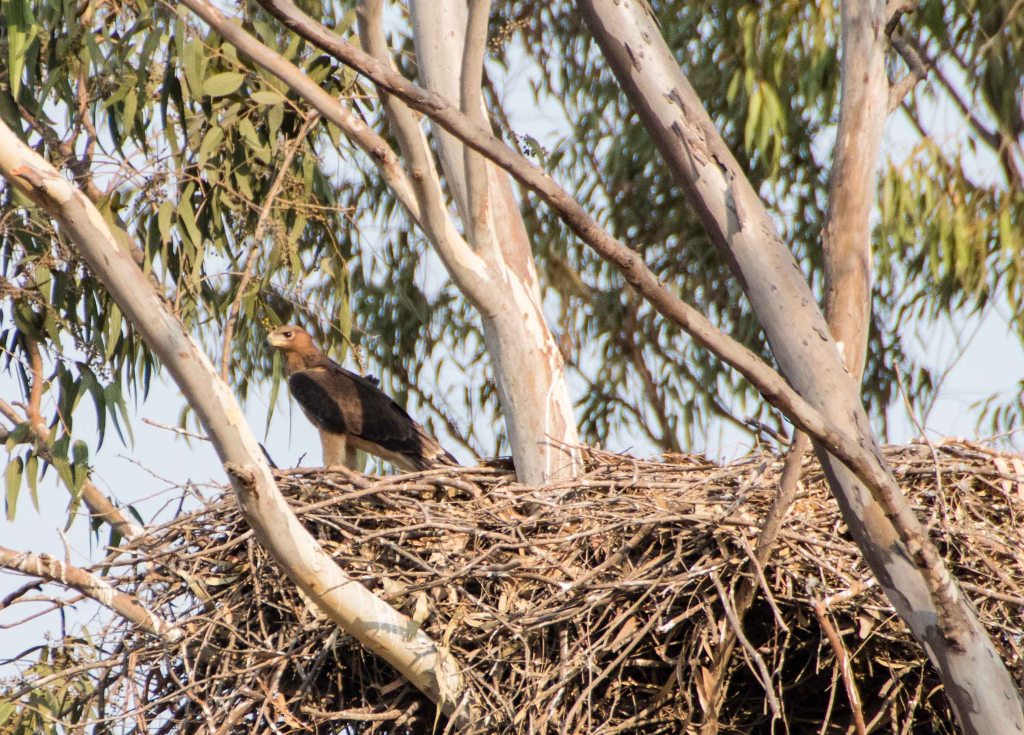
It kept calling intermittently. There were also another call coming close by. I was, however, unable to determine if it was an adult or the other juvenile calling. Finally the juvenile in the nest, flew off to the area behind the nest. I saw two other birds also fly; one off the trees nearby to that area. One had certainly been an adult. I was unable to determine if the other one was also an adult or the other juvenile.
I suspect that the juvenile that had fledged first, was starting to be more independent. The second juvenile, however, seemed to be still quite dependent on the parents. It still seemed to consider the nest as the “safe house” in case of attacks from other raptors. May be that was the intended safety protocol 🙂 .
Today there had been a lot of call exchanges from the juvenile. I guess it was trying to be reassured by the adults and just seeking their attention.
I saw the adults circle in the sky at 8:30am and then fly off to the back of the nest. I decided to leave by 8:35am since none of the birds were in sight and I had no idea if, when and where they would appear again.
Week 11 (14th Apr)
I reached the nest at 6:40am.
As I was approaching the area, I saw a Red-wattled Lapwing flying to the area. Soon I saw it “dive bombing” the adults that were sitting together on a tree top. By the time I reached the spot, the Lapwing flew off. Only the adult male was left sitting on its perch. Round 1 went to the Lapwing 🙂 .
The adult male was joined by one of the juveniles on the tree top. Soon it flew off to another tree top nearby. I could hear continuous calls by the juveniles. They seemed to be communicating with each other. There however, were no responses coming from any of the adults. I saw the second juvenile sitting on a tree top along with the adult female.
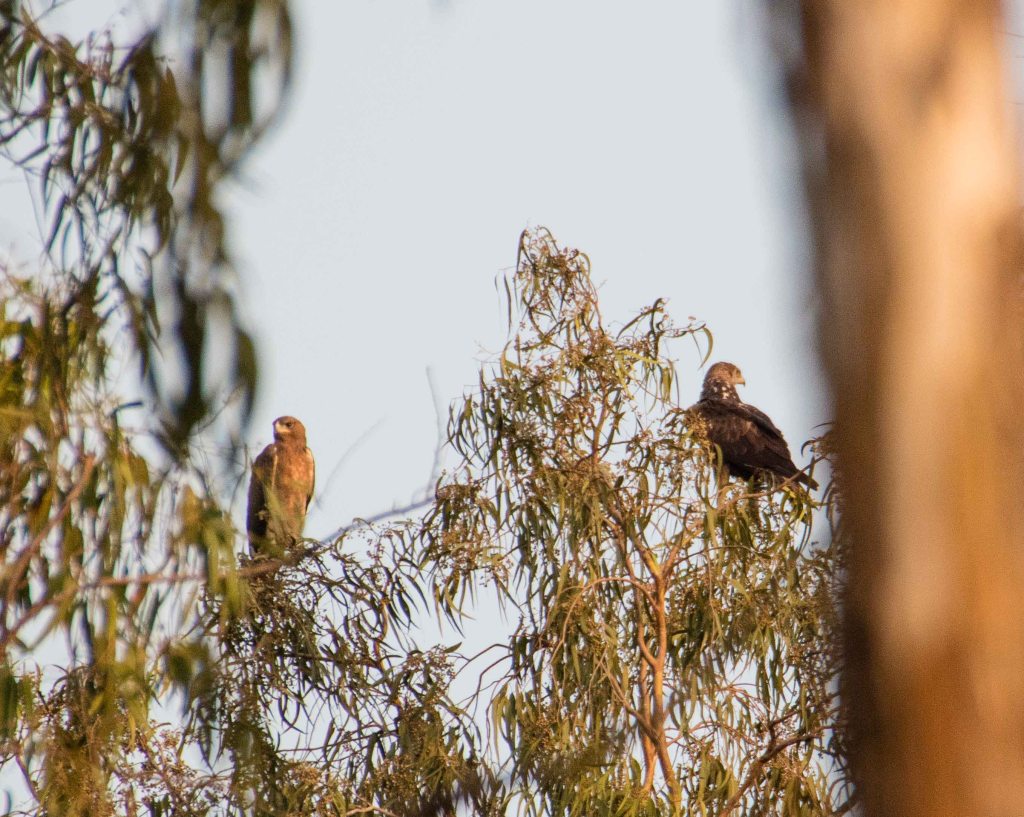
The other juvenile disappeared from its perch and then could not be located.
A Black Kite flew over the area but there was no reaction from anyone. Interesting! Maybe, it was owing to the adults being very close to the juvenile. Or was that the juveniles were growing more self confident?
Two Red-wattled lapwings came flying in again and “dive bombed” the male sitting. The male did not fly off and the lapwings finally gave up. Round 2 went to the Bonelli’s male 🙂 . I was also able to observe how the adult retracted its leg into its “belly feathers” and just sit on one leg.
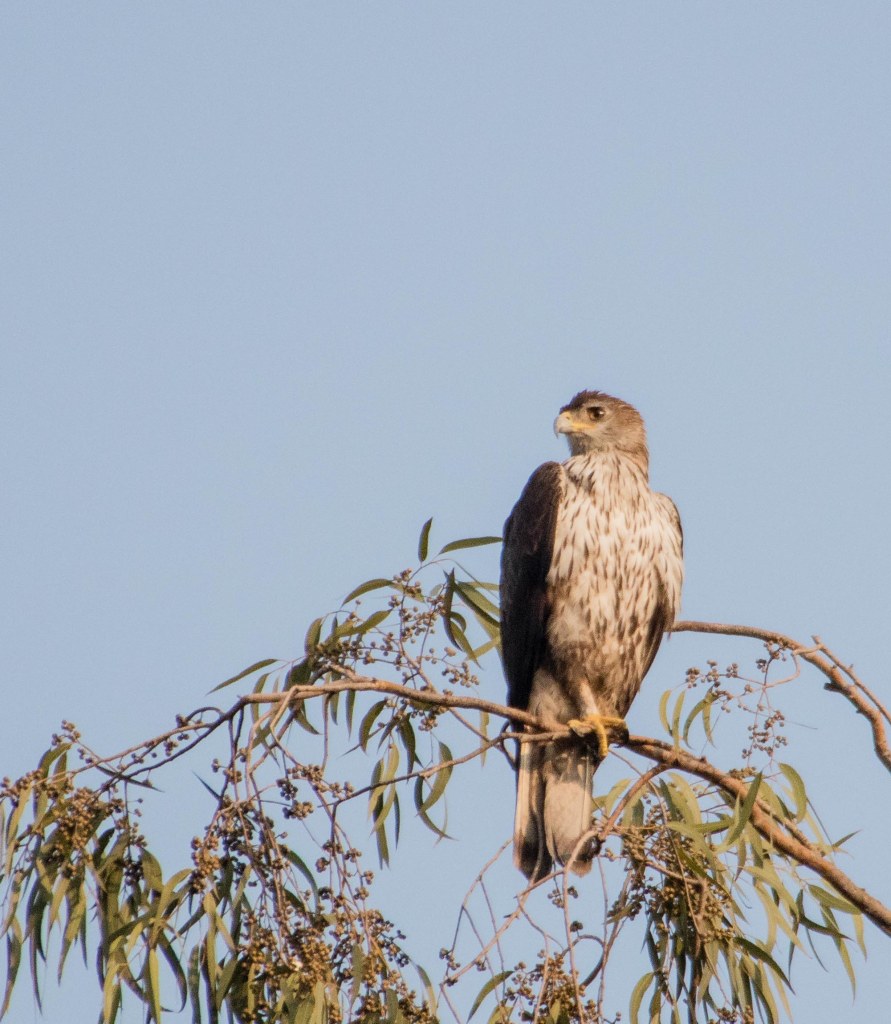
The adult female and the juvenile sitting along with it, had moved off. I finally located one of the juveniles sitting on a tree branch near the nest.
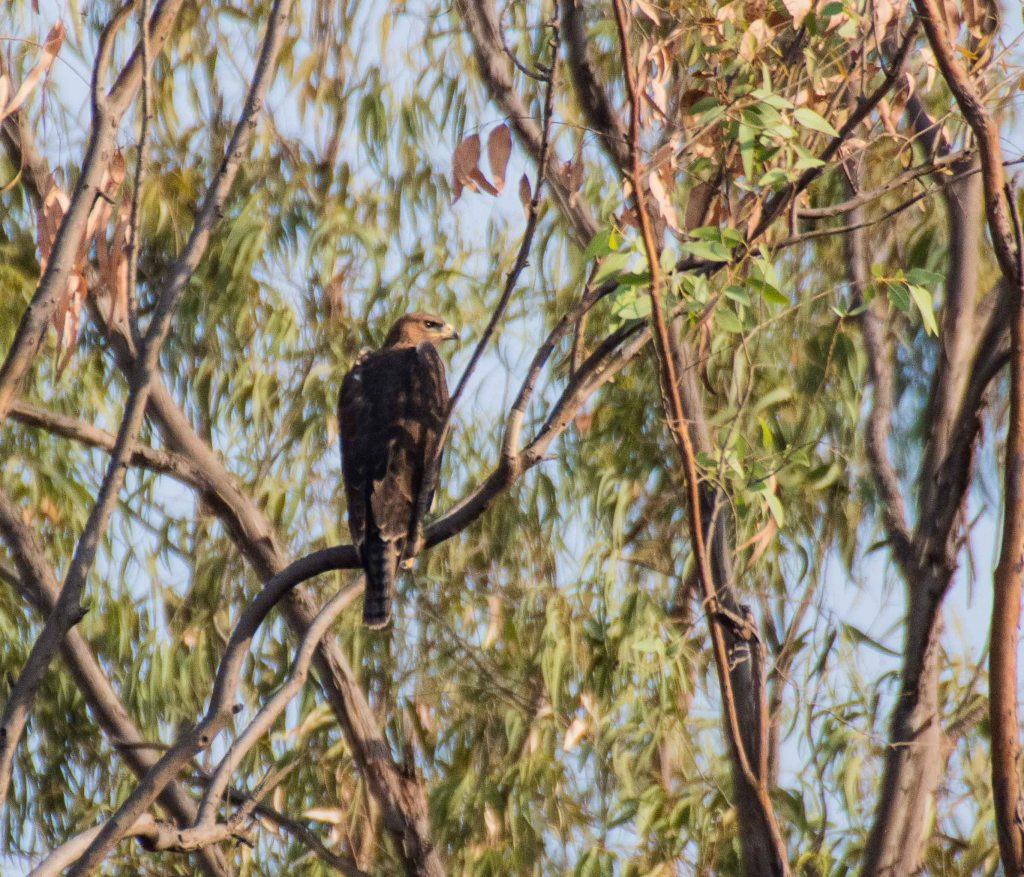
I could not spent more time observing I saw a pack of dogs coming towards me. I could also hear people’s voices. I decided to leave the area in order not to attract any unnecessary attention to the area. I left by 7:40am.
Week 12 (20th Apr)
We reached the nest area by 6:40am.
The adults were perched together on top of a tree nearby.
This time no Red-wattled Lapwings came to harass them throughout the time we were there. No calls were also coming at all. Just when I was suspecting if the juveniles had gone away, I saw one of the standing at the eastern edge of the nest. As we neared it, it flew off the nest and perched on a tree to the left.
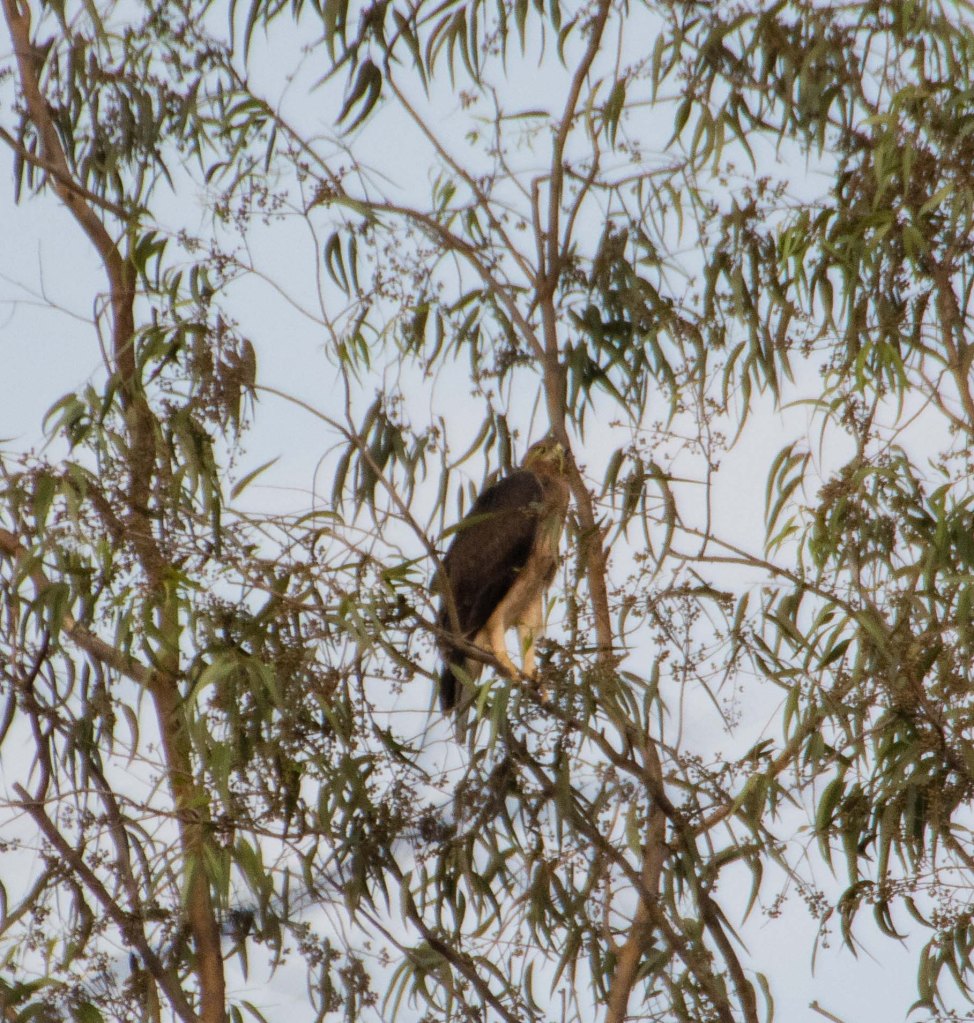
It started making its usual calls for a while then. A Black Kite glided overhead a few times. There was however, no reactions from any of the adults nor the juvenile. The Kite also did not make any aggressive moves. It flew away soon.
We decided to explore the surrounding area a bit in search of other birds. When we came back to the nest area by 8:10am, none of the Eagles were to be seen. Hence we decided to call it a wrap by 8:15am.
Week 13 (27th Apr)
I was unable to join Rahul on his visit to the nest area. I however, got news from Rahul that the juveniles were still around and where seen flying in the sky.
I had fallen ill with Viral Fever during the week. Owing to long recovery time to overcome the weakness from the fever, the 20th Apr trip became my last observation trip to the nest. I had wanted to atleast watch them for 2 more weeks. However the only thing that I was able to do, was to wish all the best to the young ones and the parents.
The Nest
This is the full length view of the nest.
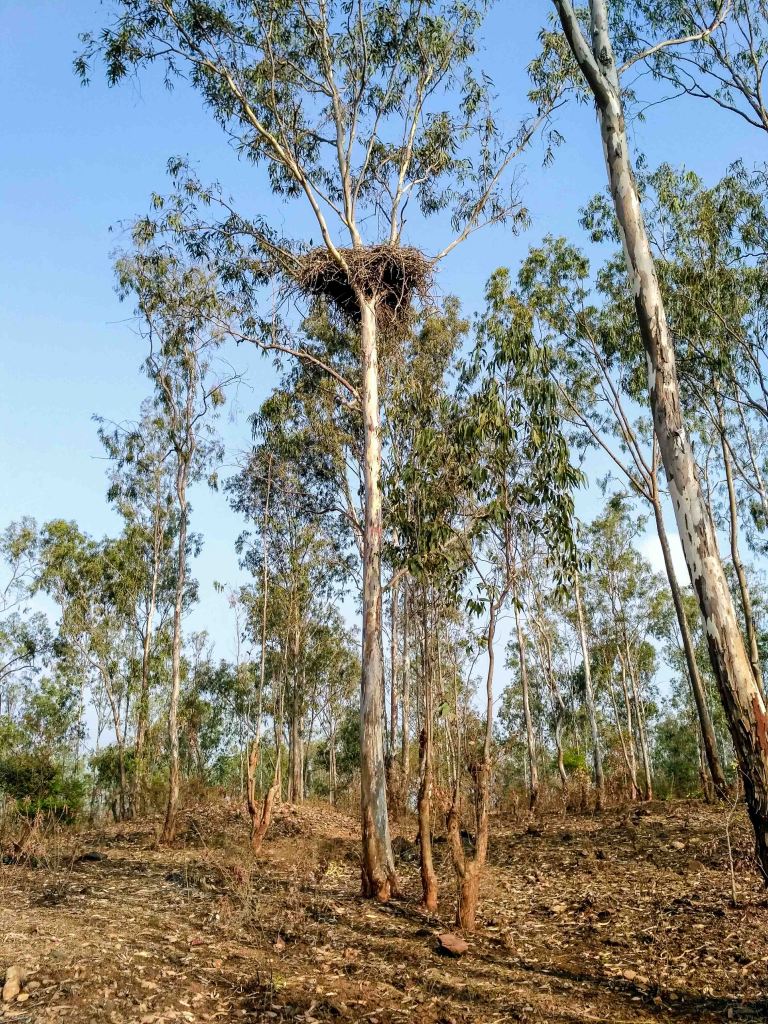
It had been built on an Eucalyptus tree and the intersection of three branches served as the supporting “foundation”. The nest material used seemed to be only small branches/twigs of Eucalyptus. Here is a view of the nest from almost under it.

The nest did not look as big from this angle and distance, unlike what it appeared to be from our usual observation spot.
Video
I started capturing, as much as possible, video recording of behaviour from the visit on Week 4 onwards. I have been luckily to capture a lot of interesting moments and behaviours. Almost all of the observations that I have described against the various weeks, have been captured on video.
In order to show the behaviour, even when the parents were not around, I have chosen to keep the video extensive. I have however inserted points of specific behaviour, to where you can directly jump. For this you will need to open the video in Youtube and expand the description to see the time markers.
All the recording has been done using my DSLR camera. So clarity is not the best. There is also a bit of shake at times as all recordings were done handheld. But it is still very much worth a watch 🙂 .
In order to make the period of capture easy to identify, I have inserted captions are the beginning of each week. Hope you enjoy the video.
A Humble Request
If you as a reader, is able to determine the location of the nesting site and decide to visit it, I request you to do so with utmost care and caution. Avoid going into the actual nesting area, especially when the adults (or potential chicks) are around. They are sensitive to people movement. Remember, the birds are the most important part 🙂 . And if you intend to tell or take an acquaintance, please be certain on the person’s “birding ethics” before you decide to do so.
Other Nesting Observations
Want to read up and see the breeding in another magnificent raptor, the Indian Eagle-Owl? Check out my detailed post on it here.
Interested in seeing nesting and breeding of some garden birds? Read my related posts Travails of Sunbird Breeding and Nesting of Common Tailorbird.
 Mad about Birding and Travel
I really enjoyed this post. Learned a lot about B eagles. I am a birder from Shillong. Thanks very much.
LikeLiked by 1 person
Thanks Glenn. I am glad you enjoyed it. I hope to bird some day in Meghalaya.
LikeLike
Excellent observation and narration.
I felt as if I was watching all the time.
LikeLiked by 1 person
Dhanapal, I am glad you liked it. Thanks for commenting as well.
LikeLike
Great observation and insights. Loved reading it. Thank you 🙂
LikeLiked by 1 person
Thanks Arpitha, I am glad you enjoyed it.
LikeLiked by 1 person
Superb documentation… Thanks for Sharing this it is very insightful.
LikeLiked by 1 person
Thanks Nitin. Happy that you found it informative
LikeLike
What amazing detailing of parenting for these two chicks. Superb!
LikeLiked by 1 person
KUDOS Thomas ! This is written exceptionally well. And as a raptor lover I can just imagine the overall experience.
More than the write up…its your passion , commitment & perseverance & relentless energy which needs special recognition.
This is a rare opportunity & I am mighty pleased you have capitalized on this to the fullest.
Certainly a dream come true! 👍👍👍
LikeLiked by 2 people
Thanks Vignesh. It was a surreal experience for me
LikeLike
Such a wonderful Article… All the best for the coming ones.
LikeLiked by 1 person
Thanks Vaibhav
LikeLike
Lovely read, thanks ! Simple format. Pictures and description
LikeLiked by 1 person
Thanks Prashanth. Yes, I wanted to make it simple for any person to read, especially for the “non-scientific” folks
LikeLiked by 1 person
You must have felt like a member of the family after your many observations!
LikeLiked by 1 person
Absolutely..I started missing them on the days that I wad not visiting the nest 🙂
LikeLike
Aren’t they stunning!
LikeLiked by 1 person
Yes Cindy, they were indeed fun to observe
LikeLike
Hi Thomas. At least not all is lost yet for the birds of Bangalore.
I saw some beautiful bird pics of Rahul taken beside Hennagara Lake. We are trying to save Hennagara lake and are working on a website for a group named Hennagara Lake Collective, so we need to add a few nice pics. But I have been unable to get any info on the net to contact Rahul. Could you please help.
LikeLike
Tushar, I will send you his email id over an email shortly.
LikeLike