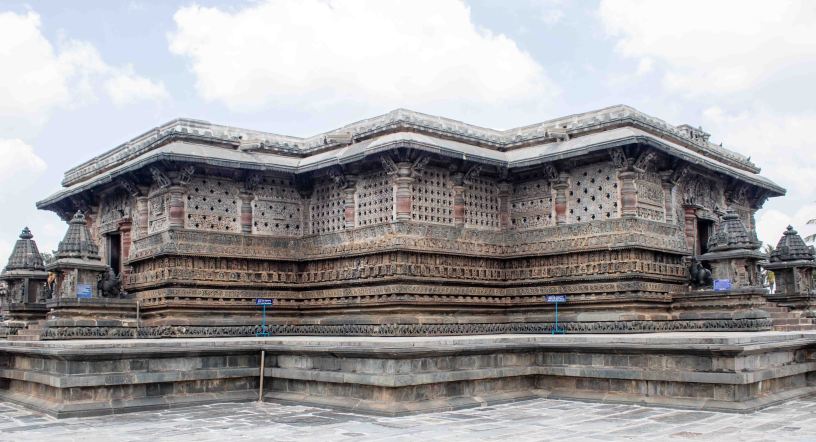
Chennakesava Temple at Belur; a wonder in its own right and a place that is not to be missed if you anywhere in the state of Karnataka or its neighbouring states in India. If you are interested in historical sites or sculptures, I guarantee that you will be blown away by it; such is the beauty of its structure and numerous intricate sculptures all around the temple.
We have been to the temple thrice over the years and yet our admiration for it has never diminished; rather it has only increased. Our first visit to the temple was in 2010. I distinctly remember the feeling of awe as well as confusion when walking around the temple complex; awe because of its beauty and confusion because I did not know where to look and what to admire. We hired a guide who helped bring in some structure to our visit 🙂 . It also helped in seeing many of its intricate details and stories behind many of the sculptures; something that we would surely have missed without the guide pointing them out.
In this post I am going to giving you an overview of the key attractions in the temple complex. But first a bit of history.
The temple was commissioned by the Hoysala King Vishnuvardhana in 1117 AD. He is said to have done this after an important victory in 1116 AD. It is said that the temple took around 103 years to build and was done so over three generations. It has been repeatedly plundered and damaged during various wars. However the temple is in pretty good shape because it has been repeatedly rebuilt and repaired. Several additions as well as removals (for e.g. in late 19th-century, the collapsing tower above the sanctum was removed to save the lower levels and never replaced) have been made to the complex over the course of time. The temple, as is evident from its name, is dedicated to Lord Vishnu; Chenna means handsome or beautiful and Kesava refers to Lord Vishnu.
Now to the key attractions in the temple complex:
The Gopuram
The gopuram that we see at the temple complex in the present day, was actually added during the reign of the Harihara II of the Vijayanagara Empire.
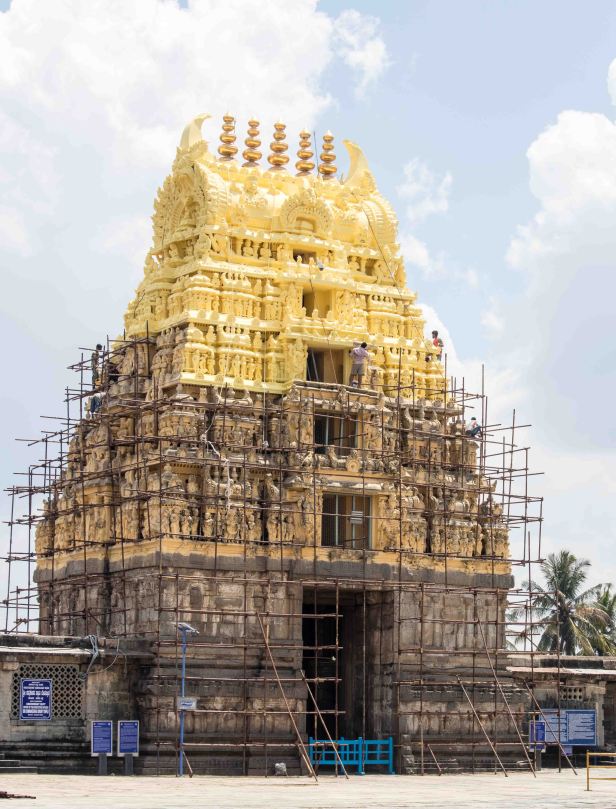
As can be seen from the picture above, it is a seven storey gopuram. It is made of brick. It is through this gopuram at the east that one usually enters the temple complex. It was getting fresh coat of paint when we visited. So we entered through another gate to the left of it.
Deepa Sthambha (Lamp Post)
Here is a panoramic view of the temple complex from the eastern gate through which we entered.
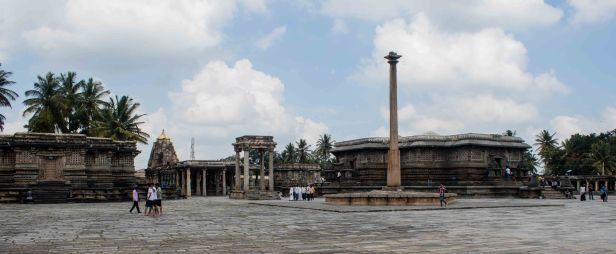
You can see the Deepa Sthambha almost in the middle of the above picture. Well, it looks like an ordinary pillar, you may say. Yes, there is nothing spectacular in its appearance. Rather it is in its design. It is roughly 42m high and the amazing aspect is that it is completely standing on its own weight; it does not have any foundation or cables that are supporting it. So it is also sometimes called as the Gravity Pillar. You can actually peer through a small gap at the bottom of the pillar if one examines carefully.
Hoysala Emblem
You can find this depicted in a large form (as in the picture below) at the entrance of the main temple.
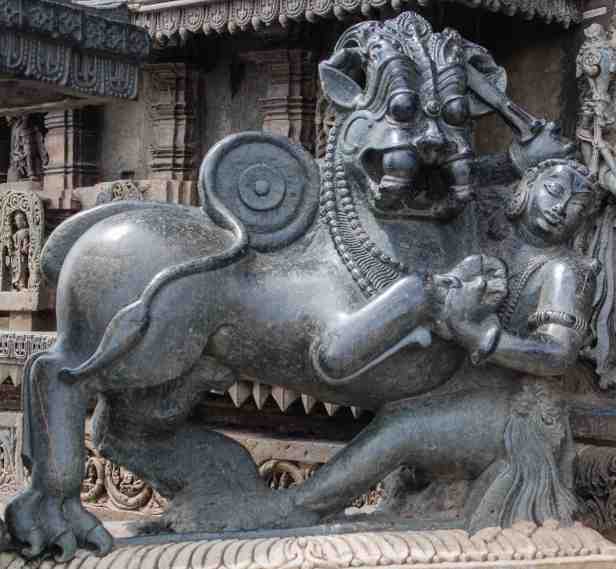
There are many interpretations behind what the emblem depicts. One of them, according to local folklore, is that of a young man by the name Sala who saved his guru by striking dead a tiger he encountered. The word “hoy” in old kannada (local language) means “strike”; hence the name “Hoy-sala”. Another aspect that may have made this legend gain popularity is after King Vishnuvardhana’s victory over the Cholas; the Hoysala emblem depicts the fight between a mythical warrior (Sala) and a tiger, the tiger being the emblem of the Cholas.
Well, whatever may be the actual origin, I think it looks really grand.
Main Temple (Chennakesava Temple)
The main temple is a single shrine structure. The overall shape of the shrine is a star shape. It is said that the temple was without walls and had an open mantapa (pillared hall or pavilion). One would have been able to see the highly ornate pillars that line the mantapa.
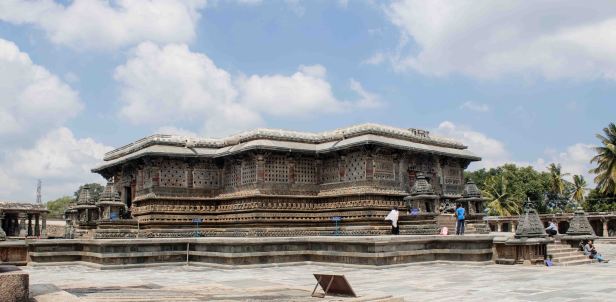
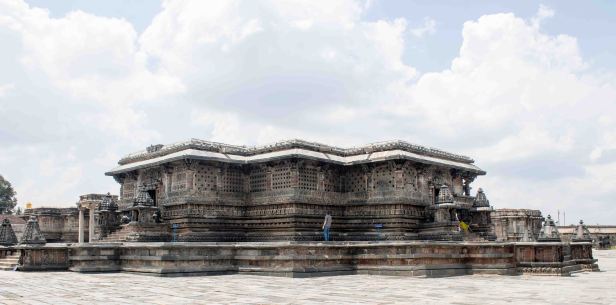 As can be seen from the above pictures, this is however no longer the case; walls and stone screens have been added thus obscuring the view of the pillars from outside. But these walls themselves have numerous artwork (covered further below in the blog post). You can also get an appreciation of the symmetry in the structure from the above pictures taken from south-east side and north-east side.
The temple itself stands on an open wide platform that goes around the complete temple. This platform is termed as jagati (meaning “worldly”). The platform provides devotees the opportunity to do a circumambulation around the temple before entering it.
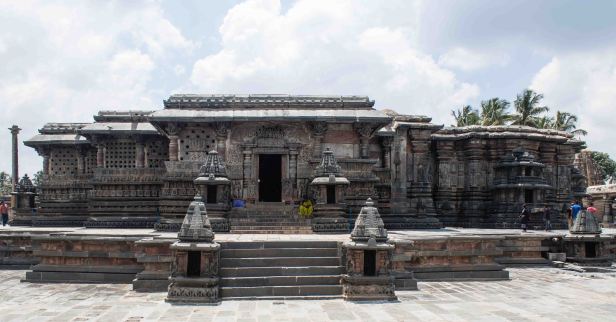
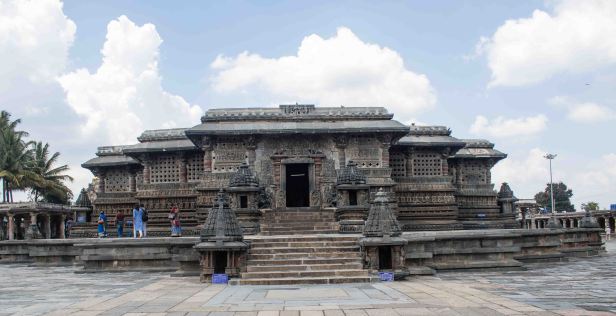
As seen from the pictures, there are a set of steps that lead to the platform and then another set of steps leading into the mantapa. It would be a good idea to follow the way of the devotees; first walking around the temple on the platform before entering the mantapa. This way you can appreciate the intricate sculptures that are there on the outer walls first and then go in to meet the deity.
Miniature Shrines
At the entrances of the mantapa and around the temple walls one can find several miniature shrines like the ones in the pictures below.
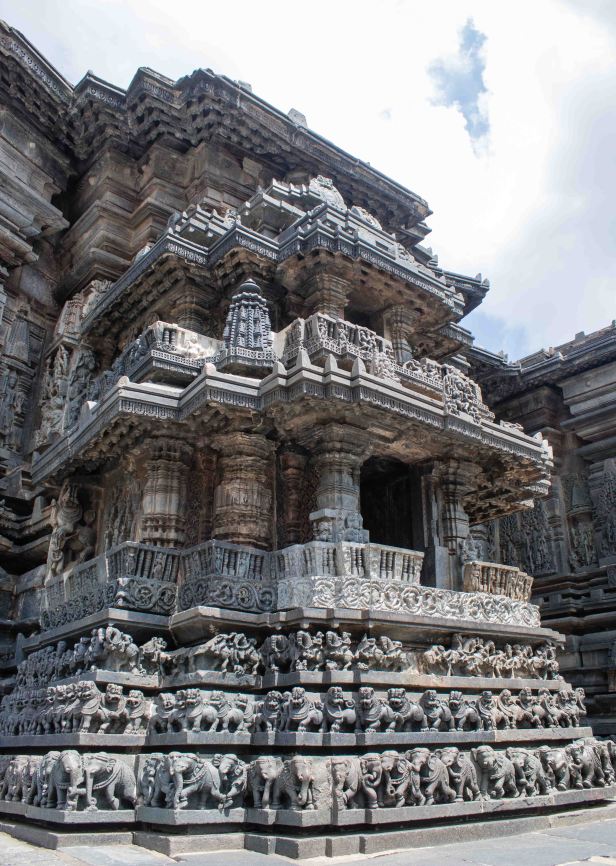

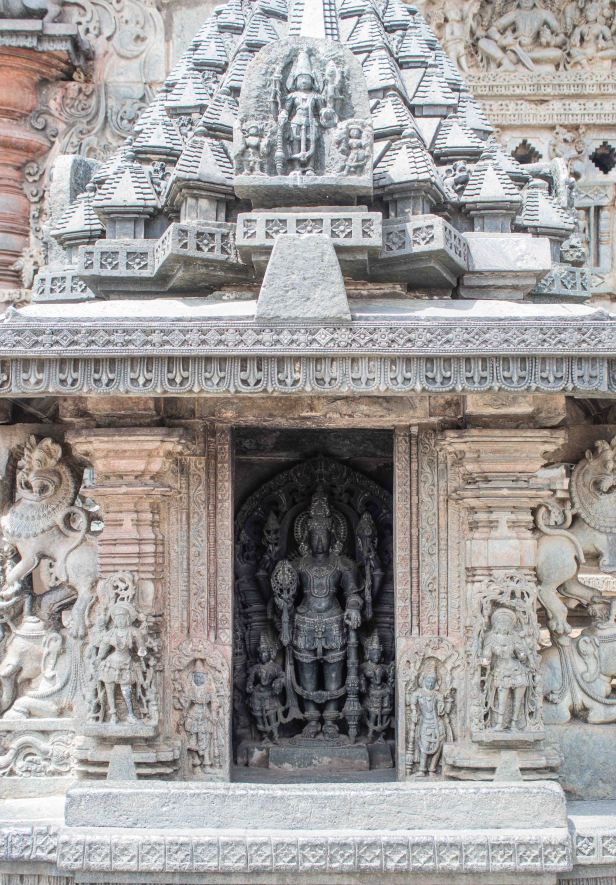 It is said that they some of them could have served as prototypes of the actual shrine that was to be built. Whatever its purpose, they are themselves intricately carved and definitely worth exploring.
Outer Walls
The best way to admire the artwork on the outer walls is to walk on the platform around the temple; and there is plenty to admire.
There are several layers that can be seen; each layer representing some specific aspect. In most parts, the bottom layer is made up of elephants with different expressions. This is meant as symbolic supporters of the entire structure or possibly representing strength. Following an empty layer and cornice work, is one that contains periodic lion faces (representing courage?). On top of this is a layer of scroll followed by cornice work again. In some part of the temple there is a layer of horsemen instead. Here is a sample of a pattern that is seen.
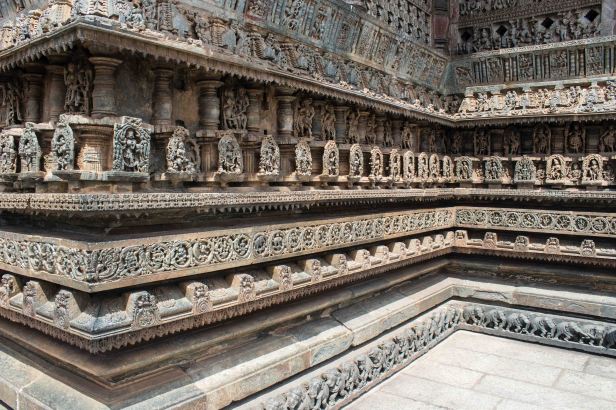
The fifth layer is set with numerous small figurines, mostly females. This layer also holds musicians and dancers. A sample of one such figurine is shown below.
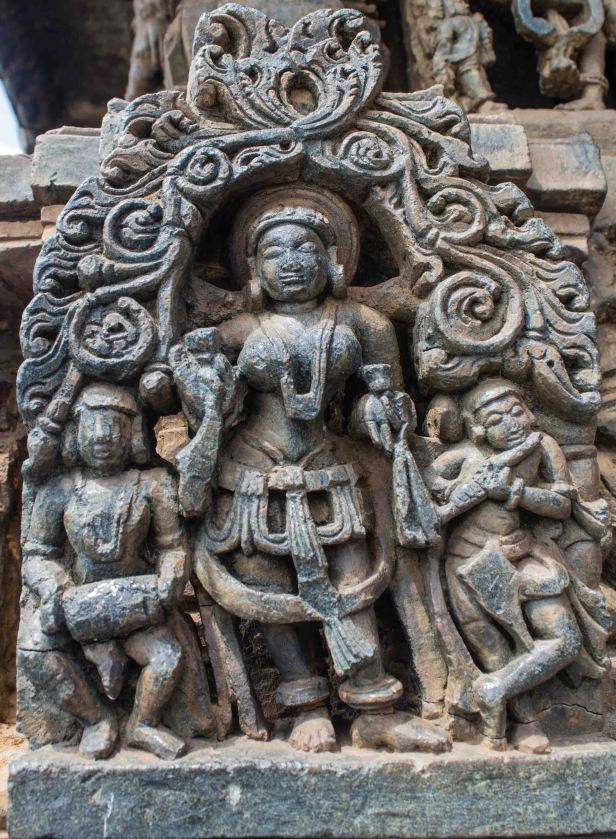
Above this is a layer that has small pillars between which are carved figures; of females or couples. After a layer of cornice work is a layer depicting scenes from common life as well as scenes from the puranas like Mahabharata. All in all, well worth giving it time to explore and discover.
Madanikas
These are one of the star attractions of art in the temple according to me, many of them with exceptional details. They are essentially sculptures of women in different poses. There were originally 40 of them around the temple. However only 38 are surviving today (sadly with some of them damaged). They can been seen on the upper layer of the outer walls on the pillars. Here is one of them depicting a mischievous monkey pulling the saree of a lady and snarling. She in turn is threatening it with a twig.
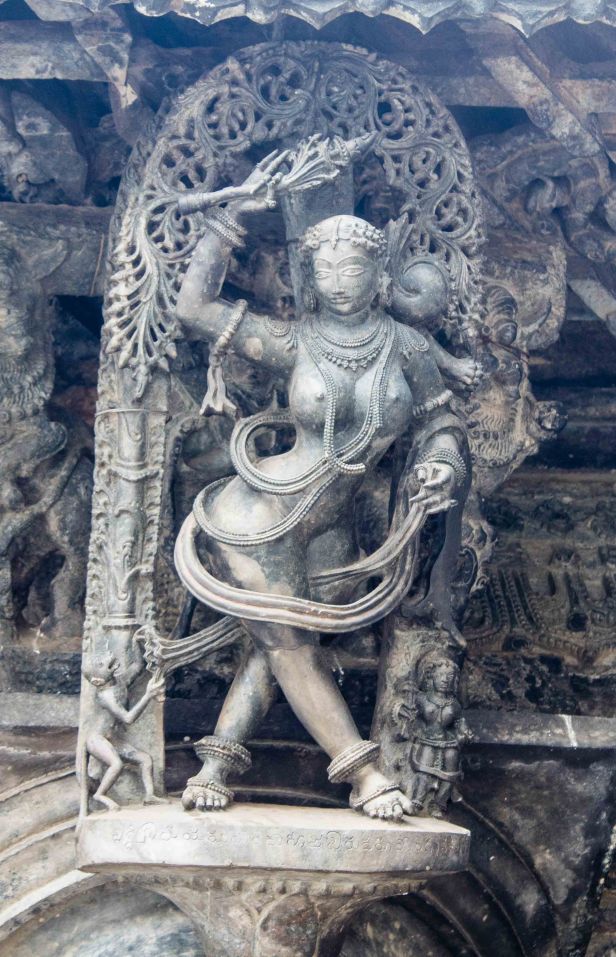
Many of the madinakas are said to have been modeled after the beautiful Queen Shantala, wife of King Vishnuvardhana.
I have not been able to explore the 38 that are remaining 😦 . Hence I intend to visit the temple just to explore the madanikas in more detail. I will follow it through with a blog post. I think they deserve one dedicated to them. They are just magnificent! (Update: I finally managed to return to explore all of them. Here is my post on the visit)
Entrance and Lintels over the Entrances
The temple has three entrances. Their doorways each have a doorkeeper (dvarapalaka) on either side. Here is the view of one of the entrances.

You can also see that the entrances have artistic work on the lintels over them. Here is one of them.
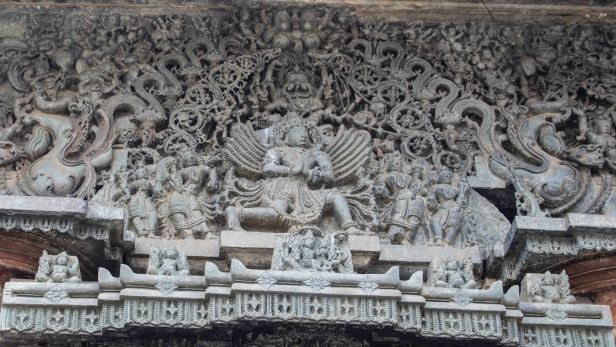
This one contains Makara, which are mythical beasts, on either side.
Pillars inside the Temple
The hall has 48 pillars. All pillars except for the central four, are each carved uniquely. the central four pillars were added later to support the internal structure owing to damage. Here is a view of some of the pillars.


All the pillars except the central four were lathe turned. The central ones were hand carved. Even though there is little sunlight that enters the temple owing to the outer walls that were added, the pillars all glisten. Such is their finish.
There are two special pillars that stand out; Narasimha Pillar and Mohini Pillar
Narasimha Pillar
This pillar is carved with miniature figures all the way from its top to the bottom. It is also said that the pillar could earlier be rotated. But it can no longer be done so. Below is a picture of the pillar.
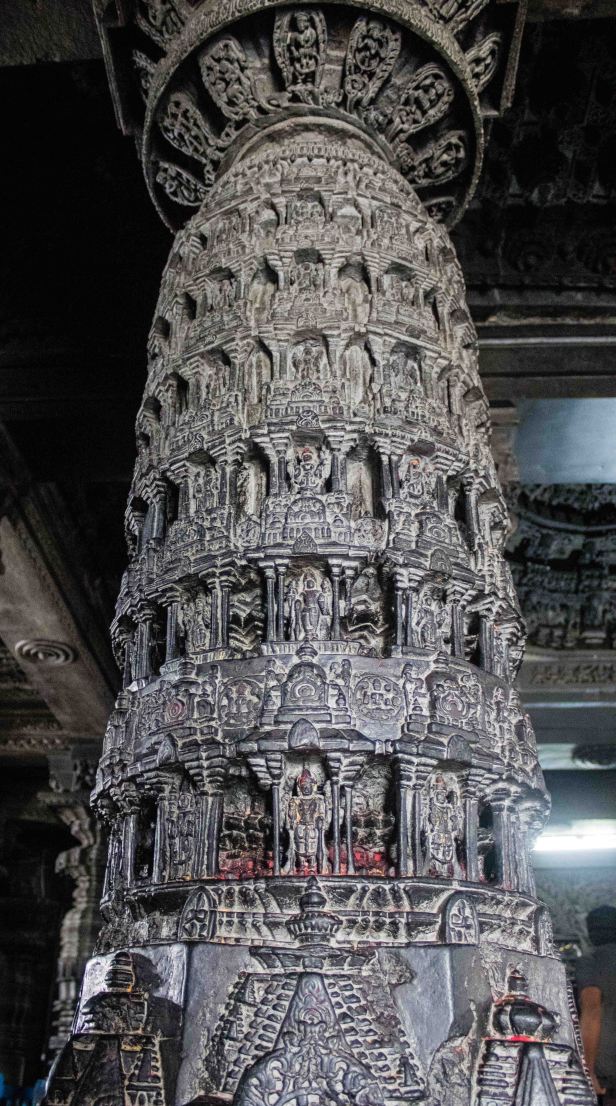
Some of the figures are “3D-ish” in nature. For e.g. you can actually pass your fingers through the spaces behind the figure shown in the centre of the picture below; so intricate were the carvings.
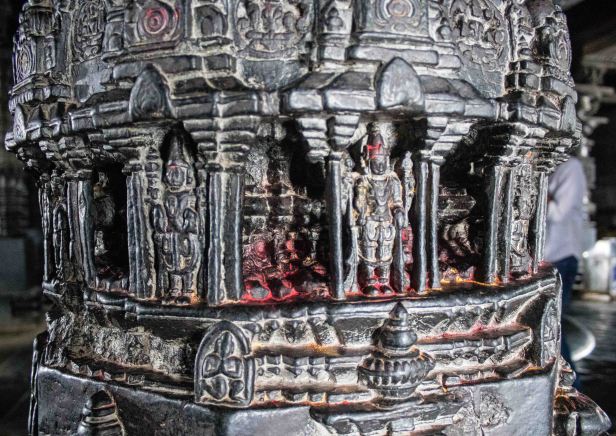
The pillar can be easily located by looking for one which has vermilion marks (look for red color) made by devotees.
Mohini Pillar
This pillar, as shown below, has the rendering of Mohini, the female avatar of Lord Vishnu.
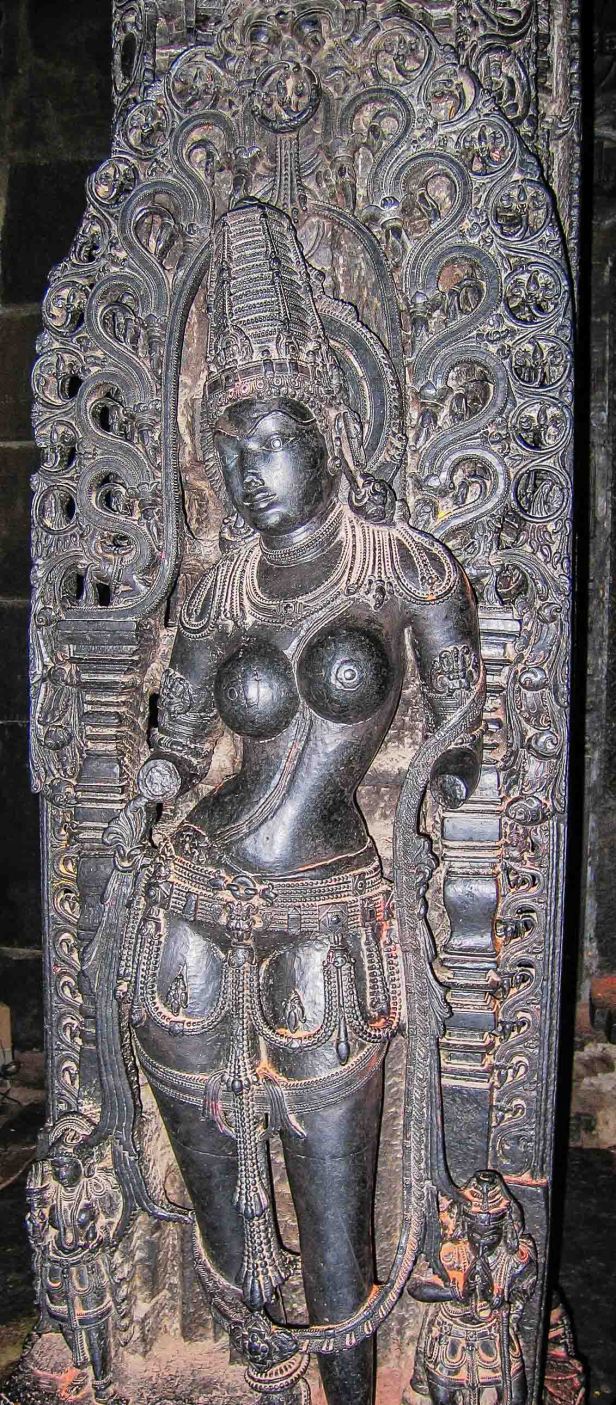
The pillar also holds carvings of several other avatars of Lord Vishnu as well as other deities and mythical creatures. This pillar too, is not to be missed in your visit.
Dome Ceiling
The center of the hall is an open area, above which is a domed ceiling, as shown below.
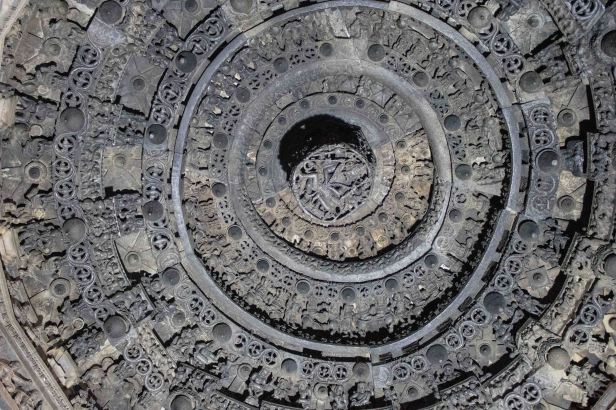
It holds depictions from various Hindu texts. Unfortunately it is not well lit owing to the limited amount of sunlight coming into the hallway.
Sanctum
The sanctum (or garbha griha) is at the end past the pillars and a doorway. This is where the primary deity resides. Here is a view of the entrance to the sanctum.
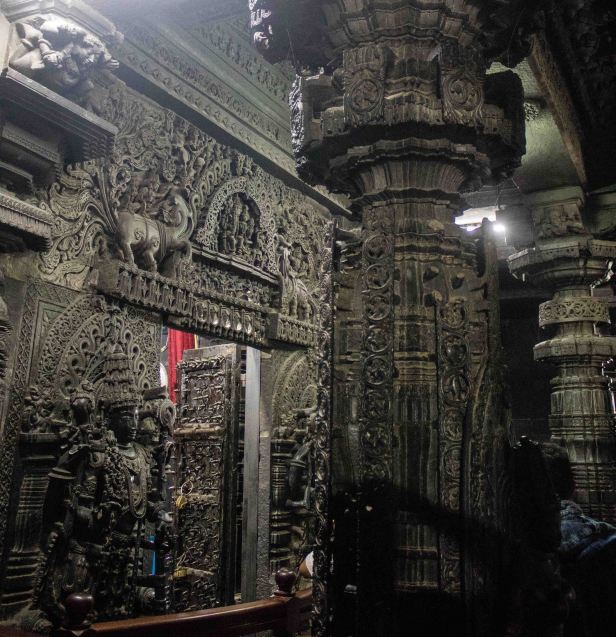
As can be seen in the picture above, the door is flanked by dvarapalas (door guardians), Jaya and Vijaya. The image of one of them can be seen below.
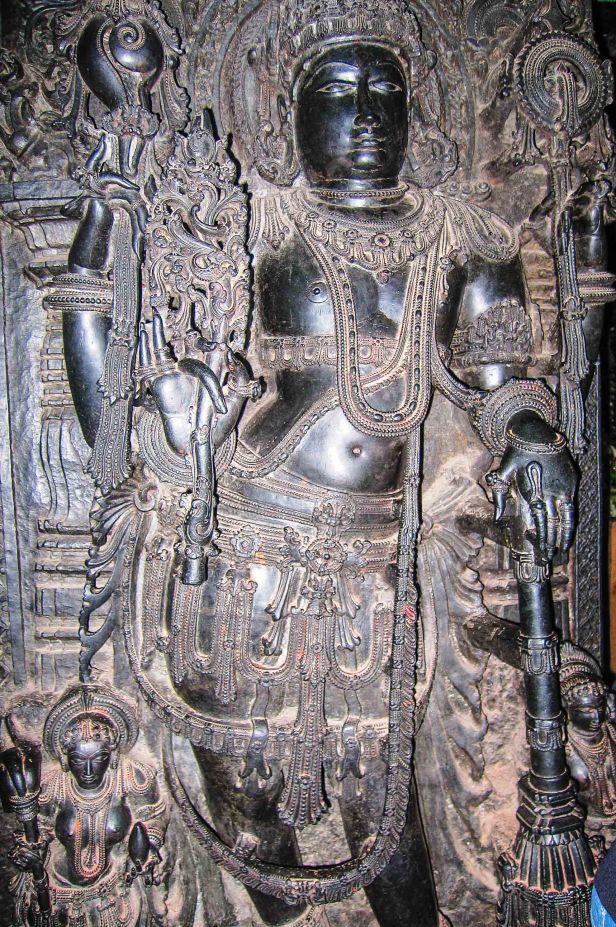
It is an active temple. Hence you will have priests doing puja and devotees doing darshana (auspicious sighting) of the deity. I did not take any photograph of the inner sanctum and the deity out of respect and hence have not included them here in this blog post. As a visitor, one can also do darshana.
Kappe Chennigaraya Temple
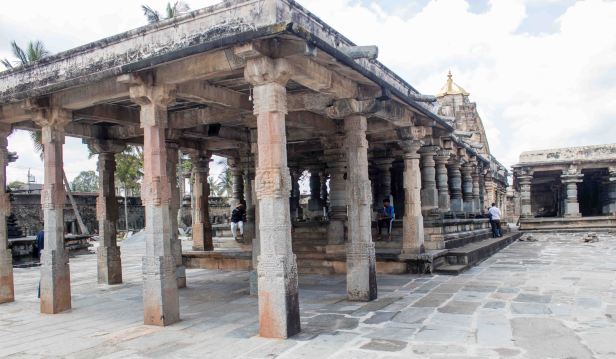
This temple is located to the south of the Kesava temple in the complex. This temple has two sanctums; one dedicated to Venugopala and the other to Chennigaraya (local popular name for Lord Vishnu). It is said to have been built by the queen concurrently with the main temple. Here are some pictures at the temple.
Veera Narayana Temple
This is located to the west of the Kesava temple. Its outer walls contain sculptures of Vaishnava (where Lord Vishnu is considered supreme) and Shaiva (where Lord Shiva is considered supreme) faith. It also depicts story of Bhima from the Mahabharata epic.
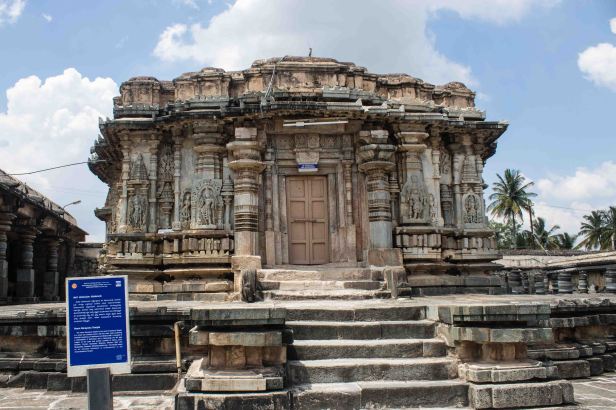
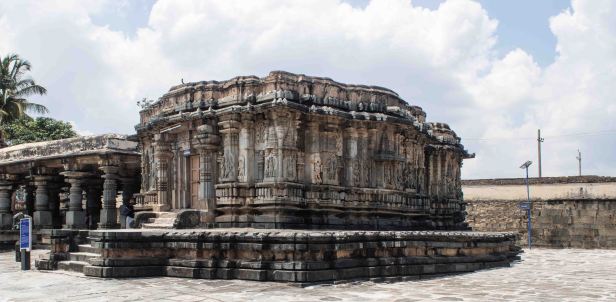
We were not allowed inside when we visited. It is small in size but is said to contain nine square halls and a sanctum.
Andal Temple
This temple is located to the north-west of the Kesava temple.
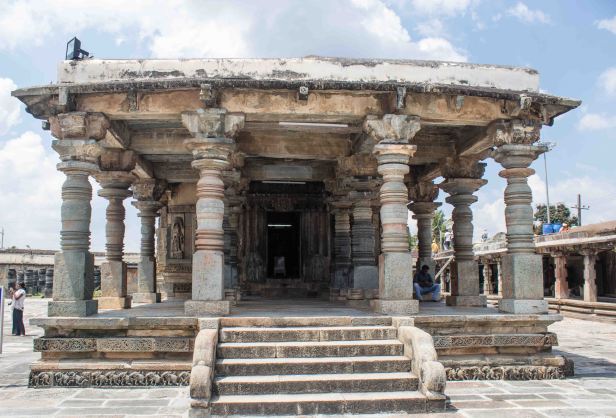
Its walls are decorated with numerous images of various deities from several traditions of Hinduism.
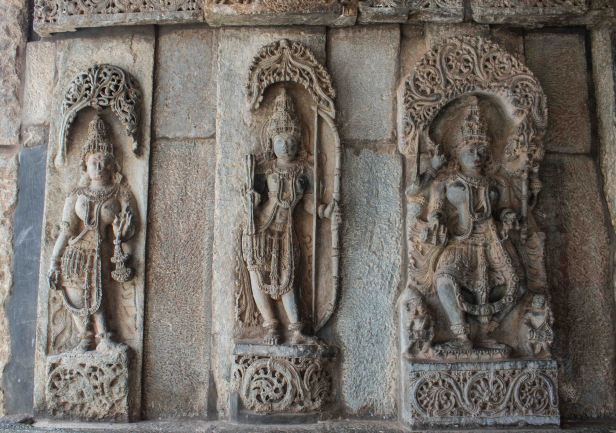
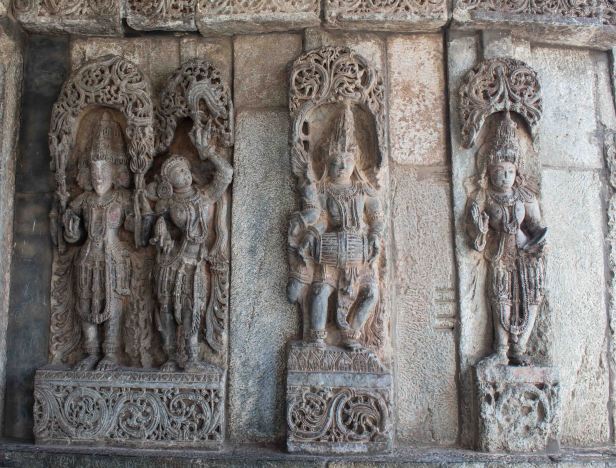
“Hallway”
I am calling it the “Hallway” as I could not find any reading material on what else it was meant for. This is located to the north of the Kesava temple. It also contains several intricate sculptures on its walls.
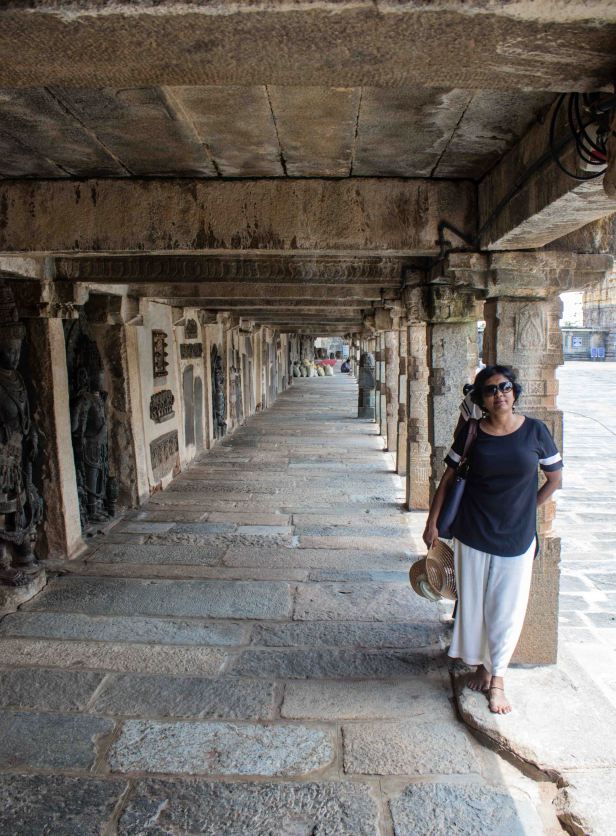
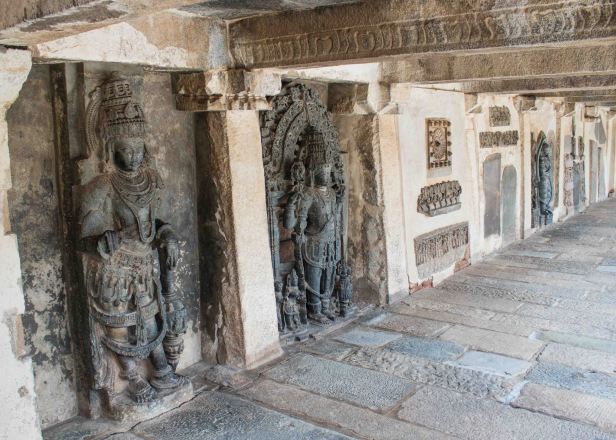
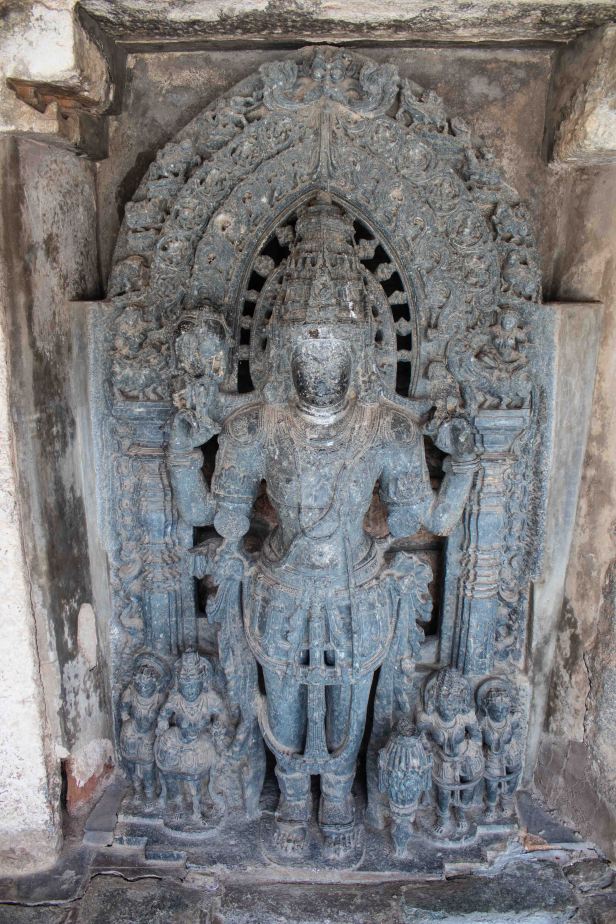
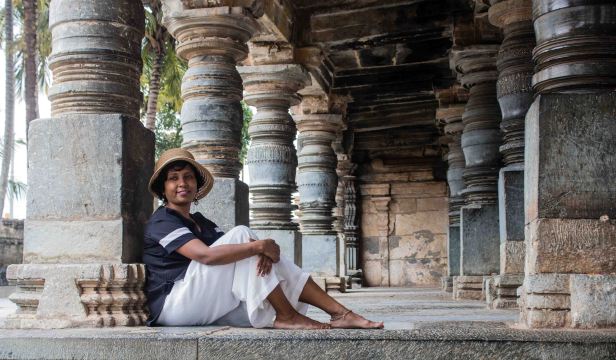
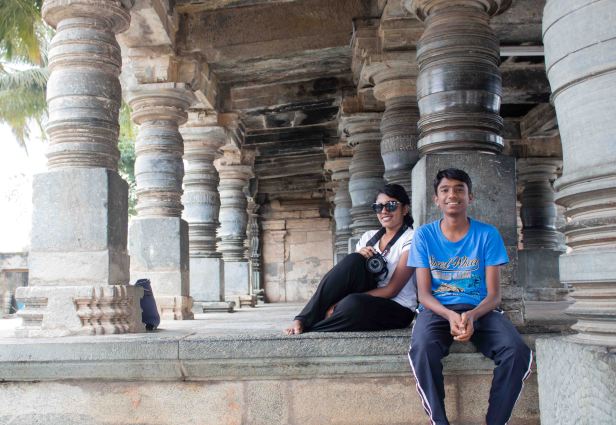
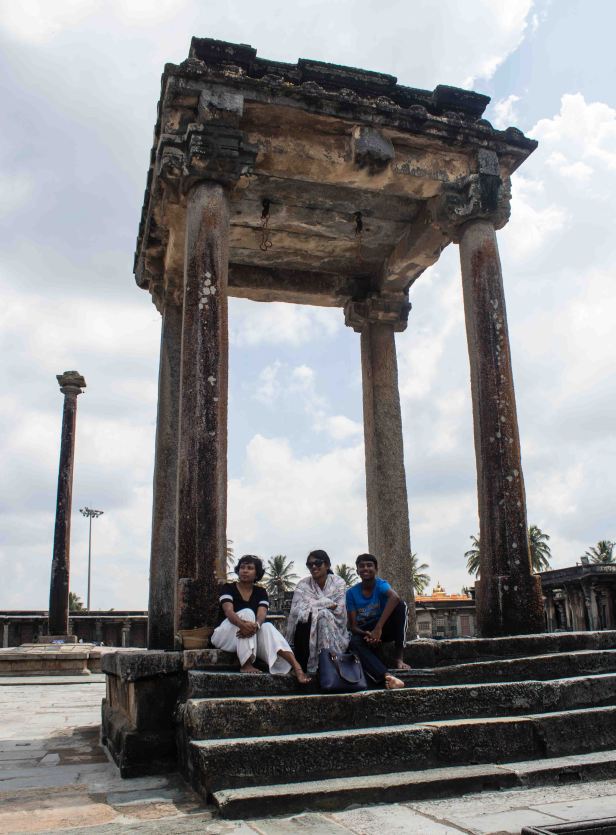
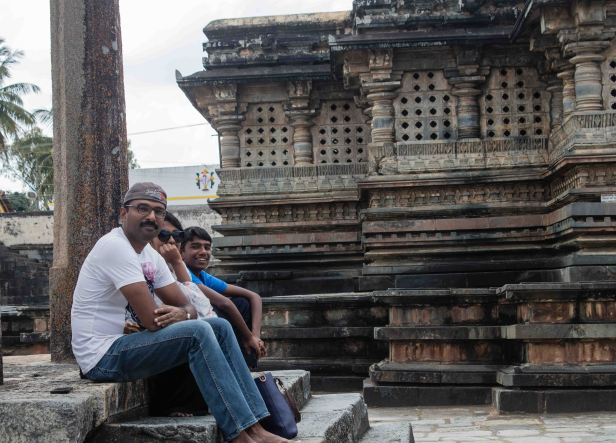
Here are a couple of pictures of us taken at another structure near the Deepa Stambha.
Virtual Tour
Here is a short virtual tour that I made of the key attractions in the temple complex.
Recommendations
How much ever one may read articles and see virtual tours of it on the web, it cannot equal the experience when one is physically there. So just go and visit it 🙂 .
It is a popular tourist destination. So if you are going on a public holiday or weekend, one should be prepared to meet crowds. Hence if possible try and visit it on any other day. It will make the experience far better.
Hire a guide. There are several authorised guides who can be found at the eastern entrances. They are very reasonable in their charges and well worth engaging them. They will show you many intricacies which can be easily overlooked in the vast temple as well as talk on history. It will enhance your experience of the place. Trust me! In a small manner you are also contributing to their livelihood.
Take a hat. The sun gets pretty strong and hot at times of the year. You will need it when walking. It is also a good idea to wear socks when going into the temple complex. You are required to leave your footwear out at the eastern gate. The temple complex ground has got rocks and therefore gets hot when exposed to sun. So wearing socks can provide comfort if you have sensitive feet.
While a visit in any season is possible, it does get pretty hot in the summer. Hence I recommend visiting it during winter (Dec to Feb).
Other Places of Interest Nearby
There are a few other places not too distant from the Chennakesava Temple of Belur that are worth visiting. They are Veera Narayana Temple at Belavadi (info here), Kedareshwara Temple at Halebidu (info here), Jain Temples at Halebidu (info here) and the Hoysaleswara Temple at Halebidu. You should aim to cover them as well during your visit.
 Mad about Birding and Travel
i simply LOVE this blog. Not only for a memorable family visit, but what a rich cultural heritage has to offer today. What an awe-inspiring architectural wonder…Make some think what our generation is leaving for the future!
LikeLiked by 1 person