
Birding in Ganeshgudi, especially at the Old Magazine House (aka OMH), is an unforgettable experience. And I had the pleasure of experiencing it first hand during the December of 2015.
First a bit about the places. Ganeshgudi is located in the Uttara Kannada district of the state of Karnataka in India. It is home to lush green forest ranges of the Sahyadris (aka Western Ghats) on the banks of the river Kali. Old Magazine House, also popularly called as OMH, is a tourist property owned by Jungle Lodges and Resorts. OMH is surrounding by thick forests and is considered a paradise for nature lovers, especially bird lovers. If you are a bird photographer then I guarantee that you will be heaven.
I had heard about OMH from several birders and how it was a destination not to be missed for any birding enthusiast. Doing some reading of it on the internet further fueled my desire to pay it a visit. However the finalisation of the trip took over a year from the time that I had heard of it. It got finally set for mid of Dec 2015. The travel group consisted of Ajit, Kumar and me. It was going to be the first visit there for both Kumar and I. Ajit had been there once a year before with a couple of other folks. The plan was to reach on a Thursday noon, stay for 2 nights and start back by Saturday evening. We choose this as on weekends the place gets pretty crowded with visitors.
Our onward travel plan was: Take an pvernight train from Bangalore and alight at Alnavar –> Catch bus to Dandeli –> Catch bus to Ganeshgudi
The overnight train ride was uneventful. We reached the Alnavar station early on Thursday morning.

Outside the station we were debating if we should catch breakfast at Alnavar or later at Dandeli. The arrival of a bus heading towards Dandeli at the station entrance forced the decision on us. We quickly boarded the bus and settled ourselves at the front. Our stomachs were protesting, but they would need to be patient till Dandeli.
Upon alighting from the bus at Dandeli we headed straight to a darshini (eating joint) opposite to the bus depot. What satisfaction it was to have piping hot Idlis and Vadas! After wolfing down our food we finished off with a coffee. Sufficiently refueled we headed out to our first birding stop of the trip; Dandeli Timber Depot.
Getting down from the autorickshaw that we hired, we walked through the gates of the Dandeli Timber Depot. I could feel my heart starting to beat faster with anticipation. This was supposed to be a hotspot to see Hornbills and Woodpeckers. And they did not disappoint. As we walked towards the main office building we heard the loud woosh woosh sound of the wing beats of a hornbill closeby. We all ran in the direction of the sound and managed to get a glimpse of the bird; a Malabar Pied Hornbill. We then went to the office building where they obliged to keep our luggage while we went birding around the depot. They next couple of hours flew past. The birds we sighted while walking in the woods included the Indian Grey Hornbill, Malabar Grey Hornbill and several pairs of Malabar Pied Hornbill

Small Minivets, Scarlet Minivets


Black-rumped Flameback, White-bellied Woodpecker, a Brown-capped Pygmy Woodpecker

a Jerdon’s Leafbird, Hair-crested Drongo, Veriditer Flycatcher and Velvet-fronted Nuthatch.

We also found a fruiting fig tree that was a magnet for birds. We saw birds including several Coppersmith Barbets, White-cheeked Barbets, a lone Brown-headed Barbet, Grey-fronted Green Pigeon and Yellow-footed Green Pigeon.
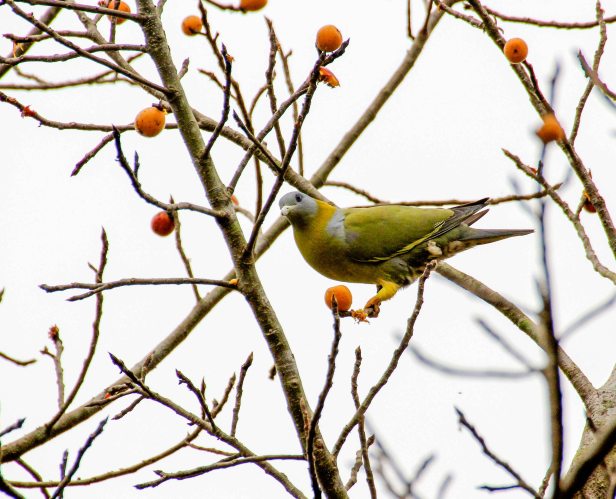
Our visit ended with sighting a Crested Serpent Eagle calling and soaring overhead as well as spotting White-rumped Needletails and Little Swifts flying around catching insects. A Malabar Giant Squirrel also obliged us with some superb views of it going about its daily chores.

Back at the Dandeli bus depot we caught a bus that dropped us of at Camp-1, the stop closest to OMH at Ganeshgudi. We had to walk a bit from the main road to reach the OMH office and residence block. Ajit warned us that though the distance was not much it would take us a while to complete it given the bird “distractions” that were expected on the path. His warning was prophetic; our walk on the path was interrupted every a minute or so with some bird appearing and disappearing. I could see that the next two days here were going to be exciting. We finally “managed” to reach the entrance of OMH.
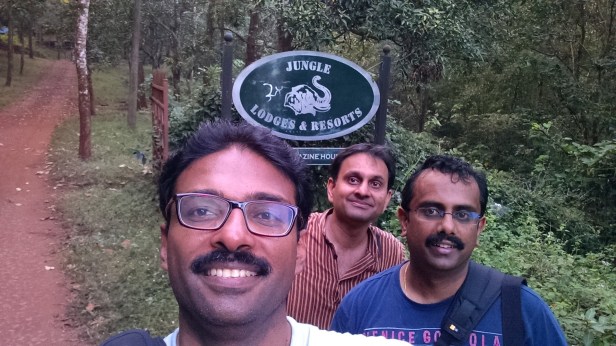
After completing the check-in formalities and freshening up we set out to bird. We could see the fabled bird baths of OMH. This is where one will find the most activity; from birds as well as photographers 🙂 . Most photographers tend to stay put near them. We could already see several tripods with cameras mounted on them positioned behind the green screen. The staff had also placed several chairs around so that the guests could sit when there was less bird activity at the bird baths and then could return quickly to their cameras when necessary to capture the “action”. The bird baths also had aesthetically created perches to enhance the beauty of photos. Best of all; the birds come to you (technically the bird bath); a bird photographer’s paradise! One could easily do arm-chair birding (read Birds @ Home to know my definition) here.
The restaurant is placed above the dormitory block. The bird baths are easily visible from here, an advantage and disadvantage. Advantage since one can keep an eye out while eating for any new or interesting arrivals at the bird baths. Disadvantage as something interesting almost always happens and mad birders like us would find it irresistible to leave the food and scamper to catch the action. So we always kept our binoculars and cameras close by whenever we were at the restaurant.
We had three days at OMH. So on the first day we spend most of the time at the bird bath area. Below are some of the birds that we saw around there during our stay:


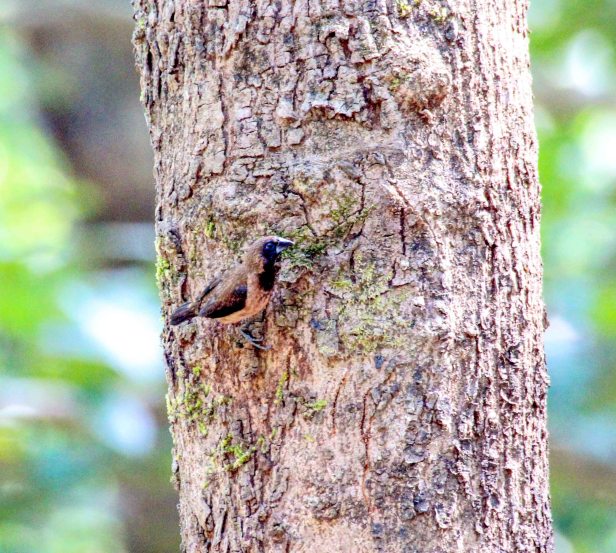

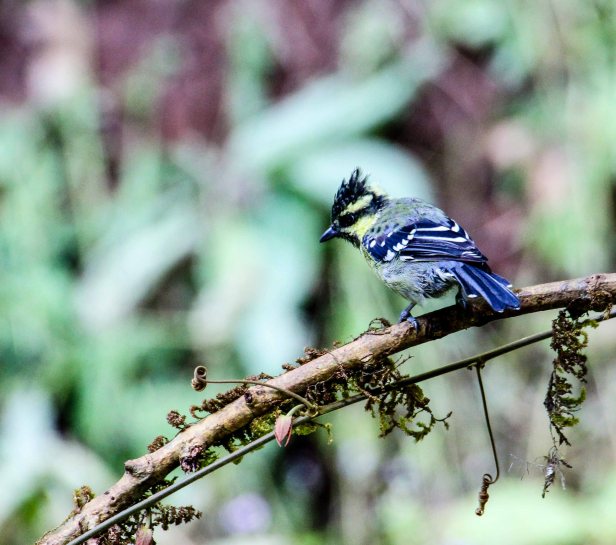
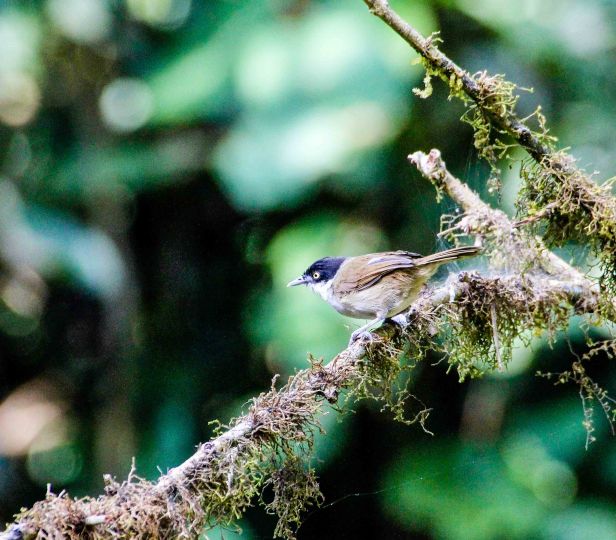


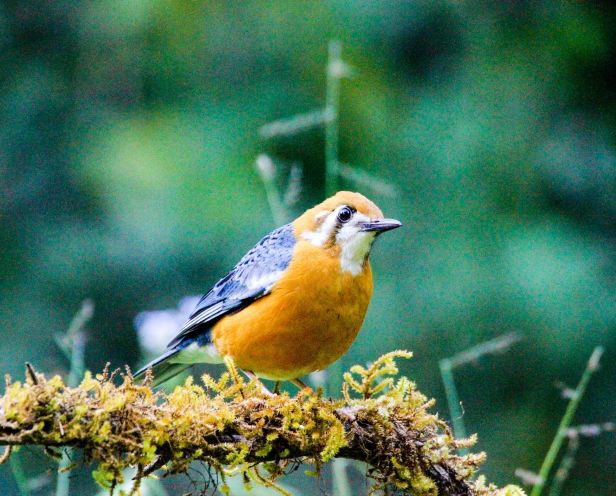
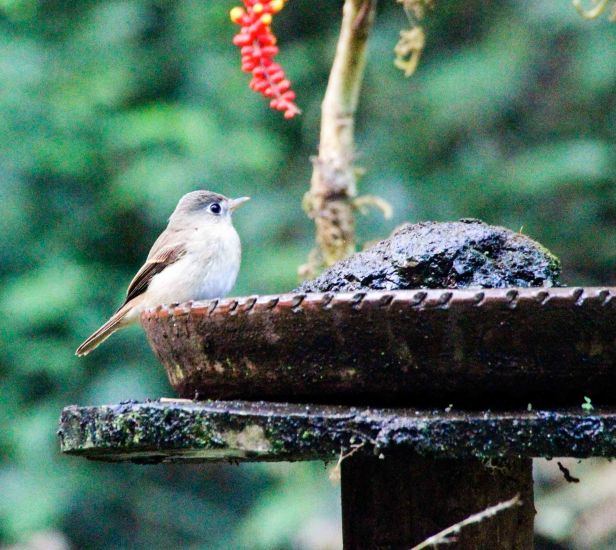

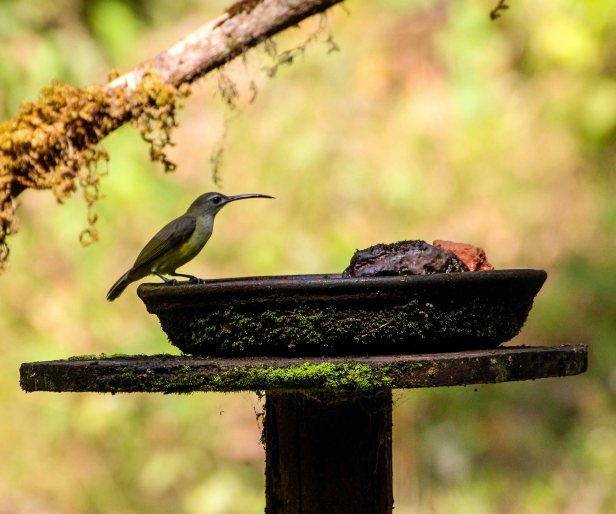
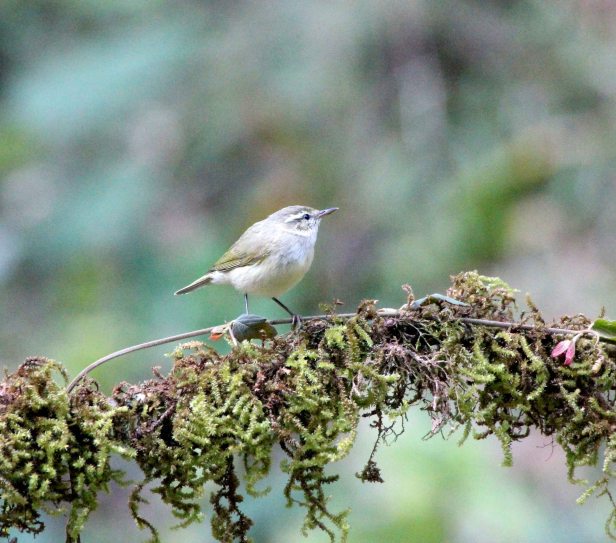
Once night fell the time was spent reminiscing on the events of the day, making notes of all the sightings, identifying the lifers for each of us, checking on the possible species in this part of the country based on the field guide and of course the general banter and fun that we always have when we get together. Post dinner we spent some time sitting outside chatting and enjoying the silence as well as the sounds of nature; something we miss when we are living in the city. We also took a short walk down the pathway leading back to the road to catch a glimpse of the resident Tarantulla as well as any Geckos. Of course we were also hoping to be surprised by an Owl or Nightjar. Luck did not favour us with the birds though.
We woke up very early in the mornings. We wanted to be ready and outside well before dawn so as to hear the calls/songs of the birds. And they did not disappoint us. It was very melodious. The most outstanding were the Malabar Whistling Thrush, Oriental Magpie-Robin and the Greater Racket-tailed Drongos. The whistling of the Malabar Whistling Thrush is unforgettable once heard; one can appreciate where it gets its name from when hearing it. The period before dawn is the best time to hear them “whistling” as they are rarely heard during other times.
The first morning brought in another star; a pair of Great Hornbills. They announced their presence by the sound of their wing-beats; a sound no other bird can match. It was a misty morning. So it took a bit of effort to narrow down where they had landed. We finally managed to spot them eating some fruits up on one of the tree tops.
The mist stayed well into the mornings. We still walked down the path back to the main road. Taking pictures of any birds was impossible in the mist. Visibility was only a few feet. However I think it also helped in a way; birds could also not see us until we were almost up to them. This is how I got to see my first Banded Bay-Cuckoo. It was sitting on an open branch besides the path. It looked equally to surprised to us. It eventually reacted and flew off.
Given the misty mornings the time spent for breakfast were long. Once the mist decreased we walked on the path all the way to the main road and then explored the road upto the entry towards the Hydro Electric Project as well as towards the opposite directions. These places provided good views of the Chestnut-headed Bee-eater, Thick-billed Flowerpecker, Scarlet Minivets and the Malabar Parakeets.
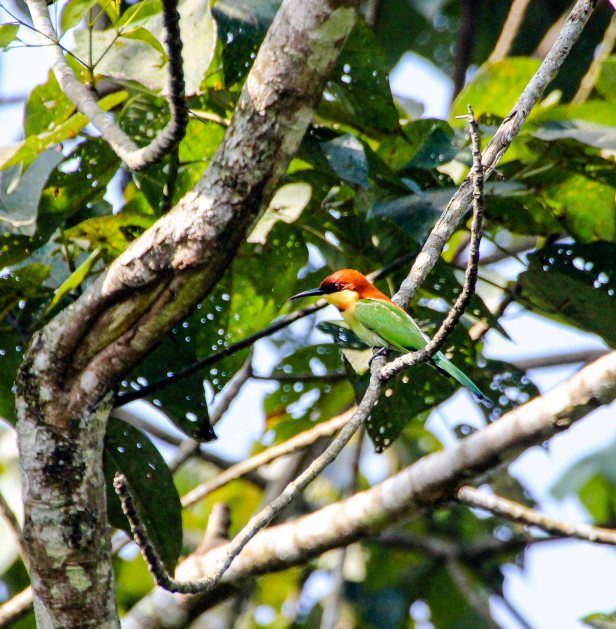

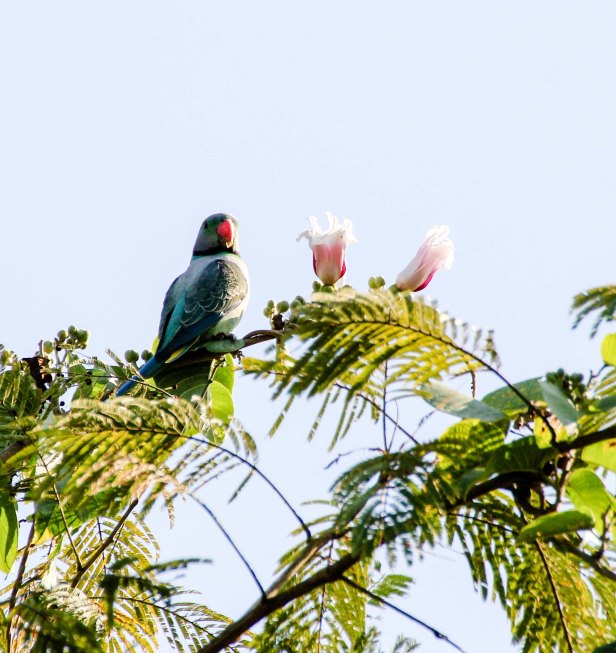
The remaining parts of the day was mostly spent walking on the path between the main road and OMH several times. It provided plenty of action. One just had to be patient and attentive; birds always show up. You have to be fast in most cases though as they will not come out and perch in the open for too long as at the bird baths. However here you will get to see birds that will usually not come to the bird baths. So the walks were well worth the effort. Below are some of the birds that I saw during these walks:


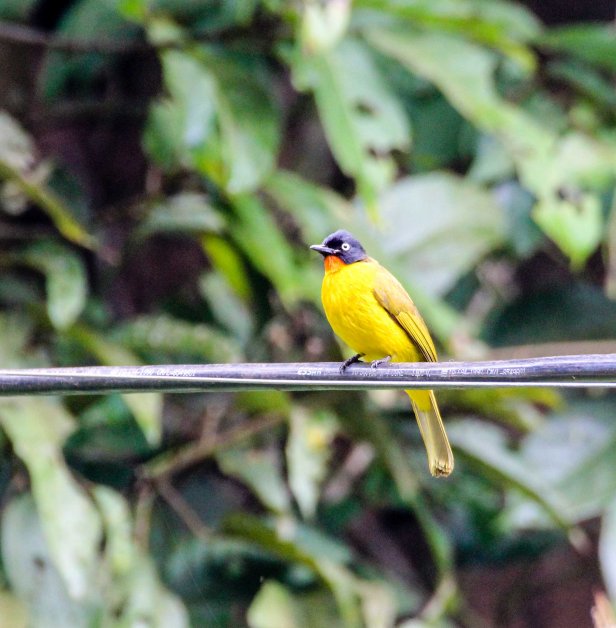


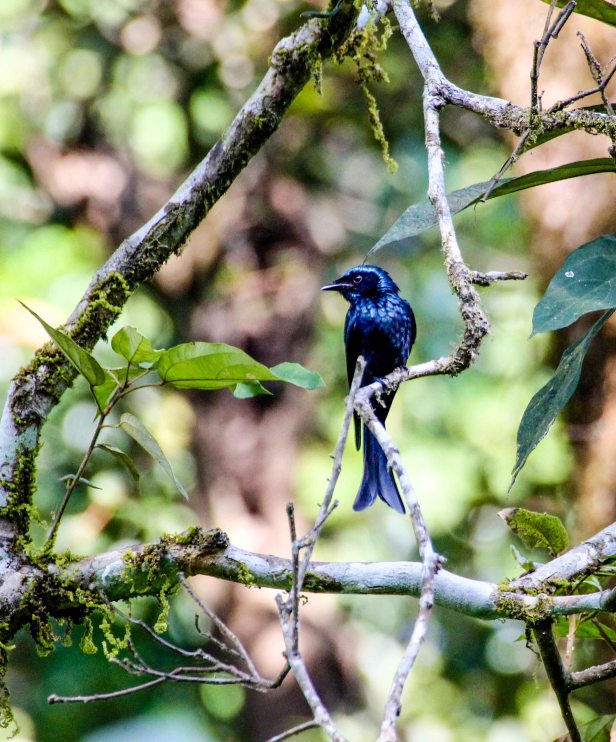

There were plenty of warblers around in the trees on this pathway; Blyth’s Reed Warbler, Green Warbler, Greenish Warbler, Booted Warbler, Sykes Warbler.
A bird that is on the wish list of people visiting OMH is the Malabar Trogon. It certainly was for Kumar as he had not seen one before. On couple of occasions while walking on the path we could clearly hear its calls from some tree not too far. However it did not reveal itself. On one such walk when Kumar had decided to stay back at the bird bath Ajit and I decided to pull a fast one on Kumar. We took a close-up photograph of the picture showing the Malabar Trogon from the billboard at the start of the path at the main road. Once back at the bird bath with Kumar we announced loudly that we had seen a Malabar Trogon. He and several other guests nearby immediately turned around and came looking at us with awe. They all wanted to see any pictures that we had managed to take of the bird. So we whipped out our camera and showed the photo we had taken. It was not soon that Kumar understood that we were playing a prank. There were smiles all around and probably relief that they had not missed seeing the bird 🙂 .
In the evening of the second day we decided to climb up the hill besides OMH. The walk up was not easy but well worth it. Reaching the top will provide an unobstructed view of the Kali River and catching the sunset here can be magical.

One can also get to some birds such Little Swifts and Common Kestrals.

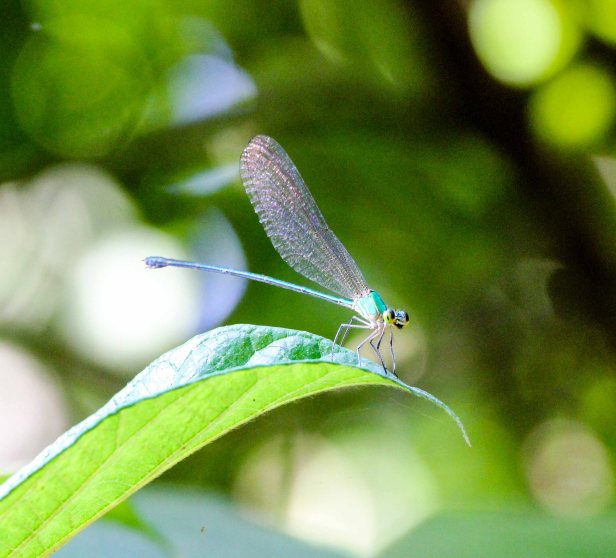
A visit to the OMH need not be only about birds. There are plenty of butterflies and damselflies to admire as well. Here is one I managed to photograph.
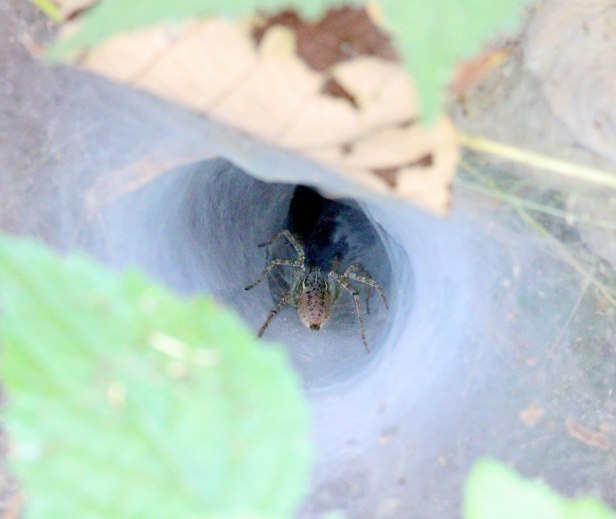
Other interesting denizens that we got to see were a family of Wild Boars, Funnel Spider
as well as the Flying Lizard or Draco.


On the evening of the third day it was time to bid goodbye to OMH and head back home to Bangalore. We hired a taxi to Londa railway station from where we caught the overnight train to Bangalore.
So had the trip been worth it? Had OMH lived up to the hype that is associated with it? The answer is an emphatic YES. I loved the overall atmosphere the place offered. It has something for every one; all that one needs is to like being in nature. The bird sightings were of course fantastic. But for me the trip is not been memorable just for the birds. Rather it was the wonderful time the three of us had as a group in the trip. We could have seen far less in the trip and it would still have been a great trip. For me that is what is going to stay strongest from the trip. So thank you Ajit and Kumar for being such wonderful co-travellers.
Recommendations
Photography is most promising at the bird baths. So if that is your thing then spend more time there. However do not miss to take a few walks on the path from the main road to OMH as well as along the main road. You may get to see many species that do not visit the bird baths. Having one of the OMH staff as a guide can also be worth it. They are very familiar with the bird calls. We found Jom particularly good.
The walk up to the hill top is well worth it. Take one of the staff from OMH with you as a guide. The path is not that well marked and can also get confusing especially when coming back down at dusk.
Try and visit OMH during weekdays. Weekends usually get fully booked and can feel crowded. I think birds will also be more forthcoming when there are less people to disturb them.
Warning
If you got into birding or bird photography only recently and are planning to visit OMH then be warned that given the “ease” with which you get to see or photograph birds at OMH it is possible that you will be set with an expectation for all birding destinations to be of similar ease. However the reality is far different. By all means do visit OMH but do not become set with this expectation 🙂 .
Bird Checklist
Below are the birds that I saw during the trip:
| 1 | Ashy Drongo |
| 2 | Asian Brown Flycatcher |
| 3 | Asian Emerald Dove |
| 4 | Asian Fairy-bluebird |
| 5 | Asian Koel |
| 6 | Banded Bay Cuckoo |
| 7 | Barn Swallow |
| 8 | Bar-winged Flycatcher-shrike |
| 9 | Black Drongo |
| 10 | Black-headed Cuckooshrike |
| 11 | Black-naped Monarch |
| 12 | Black-rumped Flameback (Lesser Goldenbacked Woodpecker) |
| 13 | Black-throated Munia |
| 14 | Blue-capped Rock-Thrush |
| 15 | Blyth’s Reed Warbler |
| 16 | Brahminy Kite |
| 17 | Bronzed Drongo |
| 18 | Brown-breasted Flycatcher |
| 19 | Brown-capped Pygmy Woodpecker (Indian Pygmy Woodpecker) |
| 20 | Brown-cheeked Fulvetta |
| 21 | Brown-headed Barbet (Large Green Barbet) |
| 22 | Cattle Egret |
| 23 | Chestnut-headed Bee-eater |
| 24 | Chestnut-shouldered Petronia (Yellow-throated Sparrow) |
| 25 | Chestnut-tailed Starling |
| 26 | Cinereous Tit (Great Tit) |
| 27 | Common Hawk-Cuckoo |
| 28 | Common Iora |
| 29 | Common Myna |
| 30 | Common Tailorbird |
| 31 | Coppersmith Barbet |
| 32 | Crested Goshawk |
| 33 | Crested Serpent-Eagle |
| 34 | Crimson-backed Sunbird (Small Sunbird) |
| 35 | Dark-fronted Babbler |
| 36 | Flame-throated Bulbul (Ruby-throated Bulbul) |
| 37 | Golden-fronted Leafbird (Golden-fronted Chloropsis) |
| 38 | Great Hornbill (Great Pied Hornbill) |
| 39 | Greater Coucal (Southern) |
| 40 | Greater Flameback |
| 41 | Greater Racket-tailed Drongo |
| 42 | Green Bee-eater |
| 43 | Green Warbler |
| 44 | Green/Greenish Warbler |
| 45 | Grey Junglefowl |
| 46 | Grey Wagtail |
| 47 | Grey-fronted Green-Pigeon (Pompadour Green-Pigeon) |
| 48 | Hair-crested Drongo (Spangled Drongo) |
| 49 | Heart-spotted Woodpecker |
| 50 | House Crow |
| 51 | Indian Blackbird |
| 52 | Indian Blue Robin |
| 53 | Indian Grey Hornbill |
| 54 | Indian Paradise-Flycatcher |
| 55 | Indian Pond-Heron |
| 56 | Indian Scimitar-Babbler |
| 57 | Indian Tit (Indian Yellow Tit) |
| 58 | Jerdon’s Leafbird (Jerdon’s Chloropsis) |
| 59 | Jungle Myna |
| 60 | Large-billed Crow |
| 61 | Large-billed Crow (Indian Jungle) |
| 62 | Little Spiderhunter |
| 63 | Little Swift (Indian House Swift) |
| 64 | Long-tailed Shrike |
| 65 | Malabar Barbet (Crimson-throated Barbet) |
| 66 | Malabar Grey Hornbill |
| 67 | Malabar Parakeet (Blue-winged Parakeet) |
| 68 | Malabar Pied-Hornbill |
| 69 | Malabar Trogon |
| 70 | Malabar Whistling-Thrush |
| 71 | martin/swallow sp. |
| 72 | Orange Minivet |
| 73 | Orange-headed Thrush |
| 74 | Oriental Magpie-Robin |
| 75 | Oriental White-eye |
| 76 | Plum-headed Parakeet |
| 77 | Puff-throated Babbler |
| 78 | Purple Sunbird |
| 79 | Purple-rumped Sunbird |
| 80 | Red-breasted Flycatcher |
| 81 | Red-rumped Swallow |
| 82 | Red-vented Bulbul |
| 83 | Red-whiskered Bulbul |
| 84 | Rock Pigeon (Feral Pigeon) |
| 85 | Rose-ringed Parakeet |
| 86 | Rusty-tailed Flycatcher |
| 87 | Small Minivet |
| 88 | Southern Hill Myna |
| 89 | Spotted Dove |
| 90 | swift sp. |
| 91 | Thick-billed Flowerpecker |
| 92 | Tickell’s Blue Flycatcher |
| 93 | Velvet-fronted Nuthatch |
| 94 | Verditer Flycatcher |
| 95 | Vernal Hanging-Parrot (Indian Lorikeet) |
| 96 | White-bellied Blue Flycatcher |
| 97 | White-bellied Woodpecker (Great Black Woodpecker) |
| 98 | White-cheeked Barbet (Small Green Barbet) |
| 99 | White-rumped Munia |
| 100 | White-rumped Needletail (White-rumped Spinetail) |
| 101 | White-rumped Shama |
| 102 | White-throated Kingfisher |
| 103 | Yellow-browed Bulbul |
| 104 | Yellow-footed Pigeon (Yellow-footed Green-Pigeon) |
 Mad about Birding and Travel
WOW! What an amazing habitat with SO many different birds gathering there!
LikeLike
It certainly is Henry. Thanks for reading and commenting
LikeLike
Thomas, just got to read this. What a write up. Lived each and every minute of the trip. I still cannot forget the near convincing Trogan prank that you and Ajit played on me 🙂
LikeLike
Yeah we almost pulled it off!
LikeLike
Very intresting with so many beautiful bird sightings
LikeLike
Made for good reading on a Sunday morning when I didn’t go birding. This destination has been on my list but haven’t yet been there. Now I have an idea of the place, thanks to your blog Thomas. Super sightings and clicks !
LikeLiked by 1 person
Thanks Anu. You must go there. It is also good place to just cut off from civilization for a bit..
LikeLike
Fabulous portfolio of pics. A feast for the eyes. Thanks for profiling them with such care.
LikeLiked by 1 person
Glad you liked it Harish. Thanks for reading and commenting
LikeLike