
When one hears or thinks of Hampi the picture that usually forms in the mind is that of sprawling historical ruins of the erstwhile Vijayanagara empire. This was the case for me as well. My family and I had gone to visit these ruins several years ago based on this (read about it at : Hampi – A Tour of the Historical Site). But this view got enhanced when I got into birding.
As a birder I love to observe birds, even if they are ones that I have seen many times before; almost always amazed by their beauty, their behaviour and in general the wonders of nature! So I end up going birding on weekends and it is mostly to places nearby to where I live. But once in a while one gets the urge to want to see some species that one has not seen before. It was one such urge that made me want to bird at Hampi.
Hampi is considered one of the best places to see the beautiful Painted Sandgrouse, Painted Spurfowl, Indian Eagle Owl and the Yellow-throated Bulbul. I had already seen the Owl and the Bulbul in other places. So the Sandgrouse and the Spurfowl were the main targets for me. So it was with this that a birding trip was conceived of. It got set up for in the first weekend of February. And what a trip it turned out to be; ending with more than just birds as well as an unexpected lifer (a term used in birding when you see a species for the first time)!
The trip was to be for 2 nights and 3 days with an intent to cover Hampi, Daroji and places around. My companions were going to be Kumar, Vinay and Aravind. Deepa had wanted to come but had to back-out as the proposed travel dates were clashing with another trip commitment that she had earlier made. We agreed to drive down in my car. Having a car would give us flexibility moving in and around Hampi. Preparing for the trip was the next bit.
Local expert: While it is possible to bird by oneself I generally prefer to have a local expert to accompany whenever possible. In the case of Hampi there is non better than Mr. Pompayya Malemath to be the local guide. He is considered an expert in the local specialities and has been involved in the conservation of the Indian Sloth Bears. Deepa, though she was not going to be able to make it for the trip, was kind enough to liaison with Mr. Pompayya to secure his services for the trip.
Research on sites and species: I went through the various blogs, trip reports, bird checklists and youtube videos for this. To my list of main targets I ended up adding a few desirables 🙂 ; Brown Crake, Indian Thick-Knee, Rock Bush-Quail, Indian Courser and the Grey-necked Bunting. Well the list was a bit more; let us however keep it as this as I would not want you to think I was crazy 😉 . But these were on top of the list of desirables.
Google Maps indicated that it was going to take roughly 7.5 hours to reach Hampi from my house in Bangalore. Mr. Pompayya wanted us to reach Hampi by around 12:30pm so that we could dedicate the second half of the day to cover the Daroji Bear Sanctuary. So we decided to start by 3:30am. The boys arrived by 3:30am at my place. After transferring all the luggage and camera equipment into my car we set off by 3:45am. Hampi, here we come!
The route we took for the onward journey was via NH48 and then turning off this highway at Hiriyur. We hoped to do some birding enroute. Our first birding stop was just before a place called Harathikote after having turned off the NH48. What made us stop were several large flocks of Rosy Starlings flying overhead across our road. But once you stop you of course have to do a bit of walking and birding 🙂 . The chill in the air was also refreshing.
We were on our way again after 45 minutes. Our tummies were soon growling and demanded that they be serviced. And who are we to deny? There did not seem too many options available on the road that we were travelling on. Soon we reached a town were we were hoped to find some. None caught our fancy. We kept going hoping our luck would change. Several minutes later it looked like we were leaving the town. I immediately pulled over to the side. There was no way I was going to miss breakfast 🙂 . We all concurred that we turn back and stop at the nearest road-side eatery. And that is what we did. We stopped at one around a minute from where we turned back.

We gobbled up several rounds of piping hot dosas, chilli bhajjis, pulao, thatte idlis and ended it with coffee. There is no appetiser better than hunger.
We did a further two stops enroute before reaching Hampi. We good excellent views of a Blue Rock Thrush and Large Grey Babblers. Indian Robins seemed to be common in these terrains. We met Mr. Pompayya at the Forest Guest House near Kamalapur a bit after noon. We first headed over to his homestay; we were going to stay there for the 2 nights. After a short break and refreshing lassi drink we set off towards Daroji Bear Sanctuary.
As the name suggests Daroji Bear Sanctuary’s most famous residents are the Indian Sloth Bears. For us it was also going to be a good habitat for Painted Spurfowl, Painted Sandgrouse, Bush-Quails and Indian Thick-Knee. Once the formalities, entry fee and camera fee were paid up at the entrance we drove on into the sanctuary. The observation tower where we headed to was a good distance inside. All through the drive we kept a keen lookout for our target birds. None obliged. However we saw a good number of Jungle Babblers and Yellow-billed Babblers.
Mr. Pompayya had packed lunch for us. We ate this at the watch tower as we took in the beautiful surroundings. The Jungle Babblers were all busy going about their activity. Noisy birds I must say! Mr. Pompayya commented that a sure shot way to get a person mad was to lock them up in a room with a bunch of Jungle Babblers 🙂 .
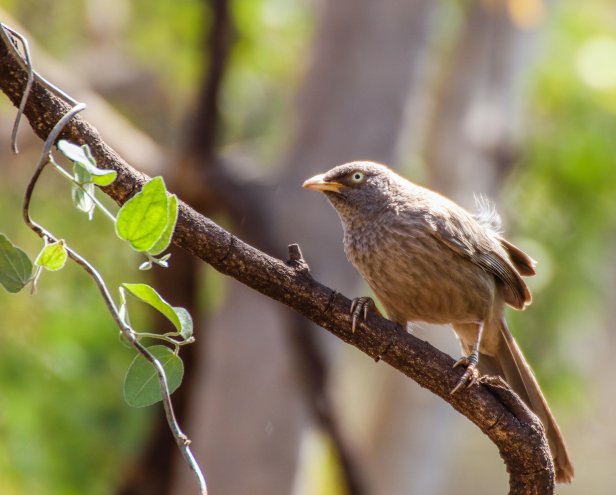
We also witnessed a young one being fed by its parent. A wonderful sight!

Our lunch was interrupted by the arrival of a pair of Painted Spurfowl. All of us abandoned eating and rushed to get good views of it. Our first target species and what a beauty they were! Mr. Pompayya told us confidently to return to our lunch as we would get to see them many more times.
Post lunch we settled ourselves in the watch tower. With the afternoon sun blazing down it was getting hot. But a frequent breeze and we being in the shade kept it comfortable. I wondered how it must be in the peak of summer! While we waited for the famous residents to appear we were kept entertained by several Indian Peafowls,

Laughing Dove, numerous Red-vented Bulbuls, Grey Francolin,
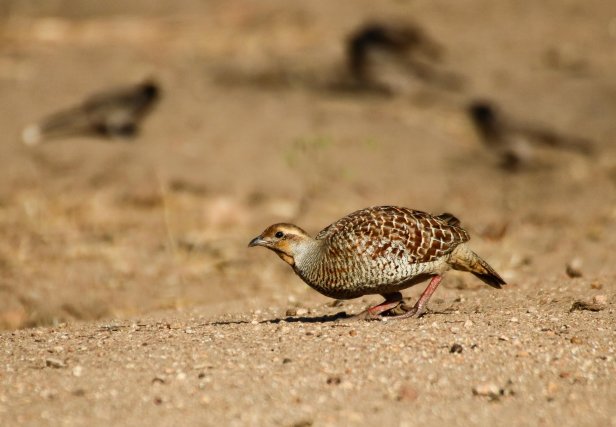
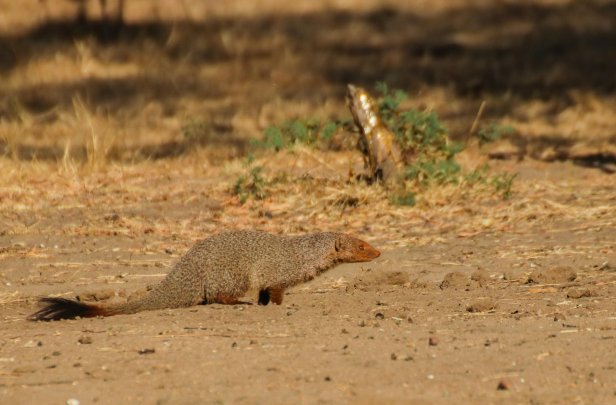
a White-browed Bulbul and a Common Tailorbird. We also had a couple of Ruddy Mongoose scurrying around in search of goodies.
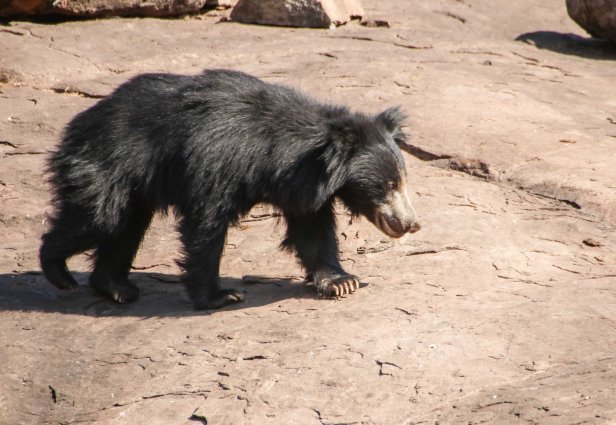
Our attention turned to the top of the rock as the royal denizens made their appearance; a mother and her two cubs. I had read that when the cubs are very young the mother carried them on her back. What a sight it must be to see her do so! The cubs we were seeing were older as they were scurrying around on their own. The forest department officials make a mix of crushed jaggery, vegetable oil and few other items and paste the mix at various spots on the rock. The bears and other creatures take advantage of this. I guess it also lets the visitors to the sanctuary also not got back disappointed without getting to see them.
Here are some pictures of the mother:

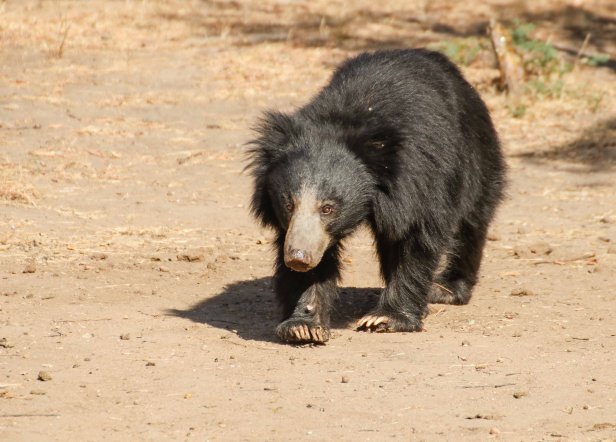
The cubs were typically children; eager to feast on what the mother had found as well as push the sibling off to grab its find. Here are some pictures of the two cubs:

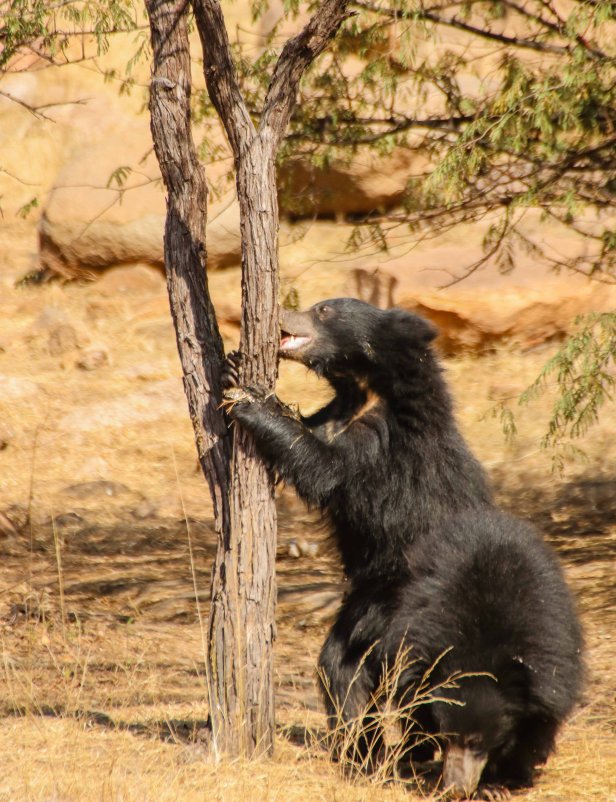
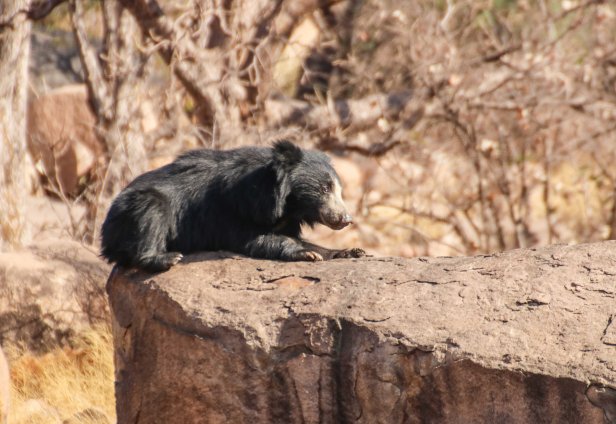

We had got our hearts-fill of the Indian Slot Bear. They finally climbed back up over the rock and disappeared, possible returning to their cave. They are nocturnal animals. The late afternoon sun must be very hot for them especially with their thick coat of black fur. Once they departed we had a fairly large group of Bonnet Macaques visiting. One even had a baby clinging on to her chest and suckling.

We were soon rewards with very good close views of the Painted Spurfowl, this time only a male.

Before we decided to head back to the car we saw a Pallid Harrier soaring above.
As we walked back to the car Mr. Pompayya told us about the habits of the bear, its diet, stories of some rescues etc. Here was a man with deep knowledge about them.
The drive back to the sanctuary entrance had us again watching keenly for any bird movements. None presented itself. Just as we exited the gate Mr. Pompayya asked me to stop the car and declared, “Painted Sandgrouse!”. The reply from all of us “Where, where?!”. He pointed towards the barren ground opposite to us. I peered through my binoculars in the direction he had indicated. Indeed there were two birds; a male and a female sitting motionless on the ground almost completely camouflaged. How in the world had he managed to see them?! We all alighted to get some photos of them. There was hardly any light to get some decent ones. But we were all satisfied nonetheless.

It was dark by the time we headed back. We stopped for a tea and snack break on the way back; no better way to get the energy back up with some crisp puffed rice bhel and chilli bhajjis 🙂 . As we drove back to Kamalapur we decided to try and see some Nightjars. It took a bit of driving on a dirt road for this. But we were rewarded with the sighting of a Spotted Owlet and an Indian Nightjar. We however did not get to see it perched on the ground as it got flushed by our car. But still satisfying to see it fly in front our car. The day ended with a tasty dinner back at the homestay followed by long session of sharing of birding adventures.
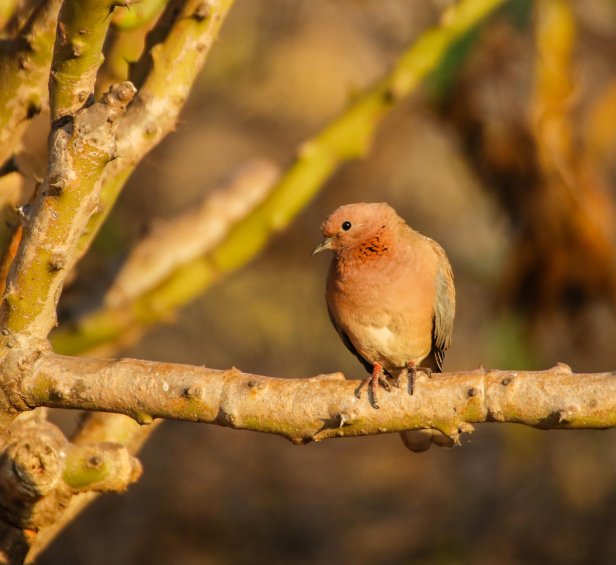
The next day started by 5:30am. We wanted to travel back on the dirt track once again. This time too we flushed a couple of Indian Nightjars. We also noticed a sizeable owl flying across. But we could not determine what it had been. We also encountered several Ashy-crowned Sparrow-Larks on the path. We finally drove to the Forest Guest house camp as the plan for the session before breakfast was to bird from a hide there. The birds we got see in the session included the Brahminy Starling, Laughing Dove
Red-vented Bulbuls,

Common Babblers,
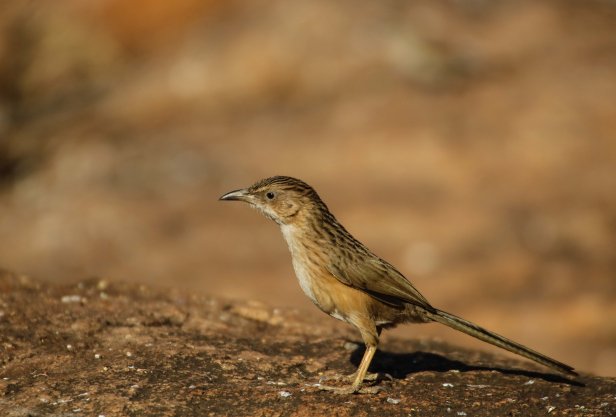
a pair of Painted Spurfowl (a species in which I think the female is as beautiful as the male),
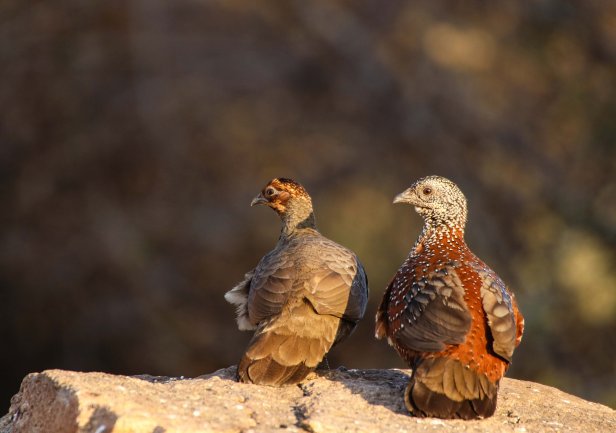
several Yellow-billed Babblers,

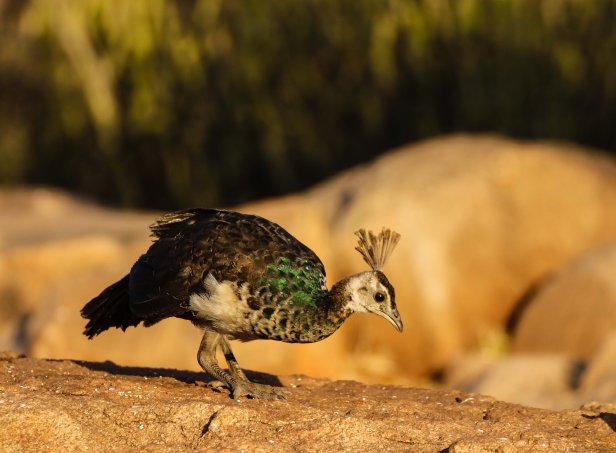
Indian Peafowl including several juveniles,
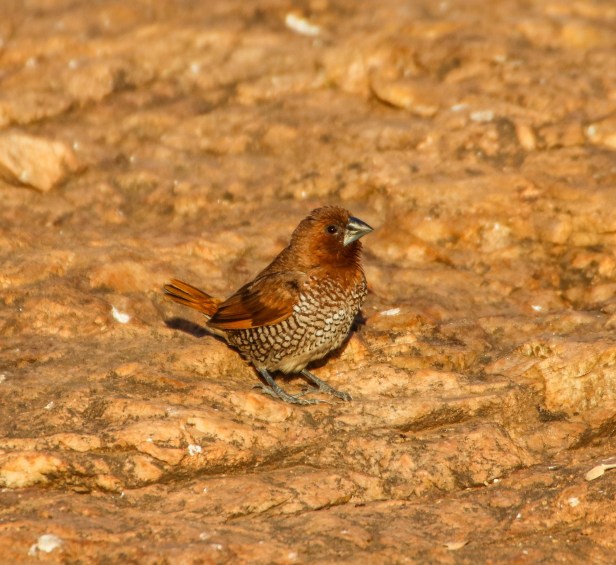
numerous House Sparrows, Indian Silverbills and Scaly-breasted Munias.

Even the common House Crow looked pretty in the golden light of the Hampi morning.

The birds all scattered when a Shikra decided to pay a visit for a few minutes; looking for breakfast maybe?
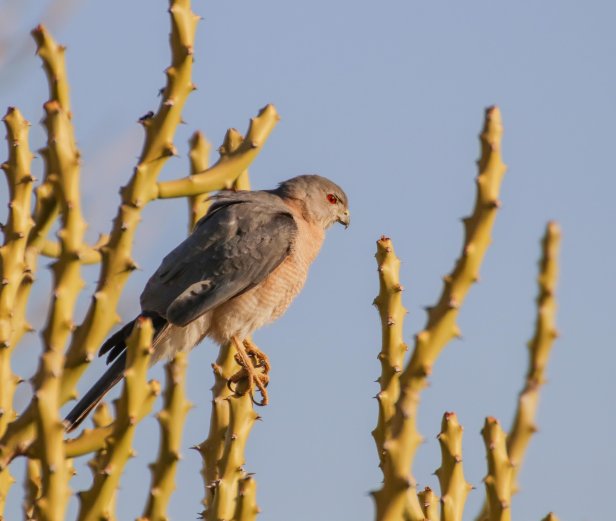
Alas we did not get to see any Bush-Quails. At one point I saw the long ears of a Black-naped Hare popping up from behind one of the rocks. It did not come out further into the open. We did however have a Grey Mongoose periodically come and dart off with pieces of banana. Those hypnotic eyes!

There were also a couple of cheeky Indian Palm Squirrels who almost seemed like the local bullies. But they were very cute especially when sitting on their hind legs; almost like saying “I didn’t do it!”.

Next was breakfast. Mr. Pompayya took us to a small joint in Hampi. It was essentially a small open shack built by the side of a coconut palm grove. But what food it served; lip-smacking idlis, chilli bhajjis and poorie! The crowd that we saw come to the shack was just another testimony to it.
Tummies full we headed towards Mathanga Hills to look for its priced possession; the Yellow-throated Bulbul. The base of hill produced a lifer for Kumar; White Wagtail. The Bulbuls like rocky terrain and this hill was one of its favorite spots in Hampi. We got to hear and then see two individuals in flight as we climbed the steps. They did not however wait to get photographed. We went further ahead to explore. An Indian Rock Agama moved across a nearby rock. It would have gone unnoticed had it not moved; such was how well it could blend into the surroundings.

A walk of the pathway into the bushes on the side yielded a Brahminy Skink that quickly slithered into a rock crevice. The most common bird everywhere we went was the Red-vented Bulbul. Inspecting the sky yielded as a Dusky Crag-Martin and then a few Asian Palm Swifts. Two raptors could be seeing using the thermals to soar; an Eurasian Kestral and an Oriental Honey-Buzzard. Our plan was to cover the area around Nava Brindavana in the afternoon. Being almost noon we called it a wrap at Mathanga Hill and walked back to the car. Our descent down the steps coincided with a pair of Grey Langurs leaping across to the temple structures ahead.
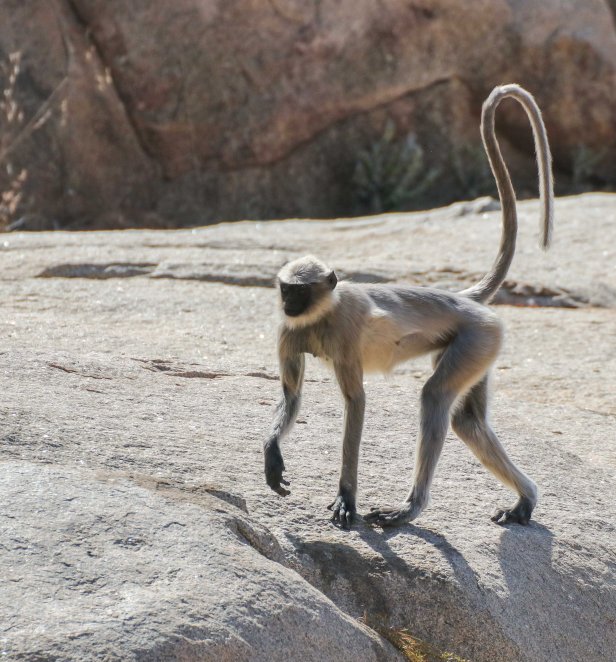
They made the leaps across the structures, boulders and trees look so effortless.
On the route to Nava Brindavana we had to cross a bridge built across the Tungabhadra river. The scenary looked beautiful on both sides. We just had to stop.
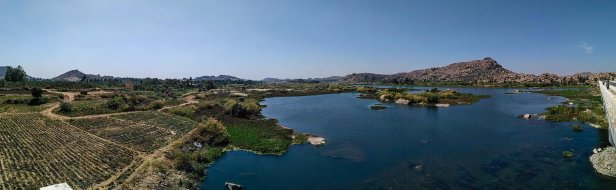

The decision to stop also yielded a lifer for a few of us; the Great Thick-Knee. In addition to this we got to see River Terns and the usual suspects of water bodies like Egrets (Cattle, Intermediate, Great), Little Cormorants, Indian Spot-billed Ducks, Bronze-winged Jacana etc. Again we saw a good number of Asian Palm-Swifts flying around. This time we also noticed the palms lining the river bank into which they sometimes went into.
After having lunch enroute we reached a place on the bank of the Tungabhadra river. We took a boat to go across to the island having Nava Brindhavana. The boat trip yielded a fashion conscious bird; a Grey Heron with a funky hairdo.

The boatman also stopped briefly near a Mugger Crocodile sunbathing on the bank. It was not impressed with our presence and promptly plunged into the river.
Our trip to the island was brief and we soon disembarked from the boat.

There were plenty of reeds all around. I was hoping that we would get to see the elusive Brown Crake in these parts. My wish was granted minutes later. Vinay frantically gestured me to come over to see a set of birds on a small island; two Brown Crakes out in the open!

They flew back into a bunch of reeds within 5 minutes. Our timing of reaching the island had been impeccable. We also got to see a big flock of Small Pratincoles perched on a barren rock to the left of where the Crakes had been seen. We soon added a Grey-bellied Cuckoo and Jacobin Cuckoo to our list. Returning back to the other bank had us see a Blue Rock Thrush that was unusually obliging.

We headed back shortly after. The plan was to look for the Indian Eagle Owl first and then try and get better views of the Painted Sandgrouse. Mr. Pompayya was on the lookout as usual as we reached the probable area for the Owl. Our first Indian Eagle Owl was a juvenile bird. Even when Mr. Pompayya pointed us towards the bird many of us had difficult locating the bird. It blended so well into the surroundings.

As we watched the juvenile bird an adult flew in to a nearby bush, presumably the parent. A few minutes later it flew off opposite to the young bird. Mr. Pompayya said that this was the parent trying to distract us away from its offspring. We decided to not stress the birds and drove off. We saw two others birds a distance away. One was sitting on its nest with its mate nearby. It was literally out in the open. Yet it was so difficult to see the bird unless someone pointed it out. Sadly the Indian Eagle Owls are being hunted or captured for bizarre reasons; superstition, for black magic etc. So one has to be careful to avoid drawing attention to their location as far as possible. I was in two minds if I should even be including the Indian Eagle Owl in this blog given this sensitivity. I decided that it would be wrong to not include these magnificent creatures when writing of the wildlife of the region. However I would not include specifics of the place nor post any pictures of the nesting pair.
Leaving the place we went to look for the Painted Sandgrouse. We were expecting to have to go back to the area near Daroji Bear Sanctuary where we had seen them yesterday evening. However luck favoured us. We saw a pair on the side of the dirt track that we were on.

We were able to go a bit more closer with the car and get better photographs.
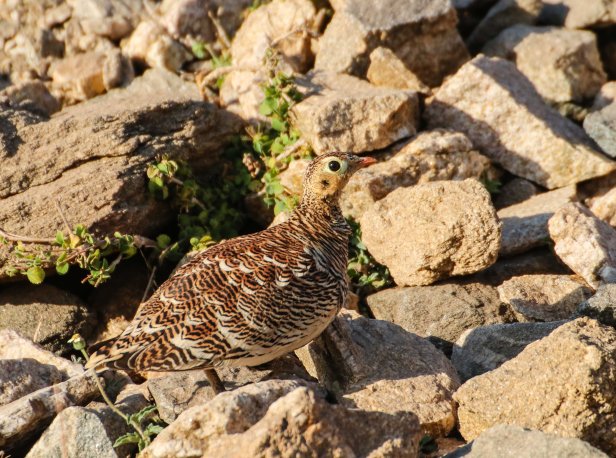
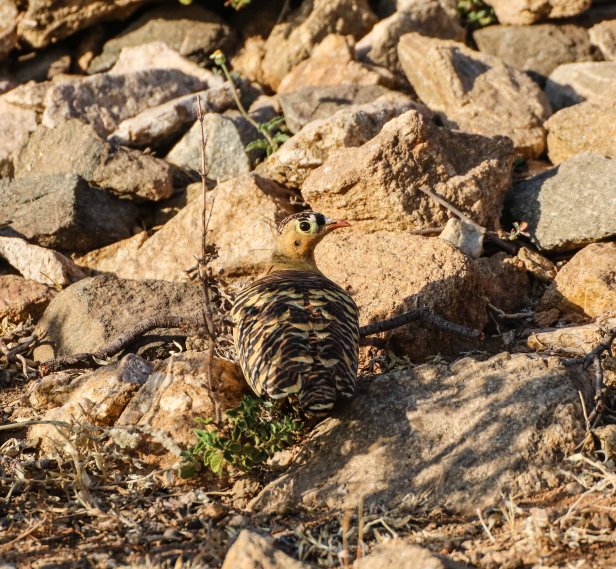
The male Painted Sandgrouse has a necklace around it neck and breast when seen from the front; part of it can be seen in the below photo.
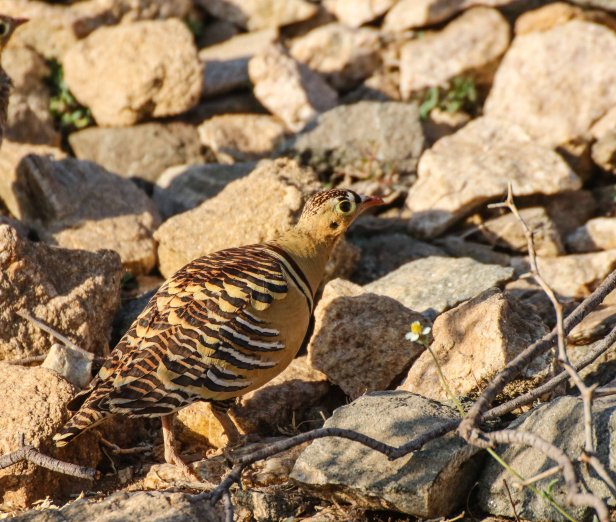
Once the pair flew off we drove to the plot of land owned by Mr. Pompayya. He had made it into a lush green patch planting most of the trees and plants himself over the years; distinct in its appearance from the surrounding land. On the way we got see a Pied Kingfisher, Yellow-Wattled Lapwings, Red-Wattled Lapwings, Rufous-tailed Lark and some swallows (Barn and Wire-tailed). At the property we treated to very good views of a flock of Baya Weavers.
It was getting dark. We decided to try for Nightjars once again. Mr. Pompayya knew an area where they were possibly roosting. The idea was to be there before they became active as that is when they would usually call. So off we went to the place and parked. It was almost completely dark. Soon we heard a loud call; not that of any Nightjar but an Indian Thick-Knee and it was really close by! We all alighted from the car and tried to locate where it was. Thankfully it called several times and I finally managed to spot it through my binoculars. All of us got views of the it. However the light was very poor to get any sort of picture. Two of these birds called and flew off overhead to us and disappeared into the night. What luck! I had earlier written off seeing this bird in the trip.
Waiting there for some time did not yield any calls from any Nightjars. We called it a day. Dinner was organised as the Forest Guest House. Kumar had to return to Bangalore. So Mr. Pompayya went to drop him off at the bus stand. We returned back to the homestay. Aravind wanted to try some astro photography. I retired soon as I had signs of coming up with a cold.
Next day morning started at 6:30am. The plan was to look for Buntings. There were none that had been reported in Hampi and Kamalapur area recently. Hence Mr. Pompayya had said we would need to head out further. Well luck only favours those who try. The drive offered us some brilliant views of a Hampi morning sky. Below are a few of the poor attempts to capture it with my phone camera:
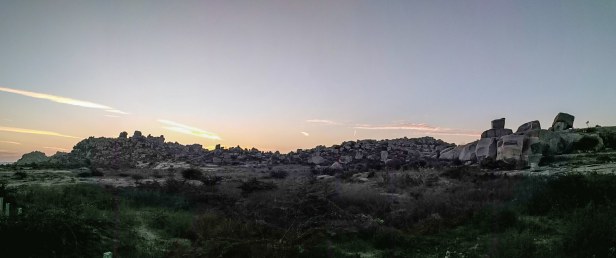


Our first stop was when we saw a flock of birds perched on wires over a paddy field. They however turned out to be Western Yellow Wagtails. We also got to see a Long-tailed Shrike, Blue-faced Malkoha and several Woolly-necked Storks.

We drove off and took a dirt track away from the main road. Eventually this track went besides one of the Tungabhadra canals. Many birds such as Little Cormorant, Red-naped Ibis, Black-headed Ibis, Black-winged Stilts, Plain Prinia were seen before we noticed a flock of birds perched on a dry tree on the side of the bank. Photo taken identified them to be Red-headed Buntings. We wanted to get closer views as well as see if they were other types of Buntings. So we backtracked on the path till we reached a spot where there was a bridge across. We parked and walked over to the other side and headed towards the spot. Here is a view from a high spot.
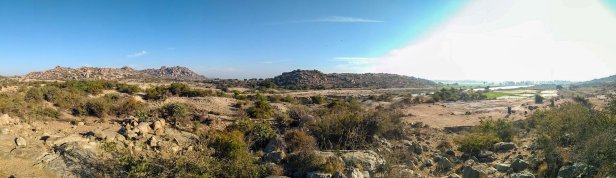
Surveying the landscape for birds from the atop a rock I thought I saw a bird that looked like Grey-necked Bunting. However the bird flew off before I could take any pictures. Guess that will have to remain a bird yet to be seen.
Walking on we finally reached the area that we had seen from the other bank. All the Buntings were indeed only Red-headed. One of the individuals obliged for a photo.
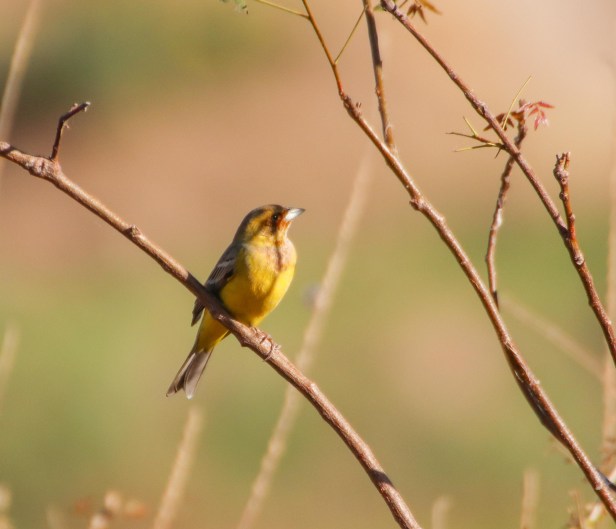
We walked around the area for some more time in the hope of seeing other birds. Mr. Pompayya said that he had briefly seen a bunch of Bush-Quails running of into the bushes. They did not show themselves while we were there to determine which they were. The dry paddy field and a pond nearby yielded a few Wood Sandpipers, Green Sandpipers and a Common Sandpiper. While back to the car we saw a Little Ringed-Plover and a young one nearby.

Again it was interesting to see how the parent was revealing itself frequently and trying to draw our attention away from the its young one. Parenting is such a strong instinct where one takes risks that otherwise one may not in normal circumstances!
Driving further we went between other paddy fields and finally a large lake. We got excellent views of a Brown Shrike and White-throated Kingfisher.

Scanning the lake from the spot we got to see Garganey, Indian Spot-billed Ducks, Lesser Whistling-Ducks, Northern Shovelers, a large flock of Black-wing Stilts, Wood Sandpipers and a lone Brown-headed Gull.
We decided to head back as it was getting later than what we had thought we would start our journey back to Bangalore. On the dirt track Mr. Pompayya asked me to slow and said “There seems to be a different looking duck”. I immediately stopped the car and looked through my binoculars; a Tufted Duck! It was an unexpected lifer. It was well into the lake. So we could not good photographs. However all of us were extremely happy for seeing this unexpected species.

A good 15 minutes later we headed back to the homestay, enroute having a very late breakfast. It was noon when we finally managed to start back home to Bangalore.
The trip to Hampi had met our expectations, going well beyond the birds that we had hoped to see. It is a place truly worth visiting both for its wildlife and its historical sites.
Video
Here is a video of some of the wildlife that we had seen during the trip.
Here is my video log of the trip. It will give you a good view of the terrain and spots that we went to see the wildlife.
Recommendations
Hire a local guide for seeing the wildlife. Sighting the specialities are not easy if you do not know their possible areas. I would strongly recommend Mr. Pompayya given his expertise on the local specialities and his contacts.
Weather
Hampi and its surrounding area get very hot during summer. So I would not think it will be easy to stay out too long during the day time then. We went when it was still winter. So the days were mostly pleasant with a breeze almost always there.
Bird Checklist
Below are the birds that we had seen during the trip:
| 1 | Ashy-crowned Sparrow-Lark |
| 2 | Asian Koel |
| 3 | Asian Palm-Swift |
| 4 | Barn Swallow |
| 5 | Baya Weaver |
| 6 | Black Drongo |
| 7 | Black-headed Ibis |
| 8 | Black-winged Stilt |
| 9 | Blue Rock-Thrush |
| 10 | Blue-faced Malkoha |
| 11 | Blue-tailed Bee-eater |
| 12 | Blyth’s Reed Warbler |
| 13 | Booted Warbler |
| 14 | Brahminy Starling |
| 15 | Bronze-winged Jacana |
| 16 | Brown Crake |
| 17 | Brown Shrike |
| 18 | Brown-headed Gull |
| 19 | Cattle Egret |
| 20 | Common Babbler |
| 21 | Common Iora |
| 22 | Common Myna |
| 23 | Common Sandpiper |
| 24 | Common Tailorbird |
| 25 | Common/Stejneger’s Stonechat |
| 26 | Coppersmith Barbet |
| 27 | Oriental Honey-buzzard |
| 28 | Dusky Crag-Martin |
| 29 | Eurasian Collared-Dove |
| 30 | Eurasian Kestrel (Common Kestrel) |
| 31 | Eurasian Moorhen |
| 32 | Garganey |
| 33 | Great Egret |
| 34 | Great Thick-knee |
| 35 | Greater Coucal |
| 36 | Green Bee-eater |
| 37 | Green Sandpiper |
| 38 | Greenish Warbler |
| 39 | Grey Francolin |
| 40 | Grey Heron |
| 41 | Grey-bellied Cuckoo |
| 42 | Grey-headed Swamphen |
| 43 | House Crow |
| 44 | House Sparrow |
| 45 | Indian Grey Hornbill |
| 46 | Indian Nightjar |
| 47 | Indian Peafowl |
| 48 | Indian Pond-Heron |
| 49 | Indian Robin |
| 50 | Indian Roller |
| 51 | Indian Silverbill |
| 52 | Indian Spot-billed Duck |
| 53 | Indian Thick-knee |
| 54 | Intermediate Egret |
| 55 | Jungle Babbler |
| 56 | Large Grey Babbler |
| 57 | Large-billed Crow |
| 58 | Laughing Dove |
| 59 | Lesser Whistling-Duck |
| 60 | Little Cormorant |
| 61 | Little Egret |
| 62 | Little Grebe |
| 63 | Little Ringed Plover |
| 64 | Long-tailed Shrike |
| 65 | Northern Shoveler |
| 66 | Paddyfield Pipit |
| 67 | Painted Sandgrouse |
| 68 | Painted Spurfowl |
| 69 | Pallid Harrier |
| 70 | Pied Bushchat |
| 71 | Pied Cuckoo (Jacobin Cuckoo) |
| 72 | Pied Kingfisher |
| 73 | Plain Prinia |
| 74 | Purple Heron |
| 75 | Purple Sunbird |
| 76 | Purple-rumped Sunbird |
| 77 | Red Avadavat |
| 78 | Red-headed Bunting |
| 79 | Red-naped Ibis |
| 80 | Red-vented Bulbul |
| 81 | Red-wattled Lapwing |
| 82 | River Tern |
| 83 | Rock Eagle-Owl (Indian Eagle-Owl) |
| 84 | Rock Pigeon (Blue Rock Pigeon) |
| 85 | Rose-ringed Parakeet |
| 86 | Rosy Starling |
| 87 | Rufous-tailed Lark |
| 88 | Scaly-breasted Munia |
| 89 | Shikra |
| 90 | Small Pratincole |
| 91 | Spotted Dove |
| 92 | Spotted Owlet |
| 93 | Tufted Duck |
| 94 | Western Yellow Wagtail |
| 95 | White Wagtail |
| 96 | White-breasted Waterhen |
| 97 | White-browed Bulbul |
| 98 | White-browed Wagtail |
| 99 | White-eyed Buzzard |
| 100 | White-throated Kingfisher |
| 101 | Wire-tailed Swallow |
| 102 | Wood Sandpiper |
| 103 | Woolly-necked Stork |
| 104 | Yellow-billed Babbler |
| 105 | Yellow-throated Bulbul |
| 106 | Yellow-wattled Lapwing |
| 107 | Zitting Cisticola |
If you liked the post then do consider following my blog. I would also love to hear your thoughts. Do leave comments below to let me know
 Mad about Birding and Travel
super Write up sir….
LikeLiked by 1 person
You played a big part in seeing what we did during the trip. So thank you.
LikeLike
Wow amazing write up Thomas. I lived every moment again. Looking forward to similar trips.
LikeLike
Thanks Kumar. I am game for trips in the future 🙂
LikeLike
nice write up… enjoyed reading,.. i am planning to visit hampi..could u share mr pompayya’s number please
LikeLike
Thanks. I can you send the details over an email. Pls use the Contact Me form so that I can get your email id.
LikeLike
Great shots and narration.
LikeLike
Nice one. Planning to go next week.. hope to see some wildlife and birds
Balu A
LikeLike
Have a good trip
LikeLike
Lovely story, beautifully narrated. A good guide to visit Hampi for birding.
LikeLiked by 1 person
Thank you 🙂
LikeLike
I found your post when researching birding in Hampi. We are visiting for a few days and I’d be interested to receive contact information for your guide. Great write up!
LikeLiked by 1 person
Thanks Erin. I have sent you an email with the contact details I have for him.
LikeLike
Thanks so much. We are birding with him all day tomorrow!
LikeLiked by 1 person
Hope it went well.
LikeLike
Really great to read your review of the Hampi area. What a nice area to visit and impressed with your writing!
My girlfriend and I are planning to come India in the end of this year. As a fanatic birder I already started with the pre fun: searching for interesting spots. Hampi is defiantly on our list
Could you share the details of mister Pompayya Malemath? It would be nice to make use of his service. Thank you so much Really great to read your review of the Hampi area. What a nice area to visit and impressed with your writing!
My girlfriend and I are planning to come India in the end of this year. As a fanatic birder I already started with the pre fun: searching for interesting spots. Hampi is defiantly on our list
Could you share the details of mister Pompayya Malemath? It would be nice to make use of his service. Thank you so much
LikeLike
Hi Daan,
I am glad you liked the blog post. I have emailed you the last contact details I have for Mr. Pomapayya. Hope you have a great trip!
LikeLike
Loved your writeup on Hampi birding. Could I have contact details of your guide Mr Pompayya
LikeLike
Thanks. I can you send the details over an email. Pls use the Contact Me form so that I can get your email id.
LikeLike
hi lovely write up … My son 7 yr old is a avid birder … Would love to get the information bout the guide ..
suma.nagappa@gmail.com
LikeLike
Thanks Suma. I have emailed you his contact details.
LikeLike