
There is a saying “Be careful what you wish for, it may just come true”. Well, in this particular case, I was happy of what I had wished for 😀. And what am I talking about? Nesting of the Common Tailorbird of course! If you still do not get what I am talking of, I would not blame you. Let me explain.
I had watched a video shared by a birding acquaintance sometime ago capturing the nesting of a Common Tailorbird. It is a bird that is a very common garden bird. I see and hear it almost everyday around my house. But I had never seen it build its nest and raise young ones. And I desperately wanted to see it do so. I secretly wished in my mind that I would get a chance. And I did, right from my house balcony 😀.
It was a Friday. We had just finished walking our dog in the morning and returned home. I finished brushing him and walked back into the house and waiting for him to also walk in. As I stood at the doorway looking out, I noticed some bird movement under a bush. It seemed to be hobbling about and picking something off the ground. It then flew off. In a couple of minutes it came back again and repeated the action. Hmmm, something was surely up. My “bird” senses were tingling 😀 . So off I rushed got my camera and my binoculars. Thankfully the bird came back again when I returned. It was a Common Tailorbird.

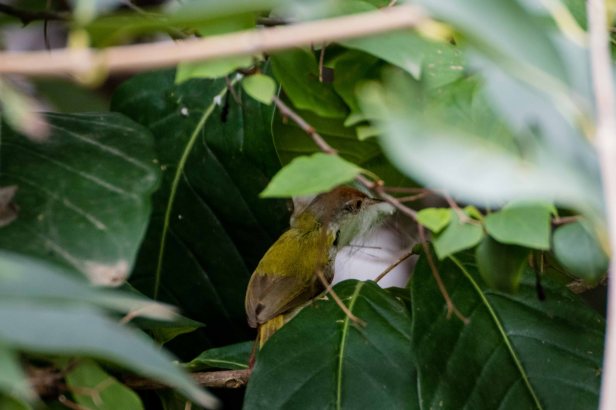
Now what was it doing? The below photos provided me with the answer.


It was a male bird (notice the long central tail feathers) collecting my dog’s fur as nesting material! I was thrilled to say the least. Now I just had to figure out where it was building its nest. So I keenly watched to find out. It turned out that it was building it on the tree right outside my house. I could not believe my luck; I was elated!
The pair had done an amazing job of making the nest well camouflaged. It took me a while peering through my binoculars from the street to determine where the nest was located. Once I got a fair idea of its whereabouts in the tree I tried to see if I could see it from my house balcony. And by God’s grace I could see it through some opening between leaves! This was my chance to observe their breeding; building the nest, sitting on the clutch and finally raise the chicks hopefully.
Here is my first view of the under construction nest.

Given the stage of the nest I suspected that this was probably day 3 of the cycle. The next two days being a weekend, I literally parked myself on my balcony to record as much of the action as I could 🙂 . I saw a lot of nest building activity by the pair. Yes, both the male and female contributed in readying the nest. I could see that the outer structure had already been stitched together. Here is a picture of the lower part of the nest. You can clearly see how the birds have pierced the two leaves and stitched them together using some material. I have marked some of them with a red arrow in the below picture.

The leaves are still attached to the branch. So in fact they are still alive. Master tailors I must say. Now you know how they got their common name 😀.
I observed the birds taking turns in getting material to line the interiors of the nest. They would not directly go into the nest. Most times they would first perch on a side branch. Look on the various sides and then eventually go into the nest. Here some photos showing this sequence.



When exiting the nest, many a times the bird would perch momentary at the nest entrance look around and then fly off for another sortie. Here is a time that I was able to take photos of this.


The birds were also working in tandem. One of them would in the nest adjusting the interiors with the material that it had brought and the other one would come and wait at the entrance. Then the one in the nest would leave and the other one would jump in. Busy bodies for sure 🙂 . You can watch all this in the video towards the later part of this post.
Once when a female Purple Sunbird came close to the nest, the male Common Tailorbird almost immediately came and chased it away; a very typical behaviour exhibited by birds when nesting; they become super protective. I was keen to see if the birds had started to roost in the nest in the night. On both days of the weekend, I did not notice them staying in the nest. So I guessed that the eggs were yet to be laid.
The nest building activity reduced on Monday. Hmmm, I guessed that the nest was ready. It was on Tuesday that I noticed a bird sitting in the nest in the morning. Wow! Surely the eggs had been laid and female was sitting on the clutch 😀 . This I noted as Day 1.
It rained very heavily during the day. I was worried for the nest and the birds. They had spent so much effort buidling it 😦 . Here is a picture that I took in between.
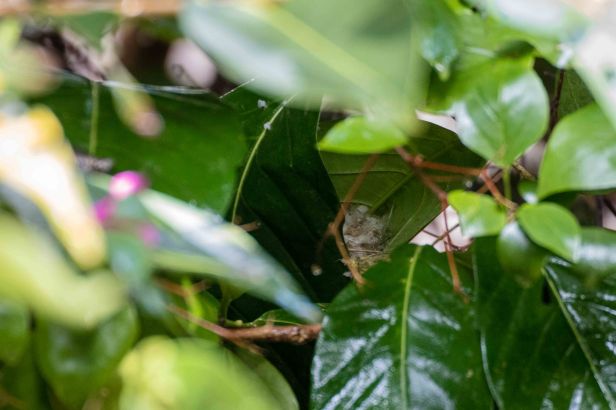
I could not see the bird in the nest. Hopefully it was all safe. Interesting, I did not notice any rain falling directly into the nest. That brought hope to my mind. I guess the natural instincts in the birds had helped them decide on an apt location for the nest.
The heavy rain continued to pour for long. At the end of the day, I could see that some twigs and leaves of the tree including one near the nest had broken and fallen from the wind and rain. But the nest was still there. Finally I could see a head of the female bird just about visible in the nest :-). You can just about see its forehead and beak in the picture below.
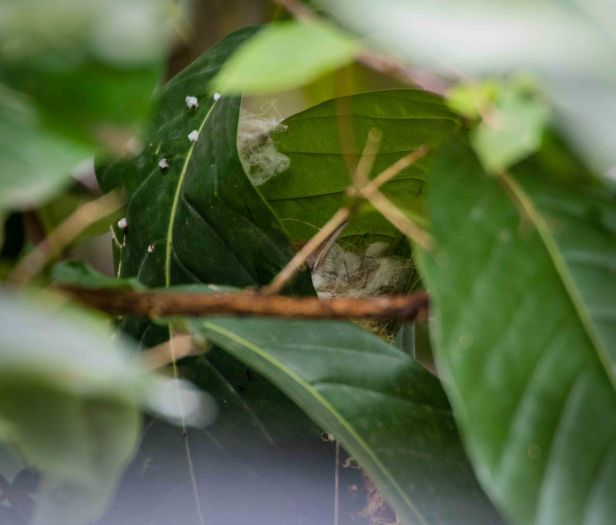
I had a scare on Day 3. The maintenance staff of our residential layout was undertaking tree trimming on our street. I was really worried on what this would do to the nest and the confidence of the parents. When it came to the tree that the nest was on and the ones beside it, I supervised the trimming with the staff to and try and minimise the disturbance and the risk of the nest getting hit. Though this went alright, I was worried if the birds would abandon the nest. I kept my fingers crossed that it would not be the case. My fears were finally allayed when I saw the female return to sit in the nest around noon. Phew!
For most of the day, there was no particular activity. The female just sat in the nest. From its point of view it, I guess it was doing its job. One cannot hurry nature, is the lesson I learnt from this experience 😀 .
I made it a point to observe the nest at intervals during the following days. The usual kind of routine was the following:
- It was only the female that was seen sitting in the nest. The female would leave the nest around 9-ish in the morning. It would return to the nest around 30 to 40 minutes later
- Around noon, the male would come on one of the trees around the one with the nest and call. Immediately the female would respond, jump out of the nest and fly off in the directly of the call. Both could not be seen for a while. The female would usually return in about 30 to 40 minutes. I presumed they had gone to feed. Hmm, I wondered if the male brought food for the female or was it calling to go feeding or was it a way of maintaining the bond. Check out the incubating section of the video to watch this happen
- When returning to the nest, the female would continue to make a particular type of call (tick tick tick….), eventually returning to the nest and sitting in it. This became my cue that it was nearby and about to return thus allowing me to capture in on video 🙂
- There were also instances when the male would come and call and the female would respond once or twice but not leave the nest
- The female was seen leaving the nest a few other times as well during the day. These were usually without any “prompting” from the male. It would return in the usual periods as other times
- Once in a few days I would notice the female, what I think is, turning the eggs. I inferred this by the way it was sat in the nest and the movements it made
Day 13 brought in some excitement. I noticed that the bird was not in the nest when I first checked it at 9:15am. I then saw it come to the nest calling at 10:45am. This time, it sat on the branch in front, jumped onto the nest and almost immediately left. I came back again in a bit doing the same routine. This time I noticed that it was actually tried to feed; stretching into the nest from the entrance. I was elated! The female then again went back to sitting in the nest. I inferred from this that atleast one egg in the clutch had hatched. There were possibly others yet to hatch.
Both the birds were more involved now. The female would leave the nest more frequently and come back with food. The male was also seen several visits to the nest, with food. A few times it would come and just sit on a branch nearby. It was also seen sitting on a Guava tree nearby, when the female was away from the nest. It was most likely to be on guard duty.
I got to see the protective behaviour of the parents. When the female was away, the appearance of a unsuspecting Pale-billed Flowerpecker near the nest had the male parent swoop down calling loudly and chased the Flowerpecker away. The male came and perched on a branch near the nest. It did not enter it though. Soon the female the returned. In another instance, I saw both the parents fly off towards the Almond tree in my neighbours garden, calling loudly. Both made some strange loud calls that I had not heard before. They seemed to be chasing away some intruder, though I could not make out what it had been.
The routine was similar for the next days. Day 3 also seemed similar. The evening however saw a strange behaviour from the male. It was evening and I was sitting in the balcony sipping tea. The male came and perched in an open branch near the nest and kept calling, as if desperately. It called for around 30 seconds, I would estimate. There was however no response from the female nor any sight of it. The male then flew away. I was worried. I had not seen this behaviour before from it. I wondered what had happened.
It again rained heavily that evening. I was not sure what was happening in the nest. Were they still surviving?
I kept a close watch the next day hoping to see some activity. It was not to be so. There were no sign of the birds nor any activity at the nest. The same was the case the following day as well. By then I inferred that the birds had abandoned the nest and the brood 😦 . It must have been equally troubling to them do so.
Video
I was able to capture on video quite a bit of the behaviour that I described above. Make sure you watch it 🙂 . A few comments on the video itself.
- I have intentionally kept the video long. This is after cutting a lot of the footage that I had captured
- I have chosen to keep each section also long. I also did not have the heart to cut out more. I mean the birds had put in so much of effort :-). Warning; it may seem repetitive to some. However if one is patient, one can get a sense of some of the many subtleties that the bird use to adjust their nest
- I have added time markers on my video in the YouTube channel to allow easy navigation. This can be used to easily jump to the key markers. For this however you will need to watch it directly in YouTube
- In the video one may see the birds appear at the nest fairly quickly with hardly any interval between their visits. In reality that is not the case. I usually only started recording only when I saw signs of them going to visit. You don’t want to be staring the leaves/nest without any action from the birds, right? 🙂
- I have tried to retain the sound as much as possible, especially when the birds were calling. There are however parts where I have had to mute it given that there was too much background noise or people’s conversations 🙂
Interested in seeing the observations of nesting in other birds? Here is the must see detailed account of Parenting in Bonelli’s Eagles and the Purple-rumped Sunbirds.
 Mad about Birding and Travel
Thomas, thank you for the great observations and wonderful documentation of Nature.
LikeLiked by 1 person
Thanks a lot for reading, commenting and appreciating 😀
LikeLike
You had the balcony view to this nest. Literally!
LikeLiked by 1 person
Yep 😀 !
LikeLike
Excellent observations & documentation
LikeLiked by 1 person
Thanks a lot Venkatesh
LikeLike
Nature and its wonders. Love how you have well documented the whole experience. From your post, one can make out who keenly you observe and how much passion you have for birdwatching. Great job!
LikeLiked by 1 person
Hi Monica
Glad you liked it. And thank you for commenting. Yes, I am extremely passionate about bird watching. I think it has also increased my ability to observe overall 🙂
LikeLike