
Taman Negara is a national park in Malaysia of an area of around 4300 sq.km and is reputed to be the world’s oldest deciduous rainforest, estimated to be more than 130 million years old (More Info on Taman Negara).
A visit to Taman Negara is high on the list for most visitors to Malaysia and is considered a must-do destination for birders. Well it certainly was a site that I did not want to miss birding at while I was living in Malaysia. I wanted my trip there to be atleast for 3 days 2 nights. Plans to visit there during mid of the year did not work out due to unavailability of Weng (my local guide in Malaysia) or of the accommodation at the place we wanted (Mutiara Resort); it was also once closed owing to the rise in water levels in the Tembeling river (more of my experience of this further in the Day 2 & 3 blog Visit to Taman Negara (Cont’d), Malaysia). Well the trip was finally fixed for mid September.
Day 1
The drive to Taman Negara from Kuala Lumpur (KL) would take around 4 hours with some break in between. So we decided to start from KL at 4:30am. The drive itself was uneventful. We stopped for breakfast at Jerantut. We then headed towards Kuala Tahan, a small town on the bank of the Tembeling river. The drive takes you through vast expanses of greenery. This view is however interspersed with stretches of Palm plantations as well as tracts of felled forest area possibly making way for “development”. Well, this is a controversial topic and one that I will be steering clear off in the post.
As we neared Kuala Tahan we rolled down our windows to listen to bird calls. Weng pulled over at the side when we noticed an “interesting” bird fly into a tree. Scanning the trees we could a quick glimpse of the back of the bird before it dropped down into the bushes. It was a Cuckooshrike but could not conclusively say which one. We suspected it to have been a Bar-bellied Cuckooshrike. We also heard calls of the Abbot’s Babbler.
Proceeding ahead, just before the arch welcoming us to Kuala Tahan, we crossed the road that would take us to “Hornbill valley”. We decided that we would visit it the next day; today we would spend the whole day in the forest itself. Weng drove straight through to Kuala Tahan and parked the car in the parking lot a bit away from the jetty.
The video below provides you a quick view of the road journey till Kuala Tahan.
We took all the essentials required for the next several hours from the car as we would be crossing over the Tembeling river and spending the next several hours in the Taman Negara forest. We walked to the jetty to cross the river. I very soon got my first views of the entrance to Taman Negara.

I could feel an anticipation of the potential birds that I would see building up in me. Calm down Thomas!
The river side was dotted with several floating restaurants. We walked down the steps and onto the jetty. We got down into the boat along with a few other passengers who were also wanting to cross over. The board ride to the other side hardly took us around a minute and dropped us at the steps leading to the Mutiara Resort and the Park headquarters.
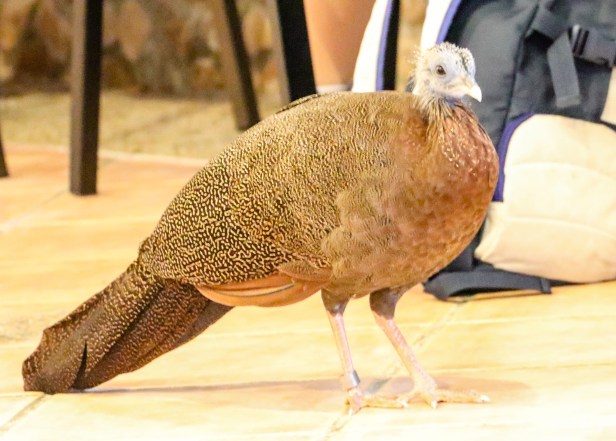
As soon as we climbed the steps and reached the resort entrance a couple of photographers told us that there was a Great Argus roaming around near the restaurant area. I hurried in that direction certainly not wanting to miss one of the star birds of Taman Negara. I soon spotted it walking cautiously in the restaurant. It was a female bird. Ah! one of the birds on my target list ticked. What a start!
Weng went to the Park headquarters office and purchased the necessary tickets and permits. Our first spot in the forest would be Tahan Hide. We walked through the Mutiara Resort for this. Walking we saw a lot of bird activity on a flowering tree. Scanning the tree through binoculars we identified several Spectacled Spiderhunters and Grey-breasted Spiderhunters flying from one flower to the other drinking nectar. We continued our walk to the Tahan Hide.
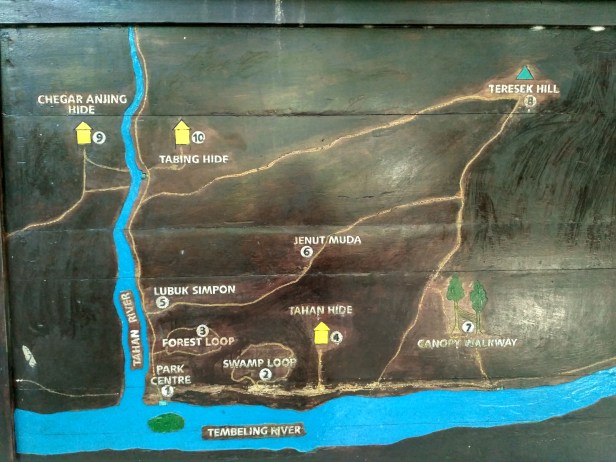
The Tahan Hide is a two storey building from which you could observe wildlife. Our main targets here were the Malayan Peacock-Pheasant and the Crested Fireback; both birds high on my target list. Weng had heard that these birds sometimes pay a visit at this spot in the mornings. There were already a few photographers at the Hide setting up their equipment, each with the same hope of getting to see these beauties. Now it was a wait and watch game.
There were no signs or calls of the birds. While waiting we scanned the surroundings through our binoculars and once in a while at the opening where the pheasant occasionally make an appearance. I saw two birds flying around a tree in the opening and identified them to be Blue-rumped Parrots. They however did not give any opportunity to be photographed. Well I was still happy to have seen them; another bird on my list 🙂
We had a White-rumped Shama and several Yellow-bellied Bulbuls showing up. Around 20 minutes later we saw the Malayan Peacock-Pheasant appear from the forest. Patience does pay!
The bird was mesmerising. I could only imagine what it would be when it was “displaying”.


Here is a video I took of the Pheasant.
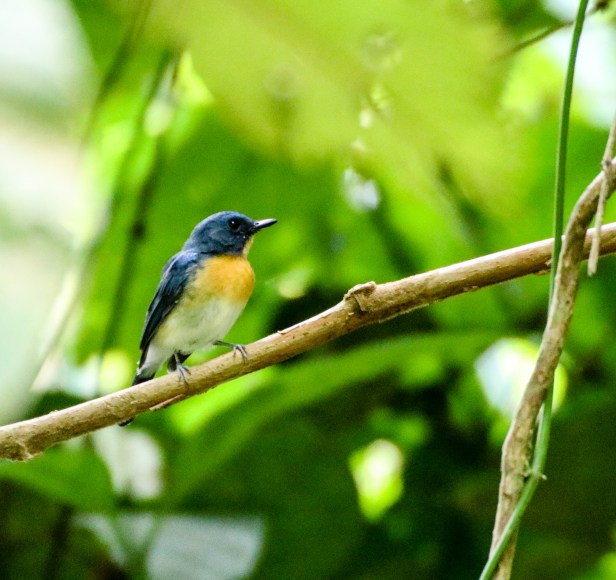
There was a also a Tickell’s Blue Flycatcher flying in and out of the clearing near the Pheasant.
With no signs of the Firebacks showing up we decided to explore other trails. We chose the Swamp Loop as our first trail. It was fairly quiet as we started on the trail with the odd Yellow-vented Bulbul appearing in between. 10 minutes into the trail we suddenly heard the loud wing beats; typical sound of a fling Hornbill. In a couple of seconds we saw one of the tree tops shaking strongly. Yes! the bird had perched. Straining through our binoculars we tried to get a glimpse of it. The bird was just not ready to show itself! There was another flurry of movement in the branches. We walked back and forth trying to see from different angles to catch a glimpse of the bird. Finally I saw it hop onto a slightly open branch. It was a Red-billed Malkoha, a bird I had failed to see in other “usual” locations. Again we heard loud wings but this with a call as well. It was the Great Hornbill. (There are two resident Hornbills at the Mutiara Resort; a Great Hornbill and a Bushy-crested Hornbill). Activity picked as we headed round the loop with a couple of Black-and-Yellow Broadbills and Black-and-Red Broadbills paying us a visit. The area nearer to the Park headquarters yielded us a Stripe-throated Bulbul, Red-eyed Bulbul and a Rufous-winged Philentoma.

We decided to explore the trail to Lubuk Simpon before breaking for lunch. We were almost immediately greeted by the calls of the Chestnut-winged Babblers, a common bird abundant in this forest. They flew from branch to branch and were joined briefly by a Rufous-crowned Babbler. As we reached Lubuk Simpon we walked down to the river bank and sat on the bench for some time. I was hoping that the Blue-banded Kingfisher would show up. This time patience did not pay; there was no sight of the bird even after 15 mins. It was close to noon and we decided to walk back to park headquarters. A Buff-necked Woodpecker held our interest as soon as we got back on the trail heading back.

Our attention was quickly drawn away by the call of a Diard’s Trogon, another bird high on my target list! We cupped our ears to try and locate the direction from where it was coming and chased the call. Damn! It was coming from the other side of the Tahan river :-(. We would have to leave it with the hope that we get to see it over the next two days.
Lunch was at one of the floating restaurants near the boat jetty. Post lunch we decided to check-in to our hotel and rest for around 1.5 hours. It gets hot in the afternoon and bird activity also lulls. Tonight we would be staying at the HAN Rainforest Resort in Kuala Tahan.
We headed back across to the forest at around 4PM. Again we decided to quickly take a peek at the Tahan Hide first. While walking towards to the Hide through the Mutiara Resort our attention was drawn by the hectic activity at the flowering tree. There were several Spiderhunters flying from one flower to the other. We scanned the birds one by one in the hope of seeing a Yellow-eared Spiderhunter, the only remaining Spiderhunter found in Malaysia that I was yet to see. Finally I got to see two of them. Yippee!


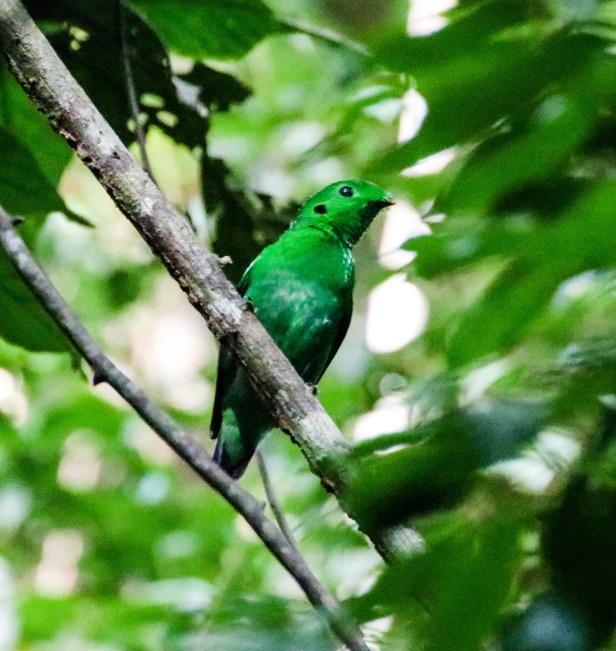
Tahan Hide did not yield any new birds. We moved on to the Swamp Loop once again. The initial stretch brought a beautiful specimen of a Green Broadbill.
Activity died-down as we moved further on the trail. It was nearing 5:30pm and light was also dropping. As we neared the end of the loop we wondered if we would see any more of the target birds. Suddenly Weng frantically gestures me to come to him. A male Diard’s Trogon perched just besides the boardwalk! My hands were trembling at seeing the bird so much so that I had trouble holding my camera steady to take a photograph 🙂

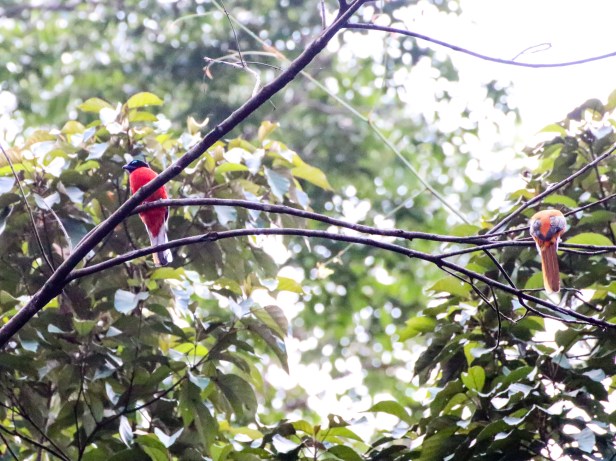
As I was observing the Trogon Weng calls me to another spot behind where I was standing. Two Scarlet-rumped Trogons were perched on an open branch a little high-up on a nearby tree, a male and female.
This was turning out to be a “happening” spot and we decided to stay put for a while. Soon we had a couple of Chestnut-breasted Malkohas and Raffle’s Malkoha joining the party.
With it becoming dark we walked back to Tahan Hide to wait and do some dusk “owl-ing”. The pathway to the Hide produced a star bird; a Crested Fireback. There were two females on the boardwalk. We had most likely just missed seeing a male as usually the male walks first and the females then follow.

Again Tahan Hide did not yield any new additions. We walked back into Mutiara Resort. A call welcomed us; a Sunda Scops-Owl very close by! We searched the nearby trees as its call continued. Finally we got to see the bird after almost 5 minutes of searching. Boy are they difficult to spot!
We finally called it a day (and night) and headed off to dinner and then to our rooms to retire.
Day 2 & 3
Visit to Taman Negara (Cont’d), Malaysia. This blog also contains videos of the Hornbill Valley and the various trails that I went birding on during my visit. Do check it out.
Area Map
Trail Videos
Checkout the video of the various trails that I went in the blog of Day 2 & 3 Visit to Taman Negara (Cont’d), Malaysia
Some Recommendations
Birding in Taman Negara is not easy. The forest is quite dense and the canopy is high. It is very easy to get frustrated as one will be hearing a lot of bird calls but not seeing them. So it is a good idea to study and memorise the calls of the birds in your target list. That is what I did. Of course having an experienced local birder familiar with the calls like I had really helps. I would strongly recommend engaging one for the trip.
Photography in the forest is difficult as the birds do not come out into the open that easily, plus the lighting can also be poor. You will want to think twice about lugging a super heavy camera/lens with a tripod; it will be hard work!
I have done quite a bit of birding in Peninsular Malaysia. I have created a blog post covering the various hotspots and the birds that are found there. You can read it here. Birding in the island of Borneo is also very rewarding. You can read about my experience birding there in the associated post.
Getting Around
The entrance to Taman Negara and all its trails are via the Park headquarters located at the Mutiara Resort. Coming from Kuala Tahan you have to cross over the Tembeling river to reach the entrance. The river crossing just takes around a minute and costs RM1 per person. Keep a wad of RM1 notes as you are likely to be doing a few of these boat trips especially if you are not staying at the Mutiara Resort.
The forest trails are well marked and the popular trails have got board-walks. This is supposed to reduce the leeches as well as make it easier. I guess it does. I however found the board-walks to give my knees a beating as they are hard and equivalent to climbing stairs in some places.
Places to Eat
At the Taman Negara forest itself there are plenty of options in the form on floating restaurants on the Tembeling river just adjacent to the jetty. We tried several of them. Food was decent and with good amount of choice. One can also eat at the restaurants that are part of the hotel that one is staying at though they may be a bit more expensive.
Places to Stay
The preferred option is to stay at the Mutiara Resort located at the entrance of Taman Negara. This is across the Tembeling river. The resort offers chalets. Staying here allows you to do activities like “owl-ing” late into the night or early morning. This would not be possible if you were to in a resort across the river in Kuala Tahan as the boats do not start operating till dawn. The resort is however costlier than the options in Kuala Tahan. If your is for a few days atleast plan to spend one night at Mutiara Resort if not more.
There are cheaper options for stay in Kuala Tahan with several resorts. We stayed in the HAN Rainforest Resort for one night. It was comfortable and only a short drive away from the jetty.
Mutiara Resort is popular with foreign tourists and does tend to get booked out quickly especially during high seasons.
Bird Checklist
Below are the checklists for my trip:
Taman Negara
Mammals Sighted
- Wild Boar
Weather
It was hot and humid during the day on all the three days I was there. One should also be prepared for a rain any time of the day or night. It rained very heavily on the second night. Rain does help bring down the humidity and temperature for some time. Take a rain jacket. I however did not get to use it as it rained only in the night.
Take some small towels or handkerchiefs. It is very humid and you will be sweating a lot, atleast I did. Also keep drinking water as it is easy to get dehydrated given the constant perspiration.
Precautions
Taman Negara is after all a rainforest in the tropics. So there are plenty of mosquitoes and leeches. The leeches are very active especially when it has rained (which is frequent). So you should be prepared with a good mosquito repellent as well as leech socks. Even with these precautions one should expect to get bitten.
It can rain very quickly and very hard. If you have come in your own car best not to have parked it at the lowest road next to the floating restaurants. The water level in the Tembeling river can rise very quickly and this road will be get submerged. Park instead at the designated parking lot one level above.
 Mad about Birding and Travel
A perfect mix of your experience and useful information. Amazing pictures as well especially the green broadbill!
LikeLike
Thanks a lot
LikeLike
Wonderfully written Thomas ! Very informative & well articulated.
Way to GO !
LikeLike
Thanks a lot Vignesh
LikeLike
Very informative blog that is visual treat too! Your excitement is palpable at many places 🙂
LikeLike
Leech bites are less these days compared to years ago before the existence of the boardwalk … we can go birding in
a leech-less spot next time
LikeLike